
Contrary to the common belief that heat pumps are ineffective in the cold, their operation is not magic but a masterful application of physics. They function by using a refrigerant with an extremely low boiling point and manipulating its pressure. This forces the refrigerant to boil and absorb latent heat energy even from 5°C air, a process that is then reversed to release that captured warmth into your pool. This article demystifies the core principles that make this counter-intuitive energy transfer possible.
For many homeowners, especially in cooler climates, the claim that a thermodynamic unit can heat a swimming pool using air at a brisk 5°C (41°F) sounds more like a marketing slogan than a scientific reality. The skepticism is understandable: how can something “find” heat in air that feels cold to the touch? The common explanation that a heat pump works “like a refrigerator in reverse” is a helpful starting point, but it barely scratches the surface and fails to address this fundamental paradox.
The feeling of warmth or cold is a subjective human perception of temperature. For physics, however, temperature is simply a measure of molecular motion. As long as the temperature is above absolute zero (-273.15°C), molecules are in motion and contain thermal energy. The genius of a heat pump lies not in creating heat, but in its engineered ability to exploit the energy differential between two environments, even when that differential seems small. This is achieved through a precisely controlled thermodynamic cycle.
But if the secret isn’t magic, what is it? The key lies in understanding that the unit isn’t just dealing with temperature; it’s actively manipulating the pressure and physical state of a specialized fluid—the refrigerant. By changing the refrigerant’s pressure, the heat pump can change its boiling point, forcing it to absorb energy from the “cold” outside air and then release it into the warmer pool water. It’s a feat of engineering that turns basic thermodynamic laws into a highly efficient heating system.
This guide will move beyond the analogies to demystify the core physics at play. We will explore how the choice of refrigerant is critical, why airflow is the ‘fuel’ for your unit, and how technologies like inverters and smart defrost cycles separate a mediocre heat pump from a high-performance one. By understanding these principles, you can make an informed decision and see why a modern heat pump is a viable and efficient solution, even when the seasons change.
To fully grasp how these elements work together, this article breaks down the essential concepts. Explore the table of contents below to navigate through the key aspects of thermodynamic heating technology.
Summary: How Thermodynamic Units Extract Heat from Air Even at 5°C?
- Why does the refrigerant gas type matter for heating in winter?
- How to shelter your thermodynamic unit without blocking essential airflow?
- Side or Top Discharge: Which Unit Fits Best in Narrow Corridors?
- The location mistake near salt water that rots heat exchanger fins
- When does active defrosting consume more energy than it saves?
- How Inverter Technology Reduces Your Pool’s Carbon Footprint by 40%?
- How to Maintain 28°C Water Temperature in October Without Bankrupting Yourself?
- Which Isothermal Cover Best Protects Children While Retaining Heat?
Why does the refrigerant gas type matter for heating in winter?
The entire principle of a heat pump rests on the physical properties of its refrigerant. The process is not about “finding” warmth, but about creating conditions where the refrigerant is so cold that the 5°C ambient air is, by comparison, a source of significant thermal energy. This is achieved through boiling point manipulation. As the refrigerant is pumped into the outdoor evaporator coil, the system drops its pressure dramatically. This pressure drop lowers the refrigerant’s boiling point to a level far below the outside air temperature.
Modern refrigerants like R32 are chosen specifically for this capability. An industry analysis confirms that R32 has an extremely low boiling point of -51.7°C (-60.1°F) at atmospheric pressure. This means that even on a very cold day, the outside air is hot enough to make the liquid refrigerant boil and turn into a gas. During this phase change from liquid to gas, it absorbs a large amount of latent heat from the air passing over the coils. This energy-laden gas is then drawn into the compressor, where the cycle is reversed to release the heat into your pool water. An older or less suitable refrigerant would have a higher boiling point, making it far less effective at absorbing energy from cold air and drastically reducing the unit’s efficiency.
Therefore, the refrigerant isn’t just a passive fluid; it’s the active ingredient. Its chemical makeup dictates the operational temperature range and overall efficiency, or Coefficient of Performance (COP), of the entire system. A single-component gas like R32 also prevents “temperature glide,” ensuring stable and predictable performance, unlike blended refrigerants.
Your Action Plan: Verifying Refrigerant Performance
- Check the Refrigerant Type: Look for R32 on the unit’s technical specifications. It’s a single-component gas ensuring stable heat transfer.
- Verify the GWP Rating: Confirm the Global Warming Potential (GWP). R32’s GWP of 675 is significantly lower than the 2088 of its predecessor, R410A, indicating a lower environmental impact.
- Note the Volumetric Efficiency: R32 systems often require about 30% less refrigerant by volume for the same heating capacity, contributing to a more compact and efficient design.
- Assess System Compatibility: Ensure the heat pump is explicitly designed for R32. Mismatching a unit and refrigerant negates any potential efficiency benefits.
- Consult Pressure-Temperature Curves: If available in technical manuals, review these charts to see how well the unit maintains its performance (COP) at lower ambient temperatures.
How to shelter your thermodynamic unit without blocking essential airflow?
A heat pump’s fan is not merely for cooling; it’s the engine that delivers the “fuel” for heat exchange. That fuel is air—thousands of cubic feet per minute (CFM). The unit must pull in a massive volume of fresh, ambient air to continuously extract thermal energy. Any obstruction that hinders this airflow starves the unit, drastically reducing its performance. A common mistake is building a shelter or enclosure that is too restrictive, which can create a destructive feedback loop.
When an enclosure is too tight, it can cause the cold, exhausted air to be sucked back into the unit’s intake. This phenomenon, known as exhaust recirculation, forces the heat pump to try and extract heat from air that it has just made colder. The result is a rapid decrease in efficiency, leading to the formation of ice on the evaporator coils and forcing the unit into frequent, energy-intensive defrost cycles. To prevent this, manufacturers specify minimum clearance distances that must be respected.
A properly designed shelter protects the unit from debris and weather while ensuring unimpeded airflow. The key is to maintain a clearance of at least 3 to 5 feet (or 1 to 1.5 meters) on all sides that have air intakes and exhausts. The structure should use wide slats or a louvred design rather than solid panels to allow air to pass through freely, preventing any possibility of recirculation. The unit should be seen not as an appliance to be hidden, but as a breathing machine that requires open space to function.
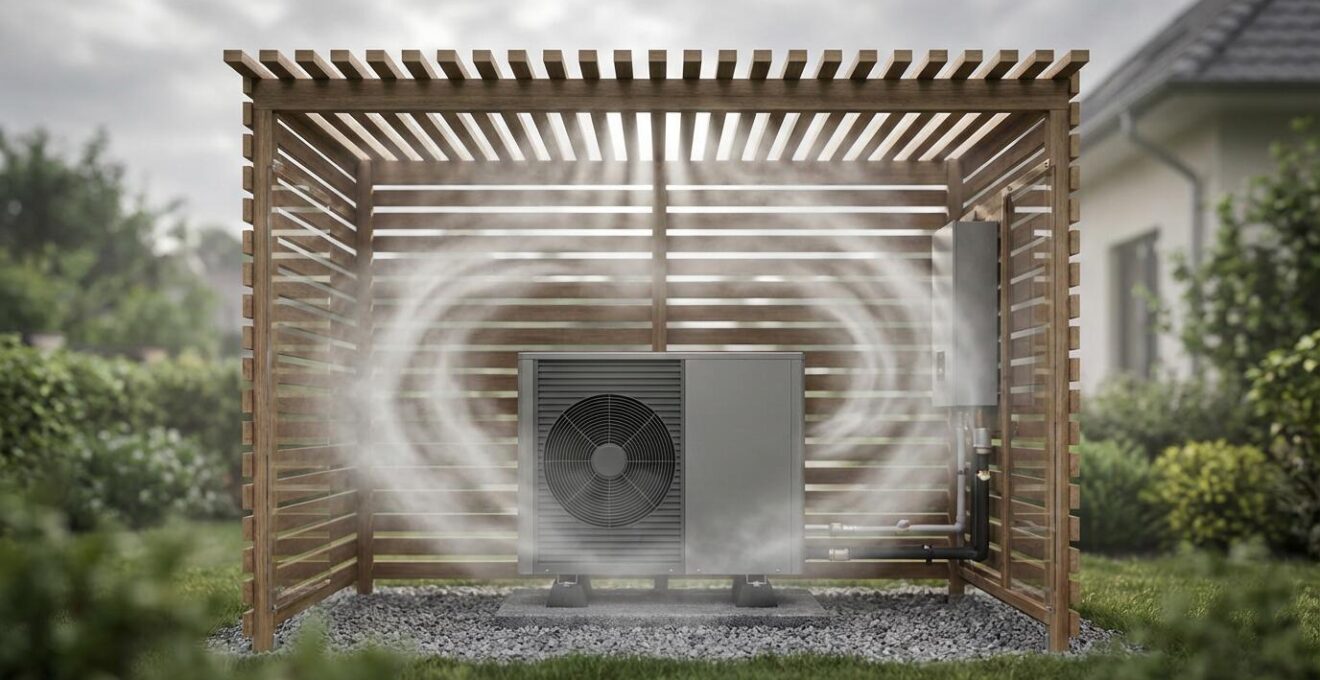
As the visualization shows, correct spacing allows cold exhaust air to dissipate away from the unit, while fresh ambient air is drawn in without obstruction. This ensures the evaporator coil is always in contact with the “warmest” possible air, maximizing its heat-extracting potential and maintaining a high Coefficient of Performance (COP). Treating airflow as a top priority during installation is one of the most critical factors for efficient operation.
Side or Top Discharge: Which Unit Fits Best in Narrow Corridors?
The physical orientation of the heat pump’s fan—whether it discharges air horizontally (side discharge) or vertically (top discharge)—is a critical design choice with significant implications for installation, especially in tight spaces. For properties with narrow side corridors or limited yard space, this decision is not just about aesthetics but about fundamental operating physics. A side-discharge unit, while common, can be a poor choice in a confined area, as its powerful horizontal airflow can bounce off nearby walls or fences.
This ricochet effect can lead to the same destructive recirculation problem seen with poorly designed shelters: the cold exhaust air is immediately drawn back into the unit’s intake. As the SpacePak Engineering Team notes in their technical documentation, “Top-discharge units expel cold air vertically, making them a far safer choice from a physics perspective in tight spaces.” By venting air upwards, a top-discharge model avoids creating turbulence and recirculation in narrow corridors, ensuring it always draws in fresh ambient air.
This design also offers a distinct advantage in noise reduction. Since the sound from the fan is directed upward rather than horizontally towards neighboring properties, top-discharge units are often perceived as quieter. While they can be more vulnerable to falling leaves or snow, their smaller side clearance requirements make them the superior and often only viable option for constrained installations.
| Feature | Side Discharge | Top Discharge |
|---|---|---|
| Narrow corridor suitability | Poor – exhaust bounces off walls | Excellent – vertical air expulsion |
| Noise direction | Horizontal towards neighbors | Upward, less intrusive |
| Debris vulnerability | Protected from above | Susceptible to leaves/snow |
| Minimum side clearance | 5+ feet required | 2-3 feet acceptable |
| Maintenance access | Side panels accessible | Top grille needs clearing |
The location mistake near salt water that rots heat exchanger fins
The outdoor unit of a heat pump is a complex assembly of thin aluminum fins and copper tubing designed to maximize the surface area for heat exchange. While robust, this system has a significant vulnerability: galvanic corrosion, particularly in coastal environments. When a heat pump is installed near salt water, the air is laden with a fine mist of salt spray. This saline moisture acts as an electrolyte, creating a tiny electrical current between the different metals in the coil (typically copper and aluminum).
This electrochemical reaction causes the aluminum fins to corrode and disintegrate over time. The fins turn into a white, powdery aluminum oxide, flaking away and clogging the air passages. This process not only damages the unit structurally but also severely degrades its performance. The fins are essential for transferring heat from the air to the refrigerant, and as they corrode, their ability to conduct heat plummets. This forces the compressor to work harder and run longer to achieve the same heating result, increasing energy consumption and wear.
The impact is not trivial. Corroded fins can form an insulating layer that chokes the heat exchanger, and according to technical resources, this can reduce heat transfer efficiency by 10-20%. For homeowners in coastal areas, this is a critical consideration. The solution involves either selecting a unit specifically designed for marine environments, which often feature coils with a protective epoxy or polymer coating, or ensuring the unit is installed as far as possible from direct sea spray and is regularly rinsed with fresh water to remove salt deposits. Ignoring this environmental factor is a costly mistake that can prematurely ruin a significant investment.
When does active defrosting consume more energy than it saves?
When a heat pump operates in cool, humid conditions, typically between 1-4°C (34-39°F), the moisture in the air condenses and freezes onto the cold evaporator coils. This layer of frost acts as an insulator, blocking airflow and drastically reducing the unit’s ability to absorb heat from the air. To combat this, all heat pumps have a defrost cycle. During this cycle, the unit temporarily reverses its operation, using hot refrigerant gas to melt the ice from the outdoor coil. However, the efficiency of this process—the thermodynamic penalty of defrosting—varies enormously between models.
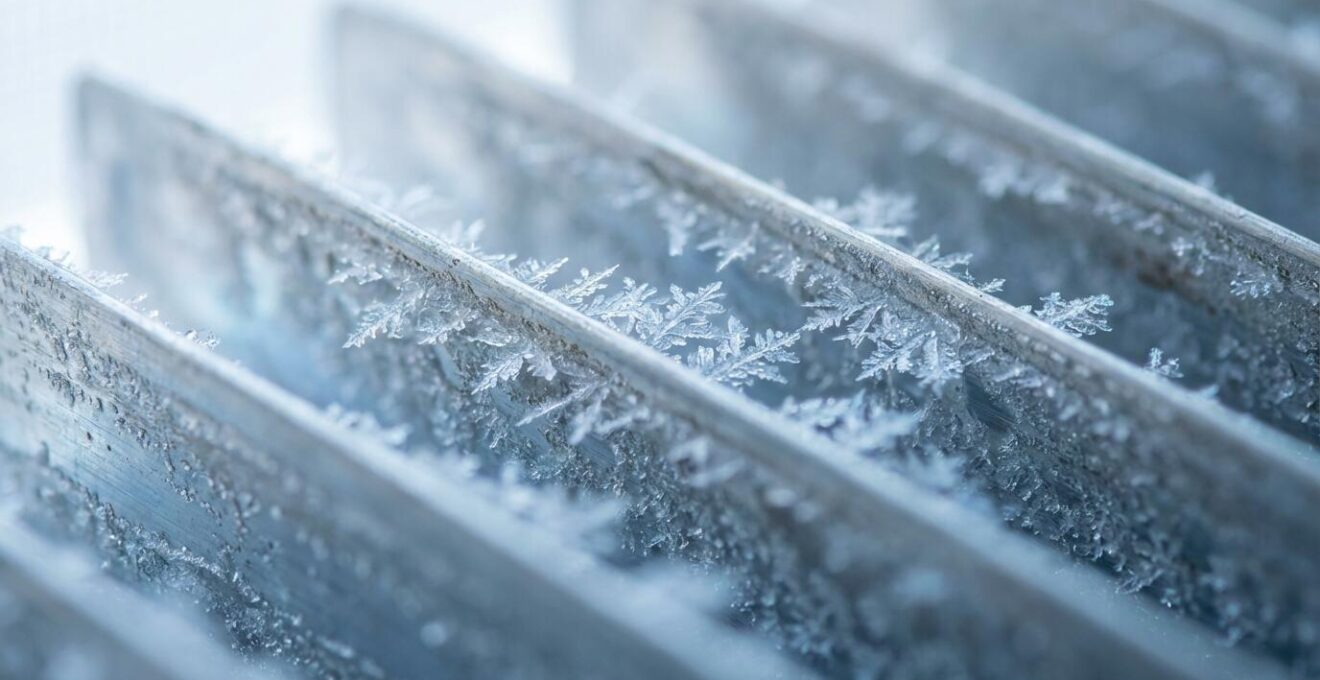
The most basic systems use a simple timer, initiating a defrost cycle at fixed intervals (e.g., every 60 minutes) regardless of whether the coils are actually frosted. This is incredibly wasteful. In conditions where frost isn’t forming, the unit still stops heating your pool and consumes energy to run a pointless defrost cycle. Conversely, in heavy frosting conditions, the timer may not run frequently enough, allowing performance-killing ice to build up.
Advanced heat pumps use “demand defrost” technology. These systems employ sensors to monitor temperature and air pressure across the coil. They only initiate a defrost cycle when a significant buildup of ice is actually detected. According to an analysis of real-world heat pump performance, this intelligence is crucial for maintaining efficiency. In prime frosting conditions, a unit might spend 10 minutes defrosting for every 30 minutes of heating. A timer-based system that defrosts unnecessarily in these or milder conditions is effectively throwing energy away, consuming more power in defrost cycles than it saves through efficient operation. A demand defrost system, therefore, becomes essential for maintaining a high real-world COP in cooler climates.
How Inverter Technology Reduces Your Pool’s Carbon Footprint by 40%?
Traditional, single-speed heat pumps operate on a simple on/off principle. When the water temperature drops below the set point, the compressor kicks on at 100% capacity and runs until the target is reached, then shuts off completely. This process is effective but highly inefficient. Each startup requires a massive surge of electricity, and the system constantly overshoots its target, wasting energy. Inverter technology fundamentally changes this dynamic, significantly reducing both energy consumption and carbon footprint.
A traditional, single-speed unit is a ‘sprinter’—it runs at 100% power then stops. An inverter is a ‘marathon runner’—it modulates its speed, running at lower, continuous power.
– Fairland Technical Team, Fairland Pool Heat Pump Technology Guide
An inverter-driven compressor doesn’t just turn on and off; it modulates its speed. To bring a cold pool up to temperature, it will run at high power. But as it approaches the set point, it slows down, operating at a very low, continuous power level (sometimes as low as 20-30% of its capacity) just to maintain the temperature and compensate for heat loss. This “marathon runner” approach avoids the high-energy startups of a single-speed unit and allows the system to operate at its most efficient point for longer periods. By constantly matching its output to the exact heating demand, an inverter heat pump can reduce energy consumption by 40% or more compared to a traditional model.
This sustained, low-power operation also allows the system to achieve extraordinarily high efficiency ratings. Because the heat exchange process is more effective at slower speeds, the latest inverter technology achieves a coefficient of performance up to COP 20, meaning it can produce 20 units of heat for every single unit of electricity consumed. This dramatic reduction in electricity usage directly translates to a smaller carbon footprint and substantial savings on energy bills, making inverter technology a cornerstone of modern, efficient pool heating.
How to Maintain 28°C Water Temperature in October Without Bankrupting Yourself?
Generating heat with an efficient inverter heat pump is only half the battle; the other half is preventing that expensive heat from escaping. During shoulder seasons like October, when ambient temperatures drop, heat loss becomes the primary driver of your energy bill. The single largest source of heat loss in a swimming pool—up to 75%—is evaporation. For every litre of water that evaporates, a significant amount of heat energy is lost from the pool. Therefore, the most impactful strategy for affordable heating is to minimize heat loss.
The most effective tool for this is a high-quality pool cover. A solar or isothermal cover that sits on the water’s surface acts as a physical barrier against evaporation. It also provides an insulating layer to reduce convective heat loss to the cold air. The impact is profound; a recent study showed that a good pool cover can reduce heat pump runtime by 50-70%. This means the unit only needs to run for a fraction of the time to maintain the desired temperature, leading to massive energy savings.
Beyond a cover, several other strategies can contribute to an affordable extended swimming season:
- Lower the Target Temperature: Each degree of heat requires significant energy. Lowering your target from a balmy 28°C to a comfortable 26°C can reduce energy consumption by 10-20%.
- Run the Pump During the Day: Operate the heat pump during the warmest part of the day when the ambient air temperature is highest. This maximizes its COP, as it has to work less hard to extract heat.
- Install Windbreaks: Wind moving across the pool’s surface dramatically increases the rate of evaporation and convective heat loss. Planting hedges or installing fencing can create a calmer microclimate around the pool.
- Use a Timer: Heat the pool only during the times you anticipate swimming. There is no need to maintain 28°C around the clock if the pool is only used on weekend afternoons.
By combining an efficient heat pump with a disciplined heat retention strategy, maintaining a warm pool in October becomes an affordable luxury rather than a financial drain.
Key Takeaways
- Heat extraction from cold air is a function of pressure manipulation and refrigerant physics, not ambient temperature alone.
- Unobstructed airflow is the “fuel” for a heat pump; proper clearance and ventilation are non-negotiable for efficiency.
- Inverter technology combined with a quality pool cover represents the most effective strategy for minimizing energy consumption and cost.
Which Isothermal Cover Best Protects Children While Retaining Heat?
While a pool cover is the undisputed champion of heat retention, not all covers are created equal, especially when safety is a concern. For families with children or pets, the choice of cover involves a critical trade-off between thermal efficiency and physical protection. A standard solar bubble cover, while excellent at retaining heat and preventing evaporation, offers absolutely no safety. It floats on the water’s surface and cannot support any weight, posing a significant drowning hazard.
On the other end of the spectrum are certified safety covers. These are made from robust materials like solid vinyl or tightly woven mesh and are anchored securely to the pool deck. They are designed to support the weight of a child or adult, providing a reliable barrier. However, their thermal properties vary. A mesh cover allows rain to pass through but offers minimal heat retention. A solid vinyl safety cover provides better insulation but blocks all solar gain and can be cumbersome to handle.
The table below outlines the primary differences, highlighting the conflict between maximizing heat retention and ensuring safety.
| Cover Type | Heat Retention | Child Safety | Solar Gain |
|---|---|---|---|
| Solar Bubble Cover | Excellent | None | High |
| Mesh Safety Cover | Minimal | Excellent | Moderate |
| Solid Vinyl Safety | Good | Excellent | None |
| Two-Cover System | Excellent | Excellent | Variable |
For those unwilling to compromise on either efficiency or safety, pool experts often recommend a two-cover system. This approach involves using a lightweight solar bubble cover directly on the water to maximize heat retention and prevent evaporation, which is then protected by a certified mesh or solid safety cover installed over it. This combination provides the best of both worlds: the unparalleled thermal performance of a bubble cover and the absolute peace of mind of a safety cover. While it requires a higher initial investment and more effort to deploy and remove, it is the definitive solution for achieving maximum energy efficiency and uncompromising safety.
By understanding these thermodynamic principles and technological features, you can confidently evaluate a heat pump not on its marketing claims, but on its engineering merits, ensuring you select a system that delivers efficient, reliable performance for your specific climate and needs.