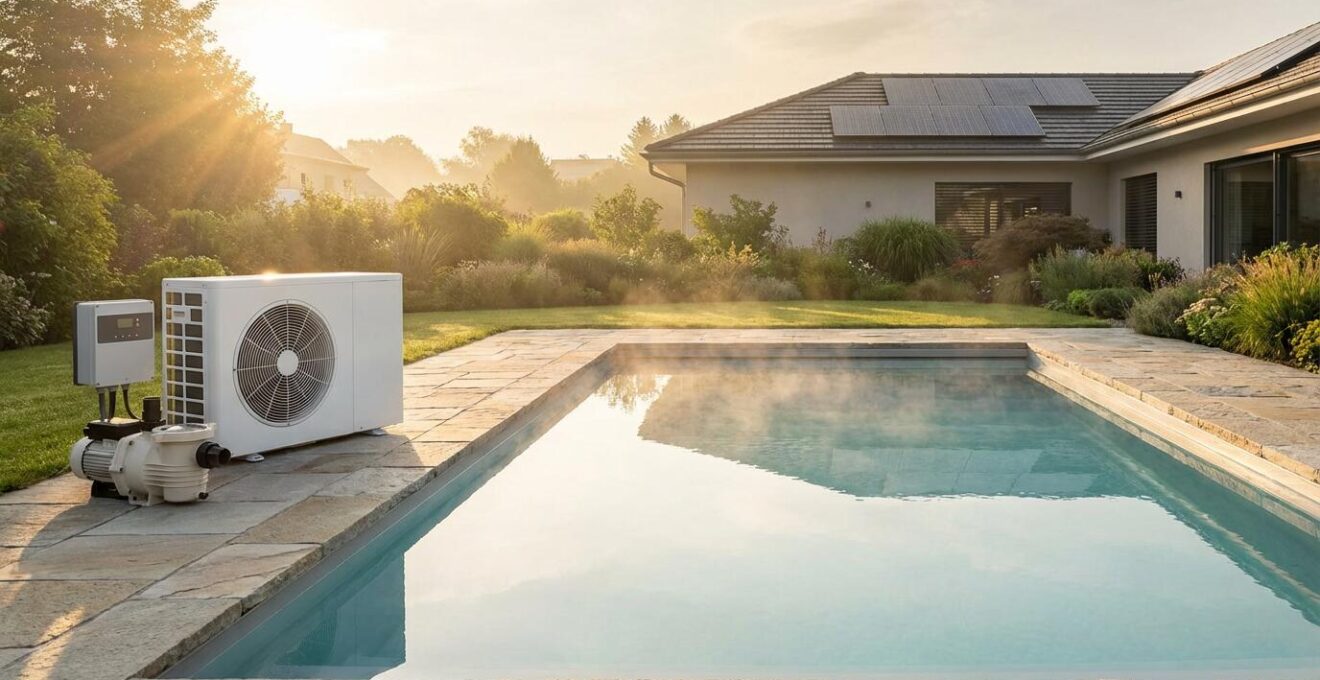
True carbon reduction from an inverter pool pump is not a passive feature; it is the active result of strategic energy management that cuts consumption by over 80%.
- Operating a pump at low speeds leverages pump affinity laws to achieve dramatic energy savings, where a 50% speed reduction cuts power use by over 87%.
- Synchronizing pump operation with peak solar production hours (10 AM – 3 PM) allows the system to run on free, zero-carbon energy.
Recommendation: To truly minimize your pool’s environmental impact, operate your system like a sustainability auditor—prioritizing low-speed filtration and aligning energy use with renewable sources.
For the eco-conscious homeowner, the luxury of a private swimming pool often comes with a nagging sense of environmental guilt. Traditional pool systems are notorious energy hogs, contributing significantly to a household’s carbon footprint. The common solution presented is to upgrade to inverter technology, promising greater efficiency. However, this is only half the story. The belief that simply installing an inverter pump will automatically slash your environmental impact is a widespread oversimplification.
The real power of inverter technology lies not in the hardware itself, but in the operational intelligence it enables. Reducing a pool’s carbon footprint is an active process of energy modulation, not a passive benefit. It requires a shift in mindset from simply turning the pool ‘on’ or ‘off’ to strategically managing its energy consumption. This involves understanding the physics of water movement, leveraging natural energy cycles, and making conscious decisions about when and how to use power. It’s about becoming the sustainability auditor of your own backyard oasis.
This article will deconstruct the core principles of effective energy management for inverter-equipped pools. We will explore the data-backed strategies that transform a simple equipment upgrade into a powerful tool for environmental stewardship, demonstrating how you can take direct control of your pool’s energy destiny and achieve—and even exceed—a 40% reduction in its carbon footprint.
To guide you through this process, this article is structured to provide a comprehensive audit of your pool’s energy system. Below, the summary outlines the key areas we will investigate to unlock maximum efficiency and environmental benefits.
Summary: A Strategic Audit of Your Pool’s Carbon Footprint
- Why does running the pump at 20% capacity yield the highest energy savings?
- How to sync your inverter heat pump with solar production peaks?
- Inverter or On/Off: Which Technology Pays Off Faster in Mild Climates?
- The sizing error that destroys inverter compressors in 3 years
- When to trigger the “Boost” mode to reach target temp without wasting energy?
- Why a High COP of 16 is Meaningless Without Contextual Air Temperature?
- Why Inverter Heat Pumps Are Worth the Extra Upfront Cost for Large Pools?
- How to Sync Your Pool Pump with Solar Panels to Run for Free?
Why Does Running the Pump at 20% Capacity Yield the Highest Energy Savings?
The single most impactful principle in pool energy management is the “pump affinity law,” a concept from fluid dynamics that governs the relationship between a pump’s speed, flow rate, and power consumption. This law reveals a non-linear reality: a small reduction in speed leads to a massive reduction in energy use. When you halve a pump’s speed, you don’t just halve the power consumption; you reduce it by a factor of eight. This is the foundational secret to the inverter’s efficiency.
Running a pump at 100% capacity is an act of brute force, necessary only for tasks like backwashing or initial heating. For daily filtration, which accounts for the vast majority of a pump’s runtime, a much lower speed is not only sufficient but exponentially more efficient. At 20% speed, the pump is merely sipping energy, yet it can still achieve the required water turnover for a clean and healthy pool. According to a technical analysis of this principle, there are 87% energy savings when pump speed is reduced by 50%. Extending this, operating at 20% capacity can reduce power consumption to less than 1% of its maximum draw, transforming the pool from an energy drain into a model of efficiency.
This is where the role of the “sustainability auditor” begins. Instead of a binary “on/off” approach, you must think in terms of modulation. The goal is to find the lowest possible speed that maintains water quality, and to run the system at that baseline for the longest possible time. This continuous, low-energy circulation is far superior to short, high-energy bursts, both for your wallet and for the planet.
Action Plan: Audit Your Pump’s Energy Efficiency
- Calculate Baseline: Determine your pump’s power consumption at 100% speed using manufacturer specifications or a watt meter.
- Apply the Cubic Law: Theoretically, running at 20% speed (0.2) requires only (0.2)³ = 0.8% of full power. This is your target benchmark.
- Verify Turnover Rate: Ensure that running at 20% speed still circulates your entire pool volume at least once per 8-hour cycle to maintain sanitation.
- Program the Inverter: Set your controller for a gradual ramp-up to 20% operational speed to avoid inefficient start-up power surges.
- Monitor and Confirm: Use the VFD’s built-in diagnostics or an external energy monitor to track actual consumption and confirm your theoretical savings.
How to Sync Your Inverter Heat Pump with Solar Production Peaks?
Once you’ve mastered low-energy operation, the next level of carbon reduction is to source that energy sustainably. Synchronizing your pool equipment’s runtime with the peak production hours of a photovoltaic (PV) solar array allows you to heat and filter your pool using free, zero-emission energy. This creates a powerful synergy between your home’s energy generation and consumption, effectively taking your pool “off the grid” during daylight hours.
The strategy is simple: schedule your inverter heat pump and filtration pump to operate primarily between 10 AM and 3 PM. This window is when solar panels typically generate their maximum output. By aligning the highest energy demand (heating and pumping) with the highest energy supply (solar generation), you consume the power directly as it’s produced. This avoids drawing from the utility grid, which may be powered by fossil fuels, and minimizes sending excess solar power back to the grid for a lower credit.
A successful implementation turns your pool into a “solar battery” of sorts. As a case study on solar integration demonstrates, a standard 1.5 HP pool pump can be fully powered by just 4 to 6 dedicated solar panels. During the 6-8 hours of daily operation within the peak solar window, the system achieves a complete energy offset. The heat generated is stored in the large thermal mass of the pool water, which retains the warmth long after the sun has set.
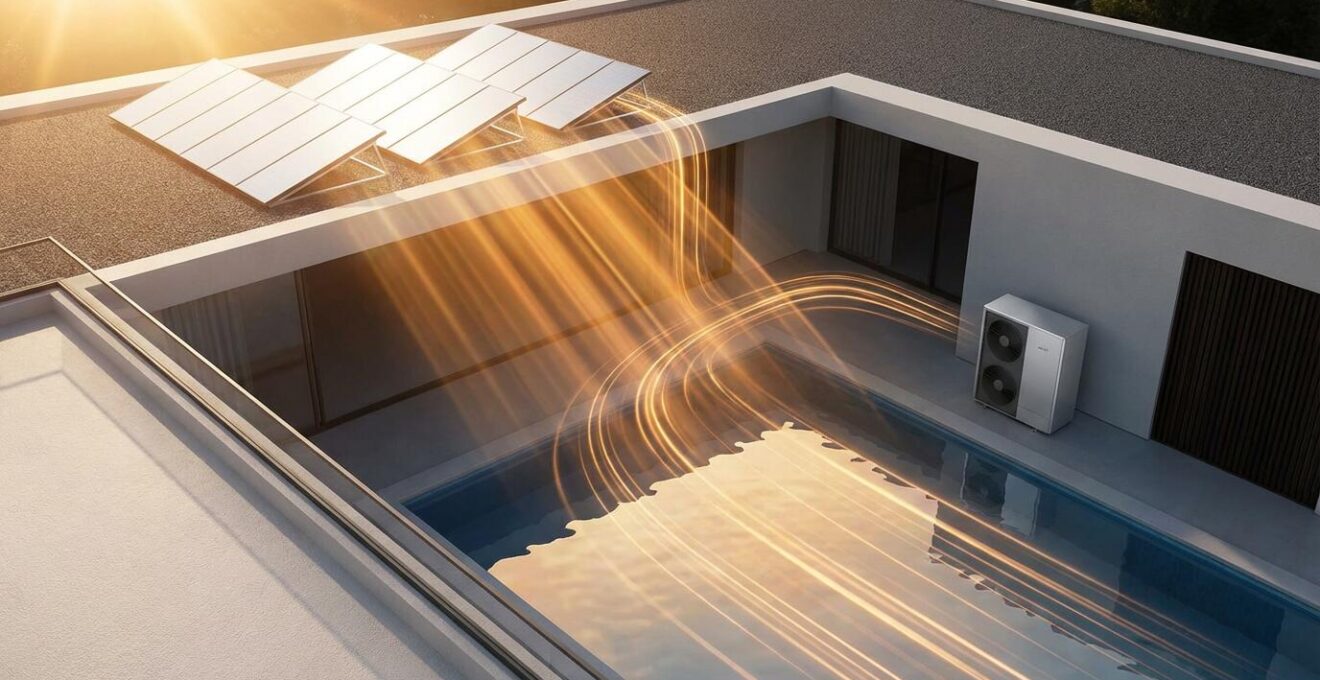
This visual representation of energy flow—from sun to panels to pump—underscores the elegant simplicity of the system. The goal is a closed loop where the energy required to maintain the pool is generated on-site. This requires an initial investment but provides a long-term hedge against rising electricity costs and an immediate, measurable reduction in your home’s carbon footprint.
Inverter or On/Off: Which Technology Pays Off Faster in Mild Climates?
When evaluating the upfront cost of an inverter heat pump versus a traditional on/off model, the payback period is a critical factor. In colder regions, the raw heating power of on/off units might seem appealing, but in mild climates, the operational intelligence of an inverter system provides a much faster return on investment and superior long-term value. This is because on/off pumps are fundamentally inefficient when dealing with small temperature fluctuations.
An on/off pump operates at 100% capacity or not at all. In a mild climate, where the water temperature only needs to be maintained or slightly increased, this system will “short cycle”—turning on at full blast for a short period, overshooting the target, and then shutting off. This constant starting and stopping is mechanically stressful and highly inefficient. In contrast, an inverter pump modulates its output. As it approaches the target temperature, it slows down, running continuously at a very low power level (e.g., 30%) to precisely match the heat loss. This soft, continuous operation is vastly more efficient and significantly quieter.
This operational difference has a direct impact on equipment lifespan and running costs. As one industry analysis highlights, the constant stress of short cycling is a primary cause of premature component failure in on/off units. According to the pool heating experts at HVACDirect:
In mild climates, an on/off pump will ‘short cycle’ more frequently, leading to faster component failure. The inverter’s steady operation extends its lifespan, a crucial factor in the total cost of ownership.
– Pool Equipment Industry Analysis, HVACDirect Pool Heat Pump Guide
The following table, based on comparative data, breaks down how these differences translate into real-world performance and financial return. It clearly shows that while the initial purchase price is higher, the inverter’s energy savings and extended lifespan lead to a typical payback period of just 3-5 years in mild climates.
| Feature | Inverter Heat Pump | On/Off Heat Pump |
|---|---|---|
| Energy Savings | Up to 50% reduction in operating costs | No variable speed savings |
| Typical Payback Period | 3-5 years in mild climates | N/A (baseline) |
| Noise Level | 32-48 dB at partial load | 65-75 dB when running |
| Temperature Maintenance | Continuous low-power operation | Frequent cycling on/off |
| Component Lifespan | Extended due to soft starts | Reduced from thermal cycling |
The Sizing Error That Destroys Inverter Compressors in 3 Years
While inverter technology offers profound efficiency benefits, its greatest strength—modulation—can become a fatal flaw if the unit is improperly sized for the pool. The most common and destructive mistake is oversizing. An oversized inverter heat pump, purchased with the “bigger is better” mindset, will fail to operate within its optimal modulation range, leading to chronic short-cycling and premature compressor failure, often within just three years.
An inverter is designed to run for long, continuous periods at a low percentage of its total capacity (e.g., 20-50%). This is where it achieves peak efficiency. However, an oversized unit will heat the pool water so quickly, even at its lowest setting, that it reaches the target temperature and is forced to shut down. Moments later, the water cools slightly, and the unit starts up again. This constant on-off cycle is precisely what inverter technology is designed to avoid. It puts immense strain on the compressor, negates all potential energy savings, and ultimately destroys the most expensive component of the system.
Proper sizing is not just a recommendation; it is a prerequisite for efficiency and longevity. Research into full-inverter technology confirms that properly sized inverters reduce electrical demand by 30-50%, a saving that is completely lost with an oversized unit. A thorough sizing calculation must go beyond simple pool volume and consider a range of environmental factors, including:
- Surface Area and Volume: The primary determinant of heat loss.
- Desired Temperature: A higher target temperature requires more capacity.
- Wind Exposure: High-wind areas can increase heat loss by 15-20%.
- Solar Cover Use: A cover can reduce heating requirements by 50-70%, a critical factor in sizing.
- Ambient Air Temperature: The average nighttime and shoulder-season temperatures dictate the real-world performance of the unit.
Failing to account for these variables results in a system that fights itself, wasting energy and accelerating its own demise. The goal is to select a unit that can maintain the desired temperature by running continuously at a low, quiet, and efficient speed, not one that violently cycles on and off.
When to Trigger the “Boost” Mode to Reach Target Temp Without Wasting Energy?
Modern inverter heat pumps often feature a “Boost” or “Power” mode, which runs the compressor at 100% capacity for rapid heating. While tempting to use, this mode effectively turns your sophisticated inverter into a less efficient on/off unit, consuming maximum energy. The key to responsible energy management is to use this feature strategically and sparingly, reserving it for specific situations where its high energy cost is justified.
Think of Boost mode as a tool for overcoming significant thermal inertia, not for daily temperature maintenance. The most effective and justifiable times to activate it are during the initial spring opening of the pool or after a prolonged period of inactivity. In these scenarios, the water temperature is far from the desired setpoint, and a powerful initial heating phase is necessary to bring the large body of water up to a comfortable temperature. Once the target is reached, the system should immediately be switched to “Eco” or “Smart” mode to maintain the temperature with minimal energy input.
Another strategic use is to trigger Boost mode for 2-3 hours just before you plan to cover the pool for the night. This injects a final dose of heat into the water, which is then trapped by the solar cover, creating a “thermal blanket” that minimizes overnight heat loss and reduces the heating demand for the following day. According to field tests on advanced systems like the TropiCal Inverter, this strategic approach—using Boost only when necessary and relying on Eco mode for maintenance—can result in overall energy savings of up to 70% compared to leaving the system in a high-power mode continuously.
Using Boost mode indiscriminately is the equivalent of flooring the accelerator in city traffic—it’s wasteful, inefficient, and puts unnecessary strain on the engine. A sustainable operator understands that true efficiency comes from smooth, modulated control, reserving full power only for the rare moments it is truly required.
Why a High COP of 16 is Meaningless Without Contextual Air Temperature?
The Coefficient of Performance (COP) is the primary metric used to market the efficiency of a heat pump. It represents the ratio of heat output to electrical energy input. A COP of 16, for example, means the unit produces 16 units of heat for every 1 unit of electricity consumed. While a higher COP is theoretically better, this single number is profoundly misleading when presented without its full operational context—specifically, the ambient air and water temperatures at which it was measured.
A heat pump does not create heat; it moves it from the surrounding air into the pool water. Its efficiency is therefore entirely dependent on the amount of thermal energy available in the air. A manufacturer might advertise a stellar COP of 16, but this rating is almost always achieved under ideal, laboratory-like conditions, such as a warm air temperature of 26°C (79°F). As the air temperature drops, the pump has to work much harder to extract the same amount of heat, causing its real-world COP to plummet.
A sustainability auditor must look beyond the sticker price and the headline COP. You must demand the performance data sheet that shows the COP at various air temperatures relevant to your climate. The advertised COP of 16 can easily drop to 6 or 8 on a cool 15°C (59°F) day, and as low as 4 in 10°C (50°F) air. This means the unit is suddenly 50-75% less efficient than its advertised rating. This context is everything.
This table, derived from technical guides, illustrates how dramatically an advertised COP can degrade as real-world conditions change. It exposes the gap between marketing claims and operational reality.
| Air Temperature | Advertised COP | Actual COP | Efficiency Loss |
|---|---|---|---|
| 26°C (79°F) | 16 | 15-16 | 0-6% |
| 20°C (68°F) | 16 | 10-12 | 25-37% |
| 15°C (59°F) | 16 | 6-8 | 50-62% |
| 10°C (50°F) | 16 | 4-5 | 69-75% |
| 5°C (41°F) | 16 | 2-3 | 81-87% |
Therefore, choosing a heat pump should not be based on the highest advertised COP, but on the model that maintains the best performance at the average temperatures of your swimming season. A unit with a lower peak COP but better performance in cooler weather will often be the more efficient and economical choice in the long run.
Key Takeaways
- Low-Speed Operation is Paramount: The greatest energy savings (over 80%) come from running the pump at the lowest possible speed required for filtration, leveraging pump affinity laws.
- Solar Synergy is Key: Aligning pump and heater operation with peak solar production hours (10 AM – 3 PM) provides free, zero-carbon energy.
- Contextual Data Over Marketing: A high Coefficient of Performance (COP) is meaningless without knowing the air temperature at which it was measured; always audit the full performance chart.
Why Inverter Heat Pumps Are Worth the Extra Upfront Cost for Large Pools?
For owners of large residential or commercial pools (over 75,000 liters), the case for investing in inverter technology becomes even more compelling. The significant upfront cost is quickly offset by massive operational savings, primarily due to an inverter’s ability to masterfully manage the pool’s enormous thermal inertia. A large body of water is like a thermal battery; it takes a lot of energy to heat up, but it also loses that heat very slowly.
This slow heat loss is the ideal condition for an inverter heat pump. Unlike an on/off unit that would engage in jarring, inefficient cycles to combat minor temperature drops, an inverter can settle into a continuous, ultra-low-power state. It precisely matches its heat output to the slow, steady rate of heat loss, maintaining a constant temperature with unparalleled efficiency. Analysis by commercial pool solution providers like Fluidra confirms that this modulated approach can achieve up to 70% energy reduction compared to cycling on/off systems in large pools.
Furthermore, the scale of the savings is magnified. A 50% energy saving on a small backyard pool is significant, but a 50% saving on a large pool represents a substantial reduction in both operating costs and carbon emissions. The collective impact of this technology is staggering; some industry research estimates there is up to 80 billion kWh annual global savings potential if inverter technology were widely adopted. For the owner of a large pool, the decision is clear: the higher initial investment is not just a purchase, but a long-term strategy for economic and environmental sustainability. The technology is simply better suited to the physics of a large water body.
How to Sync Your Pool Pump with Solar Panels to Run for Free?
Achieving a “free run” for your pool pump, powered entirely by the sun, is the ultimate goal for any sustainability-focused owner. This synergy eliminates the pump’s running costs and its associated carbon footprint during operation. The cost of generating your own solar power is now significantly lower than buying it from the grid, with some analyses showing that solar power costs less than 5c per kWh over the system’s lifetime. Realizing this goal requires a clear, tiered strategy for synchronization.
There are three primary levels of integrating your pool pump with solar panels, each offering a different degree of automation and efficiency. The choice depends on your budget and technical requirements, but all are based on the principle of running the pump during peak solar production hours (10 AM to 3 PM).
- Level 1 (Basic): The “Dumb” Timer. This is the simplest and cheapest method. You use a standard mechanical or digital timer to program your pump to run only during the peak solar window. It’s effective but doesn’t adapt to cloudy days, potentially drawing from the grid if solar production is low.
- Level 2 (Intermediate): The Relay Switch. This method uses a voltage-sensing relay connected to your solar system. The relay automatically activates the pool pump only when the solar panels are producing a sufficient amount of power (e.g., above 80% of their rated output). This is a “smarter” approach that prevents the pump from running on expensive grid power on overcast days.
- Level 3 (Advanced): Full Smart Integration. This is the most efficient solution, often involving a DC (Direct Current) pool pump connected directly to a dedicated set of 4-6 solar panels via an MPPT (Maximum Power Point Tracking) controller. This setup bypasses the need for an inverter to convert DC to AC power, minimizing energy loss and maximizing the power harvested from the sun.
Regardless of the method, the first step is to calculate your pool’s minimum daily turnover rate to determine the required run hours. Then, size your solar array accordingly—a typical 1.5 HP pump needs about 1.6 to 2.4 kW of panel capacity for 6-8 hours of operation. By implementing one of these strategies, you transform a major energy consumer into a self-sufficient, carbon-neutral asset.
To fully apply these data-backed principles, the next logical step is to perform a detailed audit of your own pool system’s current run times, speed settings, and energy consumption. This baseline data will reveal the greatest opportunities for savings and guide your transition to a more strategic, sustainable operational model.