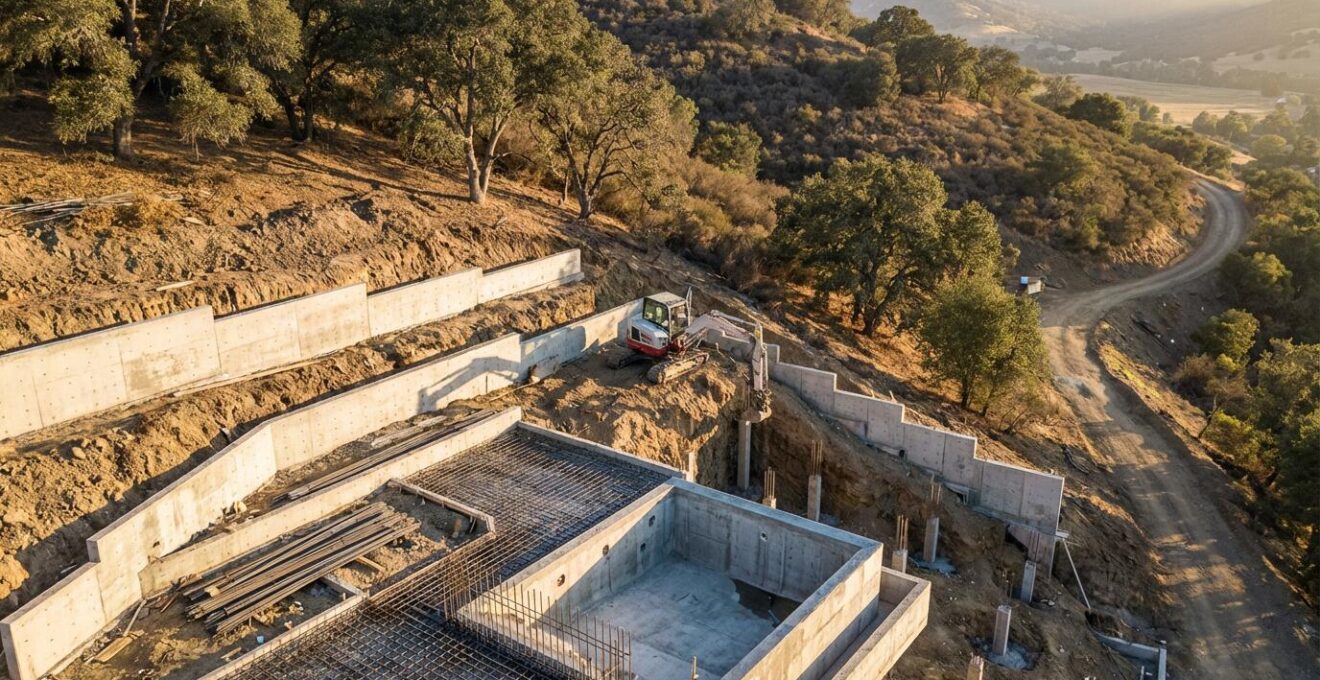
Building a pool on a steep slope is not a simple construction task but a complex geotechnical engineering challenge. The primary risk isn’t aesthetic but catastrophic failure from soil movement and water pressure. Success depends entirely on correctly analyzing and mitigating specific failure modes—such as soil creep and hydrostatic pressure—through specialized foundations, double retaining walls, and meticulous water management, turning a high-risk liability into a stable, dramatic asset.
For owners of hillside properties, the allure of an infinity pool overlooking a stunning vista is powerful. That unusable, sloped section of the yard seems like the perfect canvas for a dramatic water feature. However, this vision can quickly turn into a geotechnical nightmare. The common advice to “hire a good contractor” and “build a retaining wall” dangerously oversimplifies the physics at play. A pool is not just a hole filled with water; on a slope, it’s a massive, concentrated surcharge load—often weighing over 200,000 pounds—exerting immense pressure on unstable ground.
The conversation must shift from landscaping to civil engineering. The real challenge isn’t the slope itself, but mastering the invisible forces it creates. Without a deep understanding of soil mechanics, hydrostatic pressure, and structural load transfer, a hillside pool project is susceptible to catastrophic failure. This isn’t about small cracks; it’s about slow, creeping landslides or sudden structural collapse. Any plan that does not begin with a thorough geotechnical investigation by a licensed engineer is not a plan; it is a gamble.
This guide moves beyond generic warnings to provide an engineer’s perspective. We will dissect the primary failure modes associated with hillside pools and detail the specific engineering strategies required to neutralize them. We will explore why double retaining walls are often non-negotiable, how to select the correct foundation strategy for your site, and the critical role of water management in preventing disaster. The goal is to equip you with the knowledge to ask the right questions and ensure your dream pool is built on a foundation of safety and stability, not just hope.
text
This article provides a structured, engineering-first approach to the complexities of hillside pool construction. The following summary outlines the key geotechnical and structural considerations we will cover.
Summary: Engineering a Pool on Challenging Terrain
- Why double-retaining walls are necessary for upslope pool installations?
- How to get an excavator into a backyard with no side access?
- Piers or Gravity Walls: Which Foundation Strategy is Best for Downslope Pools?
- The drainage oversight that washes away your neighbor’s garden below
- In what order to build the pool and the retaining walls to ensure stability?
- How to Ensure Structural Integrity on Clay Soil Without Spending a Fortune?
- Why Spillover Spas Are the Ultimate Focal Point for Flat Yards?
- Why Shotcrete is the Only Viable Option for Complex Free-Form Pool Designs?
Why Double-Retaining Walls Are Necessary for Upslope Pool Installations?
When a pool is cut into a hillside (an “upslope” installation), the primary threat is not the pool sliding down, but the hill sliding into the pool. This phenomenon, known as “slope creep,” is a slow, persistent downward movement of soil and is the single most common cause of structural distress in hillside pools, according to pool engineering investigations. A single retaining wall is often insufficient because it is forced to combat two distinct forces simultaneously: the active pressure from the natural slope above and the immense surcharge load from the pool structure itself.
This creates a complex “force couple” dynamic that can overwhelm a singular wall. The engineered solution is a double-retaining wall system. The upper wall’s sole job is to hold back the natural hillside. The lower wall, constructed as a completely independent, freestanding structure, is engineered to contain the pool shell and the massive weight of its water. This separation of duties is the key to long-term stability.
A critical, and often overlooked, component is the space between these two walls. This isn’t wasted space; it’s a vital inter-wall drainage zone. Properly designed, this area prevents the buildup of hydrostatic pressure, the force of trapped groundwater that can easily buckle even the strongest walls. By managing these forces separately, the double-wall system provides a robust and redundant safety margin.
Action Plan: Installing a Double-Retaining Wall System
- Conduct Geotechnical Analysis: Identify the specific force couple dynamics. The upper wall must handle the active pressure from the natural slope, while the lower wall must manage the surcharge load from the pool.
- Install the Upper Wall First: Ensure a minimum setback of 7-10 feet from the top of the slope, as often required by building codes, to create a stable platform.
- Create an Inter-Wall Drainage Zone: Install a geocomposite drainage mat and a perforated pipe system between the walls to actively prevent any hydrostatic pressure buildup.
- Construct the Lower Wall: Build this as a freestanding structure, engineered to support the full weight of the pool (often over 200,000 pounds) without relying on soil support from the downslope side.
- Integrate Aesthetically: Transform the space between the walls into a design feature, such as a sunken garden or a green wall, to merge engineering with landscape design.
How to Get an Excavator into a Backyard with No Side Access?
A significant logistical hurdle in hillside construction is site access. Many properties with steep slopes lack the wide, flat side yards necessary for standard heavy equipment like large excavators and dump trucks. Attempting to force access can damage property and create unsafe conditions. However, a lack of conventional access does not render a project impossible; it simply requires specialized equipment and planning.
Several modern solutions exist to overcome these constraints. Spider excavators are compact, tracked machines that can navigate narrow passages as small as 3-4 feet wide and even climb stairs. For sites with no ground access at all but clear overhead space, a mobile crane can be used to lift smaller machinery, materials, and even a pre-fabricated pool shell directly into the backyard from the street. This method involves significant costs for crane rental, road permits, and certified flaggers but is often the only viable option.
For soil removal, conveyor belt systems can be set up to transport earth from the excavation site to a truck on the street, requiring only a narrow path. In some cases, the design itself can be altered to eliminate the need for heavy equipment altogether. A pier-supported pool, for instance, requires minimal excavation and can be built with hand tools, though the structural costs are typically higher. The key is to evaluate these options during the initial design phase, as the chosen method will heavily influence both the budget and the construction timeline.
This comparative table, derived from an analysis of sloped construction methods, outlines the primary options for gaining access to restricted-access backyards.
| Method | Equipment Type | Access Required | Additional Costs |
|---|---|---|---|
| Spider Excavators | Compact tracked units | 3-4 feet width, can navigate stairs | Equipment rental + operator |
| Crane Lifting | Mobile crane | Street access required | Road permits + certified flaggers |
| Conveyor Systems | Belt conveyors | Minimal width needed | Setup/breakdown fees |
| Pier-Supported Design | Hand tools only | No heavy equipment needed | Higher construction costs |
Piers or Gravity Walls: Which Foundation Strategy Is Best for Downslope Pools?
When a pool is built on the “downslope” side of a property, it is often partially or fully out of the ground, resting on fill material. This is an inherently unstable situation. The foundation’s job is to bypass this weak, disturbed soil and anchor the pool to something solid. The two primary engineering strategies to achieve this are a pier and grade beam system or a massive gravity retaining wall.
A pier system involves drilling deep shafts—piers or caissons—down through the unstable soil until they reach solid bedrock or load-bearing strata. These piers are then connected by reinforced concrete “grade beams,” which act as a solid frame upon which the pool shell rests. This strategy doesn’t fight the hill; it bypasses it entirely, transferring the entire weight of the pool directly to the stable earth deep below. It’s a precise, highly engineered solution that is often the only choice for the steepest slopes. In fact, pools have been successfully built on inclines of 45 degrees or more using this method.
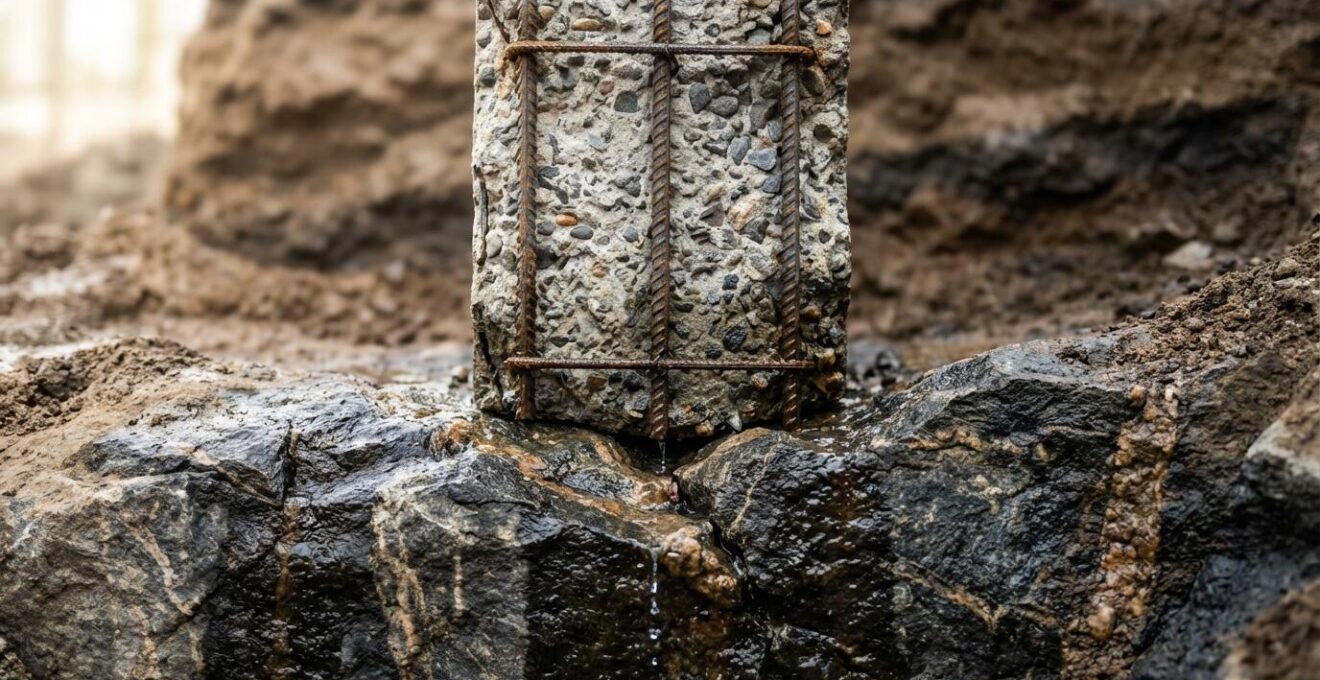
A gravity wall, by contrast, is a massive, heavy retaining wall at the downslope edge of the pool, engineered to hold back both the pool and the fill soil through its sheer weight and size. This approach can be effective on more moderate slopes, but it requires significant excavation and an immense amount of concrete and steel. The choice between these two strategies is a critical decision based on soil conditions, slope angle, and budget, with recent hillside pool construction data revealing a cost of $65,000-$85,000 for a fiberglass pool with piers versus $85,000-$125,000 for a concrete pool with gravity walls.
The Drainage Oversight That Washes Away Your Neighbor’s Garden Below
On a flat lot, water management is about keeping the pool clean. On a slope, it’s about preventing a catastrophic landslide. The single most dangerous element in hillside construction is uncontrolled water. Hydrostatic pressure—the force exerted by trapped groundwater—can build up behind retaining walls and under the pool shell, generating enough force to crack concrete and destabilize the entire structure. A proper drainage plan is not an accessory; it is the most critical safety system of the entire project.
A common and devastating mistake is “point discharge,” where all drainage and overflow water is funneled to a single pipe outlet. This concentrates a massive volume of water in one spot, leading to rapid erosion, soil saturation, and potential destabilization of the slope below—including your neighbor’s property. The correct approach is a distributed discharge system, which uses perforated diffuser pipes spread across a wide area to release water slowly and evenly, allowing it to be absorbed without causing erosion.
Furthermore, all water from the pool’s overflow and backwash systems must be captured and routed into an approved stormwater system, never discharged directly onto the downhill slope. Even the internal design of the pool must adhere to strict standards to manage water forces, as stated by the American National Standard for Residential Inground Swimming Pools.
The slope of the floor from the shallow end wall towards the deep area shall not exceed the maximum per building standards
– American National Standard, Residential Inground Swimming Pools Building Code
Aesthetic features like dry creek beds or terraced rain gardens can be integrated into the landscape to serve as both beautiful design elements and functional parts of the drainage system, proving that robust engineering and sophisticated design can, and should, coexist.
In What Order to Build the Pool and the Retaining Walls to Ensure Stability?
The construction sequence for a hillside pool is not a matter of preference; it’s a critical decision dictated by the laws of physics and the specific site topography. The wrong order can introduce instability and create irreversible structural weaknesses. The primary factor determining the sequence is whether the pool is a “cut” design (excavated into the upslope) or a “fill” design (built out on the downslope).
For a cut/upslope pool, the retaining wall must be built first. This wall’s purpose is to create a stable, level platform by holding back the hillside. Only after this wall is complete and the site is secured can excavation for the pool shell begin safely. The wall acts as the primary stabilizing element from day one.
For a fill/downslope pool, the sequence is often reversed. First, the deep foundations (piers) are installed. Then, the pool shell is constructed on top of these foundations. In this scenario, the pool shell itself often acts as an integral part of the retaining structure. The backfill and any smaller, non-structural retaining walls are completed last. Attempting to build a large retaining wall on uncompacted fill material first would be a recipe for failure.
The decision matrix below, based on insights from an in-depth construction guide, illustrates how the pool type dictates the building order.
| Pool Type | Construction Order | Key Consideration |
|---|---|---|
| Cut/Upslope Pool | 1. Retaining wall 2. Excavation 3. Pool shell | Wall creates stable platform first |
| Fill/Downslope Pool | 1. Foundations/piers 2. Pool shell 3. Backfill | Pool acts as part of retaining structure |
| Integrated Shotcrete | 1. Excavation 2. Single monolithic pour of wall+pool | Eliminates cold joint weakness |
| Limited Access Site | 1. Consider staging area 2. Build based on equipment access | Logistics may override ideal sequence |
How to Ensure Structural Integrity on Clay Soil Without Spending a Fortune?
While a steep slope is a visible challenge, an invisible one lurking beneath the surface can be just as destructive: expansive clay soil. Common in many regions, clay soil acts like a sponge, swelling dramatically when it absorbs water and shrinking and cracking when it dries. This constant movement, known as “soil heave,” exerts powerful, uneven forces on a pool’s structure, leading to cracks, tilting, and eventual failure. Simply over-engineering the pool shell is a costly and often ineffective solution.
A far more effective and economical approach is to treat the soil itself. Chemical soil stabilization is a geotechnical process that permanently alters the properties of the clay. An ionic clay stabilizer solution is injected into the ground around and under the proposed pool area. This solution triggers a chemical reaction with the clay particles, neutralizing their ability to absorb water. The expansive qualities of the soil are permanently eliminated, transforming it from a volatile, unpredictable material into a stable, inert foundation base.
This pre-emptive strike against soil movement is vastly more cost-effective than dealing with foundation repairs later. The SWIMSOIL process, for example, is an environmentally safe treatment designed specifically for this purpose. The results are not trivial; soil stabilization studies demonstrate an up to 88% reduction in foundation movement after treatment. By addressing the root cause of the problem—the soil’s volatility—you ensure the long-term structural integrity of the pool without having to spend a fortune on a massively overbuilt structure designed to resist forces that no longer exist.
Why Spillover Spas Are a Geotechnical and Aesthetic Masterstroke on Slopes
While the title of this section mentions flat yards, the true potential of a spillover spa is unlocked on a sloped property. On a flat lot, a spillover spa is a pleasant feature. On a hillside, it becomes a breathtaking, multi-level cascade that fully leverages the “elevated topography,” as noted by pool design specialists. The slope is no longer an obstacle to overcome but a design opportunity to be exploited.
From an engineering perspective, integrating a spa at a higher terrace level offers several advantages. Its structural support can be integrated with the upper retaining wall, creating a more cohesive and robust overall structure. The spillway itself can be designed not just for visual effect but also for its acoustic properties, creating the soothing sound of a waterfall that masks other noises. Most importantly, the water’s journey from the spa down to the pool can be part of the property’s overall drainage strategy.
By designing intermediate catch basins or a series of terraced water features, the “spillover” becomes a controlled and aesthetically pleasing way to manage water flow down the slope. In the most sophisticated designs, the spa’s overflow can be connected directly to the pool’s infinity edge, creating a seamless, continuous flow effect that makes the entire structure feel like a natural extension of the landscape. This transforms a purely functional element into the central focal point of the entire backyard, proving that a slope is a canvas for dramatic design, not just a problem to be solved.
The elevated topography allows pool builders to use special design elements, including infinity edges and cascading waterfalls, making the pool appear as a continuation of your backyard landscape
– Pool Design Specialists, The Ultimate Guide to Building an Inground Pool on a Hill
Key Takeaways
- A hillside pool is a civil engineering project, not a landscaping one; a geotechnical engineer is non-negotiable.
- The greatest risks are invisible: hydrostatic pressure from groundwater and expansive clay soils.
- Double-retaining walls and deep pier foundations are not upgrades; they are essential safety systems for managing slope forces.
- The construction sequence and access method must be determined by site physics, not convenience.
Why Shotcrete Is the Only Viable Option for Complex Free-Form Pool Designs?
When dealing with the complex forces of a hillside location, the structural integrity of the pool shell is paramount. While fiberglass or vinyl liner pools can sometimes be used on gentle slopes with extensive foundation work, shotcrete (or gunite) construction offers unparalleled strength and flexibility, making it the superior—and often only—viable option for steep or complex sites.
Shotcrete is a method where concrete is pneumatically projected at high velocity onto a steel reinforcement grid (rebar). This process creates a monolithic, one-piece structure. Unlike panel-based or pre-fabricated pools, a shotcrete shell has no seams or cold joints, which are inherent weak points. On a slope, where the structure is subjected to immense and uneven torsional and shear forces from soil and water pressure, this seamless integrity is a critical advantage.
This method allows for a completely custom design, adapting the pool’s shape to the unique contours of the hillside. More importantly, it allows the engineer to modify the structure precisely where needed. For a sloped site, the gunite shell will be engineered with significantly more steel rebar and thicker walls and floors on the downslope side to counteract the specific pressure points identified in the geotechnical survey. This ability to create a custom-engineered, monolithic vessel capable of withstanding the site-specific forces is why shotcrete is the default choice for any serious hillside pool project. It provides the necessary strength to safely contain the immense weight of the water, which structural engineering analysis shows shotcrete pools hold, often exceeding 200,000 pounds.
Ultimately, building a pool on a slope is a testament to the power of sound engineering. By respecting the forces of nature and employing proven geotechnical strategies, it is possible to transform a challenging piece of land into a safe, stable, and spectacular feature. To begin this process, the first and most critical step is to engage a qualified geotechnical engineer to perform a comprehensive site analysis.