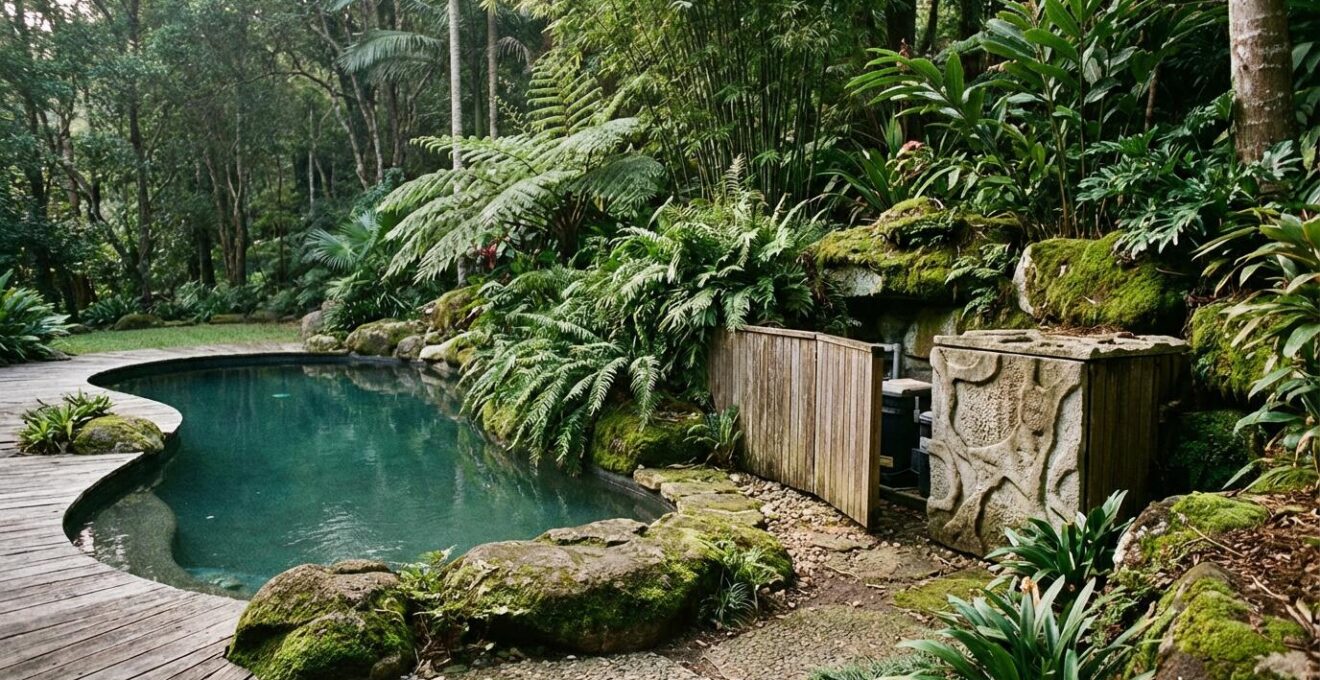
The secret to a truly natural-looking pool is not just hiding the equipment, but dissolving it into a living, multi-sensory ecosystem that blurs the line between the man-made and the wild.
- Effective design uses a “living buffer zone” of carefully selected plants and materials to integrate, not just conceal, technology.
- Layering textures, scents, and sounds creates an immersive experience that directs attention away from functional elements.
Recommendation: Instead of adding landscaping as an afterthought, plan your biophilic transition from the outset, treating your pool and its surroundings as one cohesive, engineered ecology.
The dream is a serene, natural pond shimmering in your garden—a private oasis that feels like a secret discovery. The reality often involves the relentless hum of a pump, the stark white of a filter, and a tangle of pipes that shatter the illusion. For nature lovers, this disconnect between the wild aesthetic they crave and the functional hardware a pool requires can be a constant source of frustration. The common advice is to put up a fence or plant a few generic shrubs, effectively putting the problem in a box but failing to solve the core issue.
The surge in creating personal retreats is real; industry data reveals that new pool construction went up nearly 25% in 2020 over 2019 levels, intensifying the need for more thoughtful design. But what if the solution wasn’t to simply hide the hardware, but to make it disappear into the landscape? This is the essence of a biophilic transition. It’s an approach that moves beyond simple concealment and into the realm of clever, organic integration. The goal is to create a “living buffer zone”—a multi-sensory, functional ecosystem that works in harmony with the pool’s technology.
This guide abandons the idea of brute-force screening. Instead, it offers a designer’s perspective on how to weave technology into a natural tapestry. We will explore the science of plant selection for harsh pool environments, the art of sensory layering to guide the experience, and the strategic choices that make your pool’s edge dissolve seamlessly into a thriving garden, all while ensuring every piece of vital equipment remains accessible.
This article provides a complete roadmap for designing this seamless integration. You will discover the practical strategies and clever tricks to transform your pool’s surroundings from a utility area into an integral part of your garden sanctuary.
Summary: The Art of the Biophilic Transition: Hiding Pool Equipment Without Sacrificing Access or Aesthetics
- Why some tropical plants die instantly when placed near saltwater pools?
- How to layer scents and textures to enhance the swimming experience?
- Natural Edge or Coping: Which Border Style Fits a Wild Garden Aesthetic?
- The “innocent” tree species that will crack your pool shell in 5 years
- When to plant privacy hedges to ensure screening by the first swim season?
- How to Block the Neighbor’s View of Your Pool Immediately?
- How to Cultivate a Lush Garden That Survives Pool Splash and Humidity?
- Why Switch to Eco-Friendly Water Treatment if Your Chlorine Pool Seems Fine?
Why some tropical plants die instantly when placed near saltwater pools?
The tragic sight of a lush palm or vibrant hibiscus withering days after being placed by a new saltwater pool is a common and costly mistake. The culprit isn’t just the occasional splash; it’s the invisible assault of salt aerosol and chlorine vapor. Saltwater pools, through evaporation and the agitation of swimmers, release a fine mist of saline water. This mist settles on leaves, causing osmotic stress—the salt literally pulls moisture out of the plant’s cells, leading to dehydration, brown edges, and leaf drop. For many tropical plants not adapted to coastal conditions, this is a fatal environment.
Similarly, both chlorine and saltwater systems release sanitizing chemicals into the air that can scorch sensitive foliage. The solution lies in creating an “ecological gradient” around the pool. This means selecting plants based on their tolerance and placing them in appropriate zones. The most successful biophilic designs use hyper-tolerant native species right at the water’s edge. As one Florida-based landscaping case study shows, using native plants like Coontie Palms and Blue Daze directly in the splash zone works because they are naturally resilient to salt and require minimal care. Further back, you can introduce slightly less tolerant species, creating a layered, resilient garden.
Even with tolerant species, proper acclimation is key. You can’t take a plant from a sheltered nursery and expect it to thrive in the harsh, full-sun, chemical-adjacent environment of a poolside. They need to be “hardened off” to their new reality.
Action Plan: Hardening Off Tropical Plants for Poolside Placement
- Begin Acclimation: Start the process at least 4 weeks before you plan to permanently place the plants near the pool.
- Gradual Sun Exposure: Begin by moving the plants into an area with increased sunlight for just 2-3 hours per day, gradually increasing the duration.
- Introduce Pool Conditions: Place the plants in their final poolside location for 1-2 hours per day, then return them to a more sheltered spot.
- Monitor for Stress: Carefully check for signs of salt or chlorine burn, such as yellowing leaves or browning edges, and reduce exposure if necessary.
- Increase Exposure Time: Lengthen the poolside exposure by about 30 minutes each day until the plants can comfortably withstand the conditions for a full day.
- Flush the Soil: After each exposure session, provide a deep watering to the plant’s soil to help flush out any accumulated salts from the root zone.
How to layer scents and textures to enhance the swimming experience?
A truly biophilic design engages all the senses. The goal is to create such a rich sensory tapestry that the functional, man-made elements of the pool simply fade into the background. This is “sensory weaving”—the intentional layering of scents, textures, and even sounds to create an immersive, naturalistic experience. It transforms the act of swimming from a simple activity into a journey through a living garden. The rustle of ornamental grasses in the breeze can be just as important as the color of a flower.
As landscape professionals at Heyden’s Gardens point out, the auditory dimension is often overlooked. They note that the right plants can add a subtle, natural soundtrack to the poolside environment:
Many plants will produce pleasant sounds when their seed heads or foliage rustle in the breeze.
– Heyden’s Gardens, Creating Sensory Gardens for All Ages
Texture is the next layer. The transition from a soft, springy lawn to a pathway of smooth, cool river stones, and then to the warm, fine-grained texture of a wooden deck creates a tactile narrative. This pathway guides the body and mind, creating a deliberate transition into the water. This photo shows how varied ground textures create a rich, sensory pathway leading to the water’s edge, making the journey to the pool as pleasant as the swim itself.
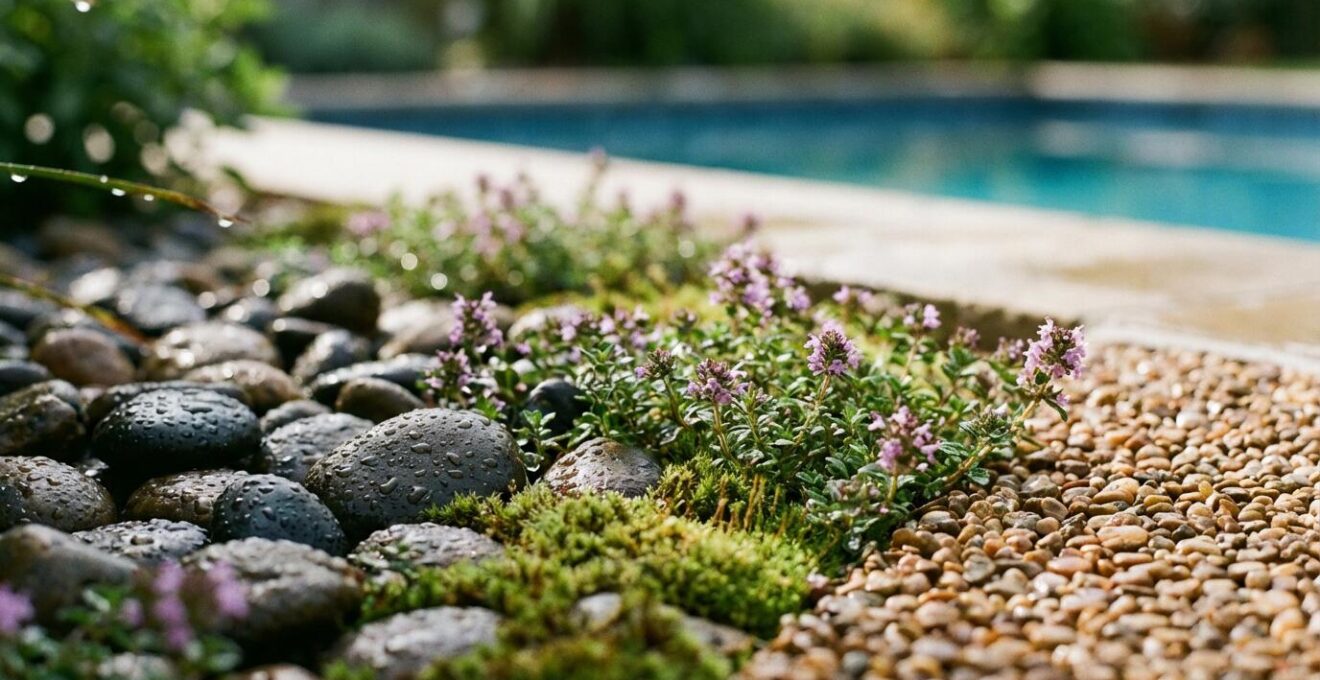
As you can see, the interplay of soft moss, smooth pebbles, and rugged stone offers a feast for the feet and eyes, turning a simple walkway into an experience. The final, most evocative layer is scent. The key is to orchestrate a “time-release” fragrance experience throughout the day, ensuring the air is always filled with a pleasant, natural aroma that masks any chemical smells.
This requires a careful choreography of plants that release their scent at different times of the day, a strategy detailed in sensory garden design principles from Penn State Extension. The table below offers a blueprint for this aromatic journey.
| Time of Day | Plant | Fragrance Type | Pool Placement |
|---|---|---|---|
| Morning (6am-10am) | Citrus Trees | Fresh, zesty | 15ft from pool edge |
| Midday (10am-4pm) | Lavender | Herbaceous, calming | Pool deck containers |
| Evening (4pm-8pm) | Gardenia | Sweet, heady | Seating areas |
| Night (8pm-12am) | Night-blooming Jasmine | Intense, exotic | Near pool lighting |
Natural Edge or Coping: Which Border Style Fits a Wild Garden Aesthetic?
The edge of the pool is the most critical boundary between the man-made and the natural. It’s the line that your design must either celebrate or dissolve. Traditional pool coping creates a hard, defined, and often artificial border. It clearly states: “Here the structure ends, and here nature begins.” For a formal or modern design, this clarity is desirable. But for a nature lover seeking a wild, pond-like aesthetic, this hard line is the primary obstacle to achieving an integrated look. It works against the very illusion you are trying to create.
A natural edge, by contrast, is designed to blur this boundary. Instead of a raised, uniform material, it uses carefully placed, irregular natural stones, boulders, or even cantilevered decking that extends slightly over the water. This technique is fundamental to the “living buffer zone” concept. It creates pockets and crevices where marginal plants, like creeping Jenny or water mint, can be planted to spill over the edge and touch the water. This softening of the border is the single most effective strategy for making a pool feel like a natural body of water.
The choice is a philosophical one. Coping contains the water; a natural edge invites the garden in. While coping is often easier to install and maintain, a natural edge is the true signature of a biophilic design. It allows the surrounding textures of your garden—the moss between stones, the delicate ferns, the soft grasses—to creep right up to the water’s surface. This creates a powerful visual effect where the pool no longer feels like an object placed *in* the landscape, but an element that has emerged *from* it. It’s an alchemical trick of design that turns a swimming pool into a swimmable lagoon.
The “innocent” tree species that will crack your pool shell in 5 years
In the quest for a lush, mature-looking garden, the temptation to plant fast-growing trees near the pool is immense. They promise quick shade and an instant sense of establishment. However, some of these seemingly innocent species are ticking time bombs for your pool’s structure. Their aggressive, water-seeking root systems can travel far and wide, and when they meet the unyielding barrier of a pool shell, they don’t simply turn away. They push, expand, and eventually exert enough hydrostatic pressure to crack concrete, tear liners, and heave decking.
The primary culprits are trees with shallow, fibrous, and invasive root systems. Species to be extremely wary of include:
- Weeping Willow (Salix babylonica): A classic water-lover whose roots will aggressively seek out any moisture source, including the soil around your pool, which is often damp from splash-out.
- Silver Maple (Acer saccharinum): Notorious for its fast growth and dense, shallow roots that are known to break up sidewalks and, by extension, pool decks and shells.
- Poplar species (Populus): These trees, including Lombardy and Cottonwood, grow incredibly fast but have notoriously weak wood and invasive root systems that are a known liability near any structure.
This is a classic failure of “engineered ecology”—planting without considering the long-term dynamic between the living element and the built one. The problem isn’t the tree; it’s the placement. A successful biophilic design requires foresight. Instead of these high-risk species, opt for trees with deep, non-invasive taproots or smaller, ornamental varieties with more contained root balls. Japanese Maples, certain Dogwoods, or large shrubs trained into tree forms (like Crape Myrtle) offer beauty without the structural threat. Always research a tree’s mature root system, not just its mature height, before planting it anywhere within 20-30 feet of a pool.
When to plant privacy hedges to ensure screening by the first swim season?
The dream of a private poolside sanctuary can be quickly dashed by the reality of a neighbor’s second-story window. While a lush, living wall of green is the ultimate biophilic solution, it’s not an instant one. Achieving effective screening by your first swim season requires a strategic understanding of plant growth rates and a bit of planning. The key is to work backward from your desired outcome. Don’t just ask “What should I plant?” but rather “How tall does it need to be, and how fast can it get there?”
First, determine the exact sightline you need to block. Have a person stand at the vantage point you want to screen (e.g., the neighbor’s deck) while another person at the pool uses a pole or ladder to measure the required height for a complete visual block. This gives you your target height. Next, research your chosen hedge plants to find their average annual growth rate in your climate. A simple formula can give you a realistic timeline: (Target Height – Starting Height) / Annual Growth Rate = Years to Privacy.
For first-season privacy, you have two main options:
- Invest in Maturity: Purchase larger, more mature plants from the nursery. A 6-foot tall Arborvitae will provide significant screening immediately, whereas a 2-foot starter plant will take several years to do the same job. This is the most direct but also the most expensive route.
- Choose a Sprinter: Opt for a very fast-growing species. Ligustrum (Wax-Leaf Privet) or certain varieties of Bamboo (with a root barrier!) can add several feet in a single season. The trade-off is that these “sprinters” often require more frequent trimming and maintenance to keep them in check once they reach the desired height.
The best strategy is often a hybrid one. Plant your main, long-term hedge with specimens that are as mature as your budget allows, and fill in any gaps with fast-growing annual vines on a temporary trellis for immediate, first-season cover while the permanent hedge establishes itself.
How to Block the Neighbor’s View of Your Pool Immediately?
While a mature hedge is the ideal biophilic privacy screen, it’s a solution measured in seasons, not days. When you need to block a neighbor’s view *immediately*, you must turn to “hard” or structural solutions. The clever designer’s approach is not to see these structures as a compromise, but as a “scaffold” for future greenery. You are creating the bones that the living garden will eventually flesh out, providing instant privacy while the slower, softer elements grow in.
The most effective immediate solutions involve vertical structures that can be integrated into the landscape design:
- Strategic Screen Panels: Rather than a solid, monolithic fence, use decorative screen panels made of wood, composite, or laser-cut metal. Placed strategically, a few 6×6 foot panels can block a specific window or a view from a deck without creating a “fortress” feeling. These panels become a perfect trellis for climbing vines like clematis or jasmine, softening their appearance over time.
- Pergolas and Arbors: A pergola built over a seating area or a section of the pool deck doesn’t just provide shade; it creates a “ceiling” that blocks overhead views from second-story windows. You can hang outdoor curtains for instant, adjustable privacy or grow fast-growing annual vines like morning glory for quick first-season cover.
- Layered Planter Boxes: Create a tiered wall of large, tall planter boxes. The boxes themselves create an immediate barrier of 2-3 feet, and when planted with tall, dense ornamental grasses, clumping bamboo, or even seasonal corn stalks, they can easily add another 4-6 feet of screening in the first year.
The principle of functional integration is key. The privacy structure shouldn’t just be a wall; it should serve another purpose. A screen can become a backdrop for a water feature, a pergola defines an outdoor room, and a planter wall becomes a vertical garden. By thinking this way, the “immediate” solution doesn’t feel like a temporary fix but a foundational element of your evolving biophilic design.
How to Cultivate a Lush Garden That Survives Pool Splash and Humidity?
Creating a thriving garden right at the pool’s edge is about more than just picking salt-tolerant plants; it’s about understanding and designing for the unique microclimates your pool creates. The area immediately surrounding a pool is a challenging environment. It’s a zone of high humidity from evaporation, intense reflected heat from the water and decking, and intermittent chemical splashes. A successful poolside garden works *with* these conditions by embracing the concept of an “ecological gradient.”
Think of your pool’s edge as a coastline in miniature, with distinct zones that support different types of life.
- The Splash Zone (0-3 feet): This is the most hostile territory, receiving direct splashes of chlorinated or salted water. It’s the domain of the toughest plants. Look for species with waxy or leathery leaves that repel water, such as Cast Iron Plant (Aspidistra elatior), or succulents like Agave and Sedum that are naturally adapted to arid, salty conditions.
- The Humidity Zone (3-8 feet): This area doesn’t get direct splashes but is constantly bathed in high humidity. This is where you can have success with lush, tropical-looking plants that love moisture in the air but not necessarily at their roots. Ferns (like the resilient Ostrich Fern), Hostas, and Elephant Ears (Colocasia) can thrive here, provided the soil has good drainage.
- The Borderland (8+ feet): Beyond the immediate influence of the pool’s humidity, conditions begin to normalize with the rest of your garden. This is the transition zone where you can plant a wider variety of perennials, shrubs, and small trees that tie the poolside landscape into the larger garden design.
By planting in these zones, you’re not fighting against the environment; you’re collaborating with it. You’re creating a resilient, layered ecosystem where each plant is positioned to thrive. This approach reduces plant loss, minimizes maintenance, and results in a far more lush and natural-looking landscape that appears effortless because it is ecologically sound.
Key Takeaways
- A successful biophilic pool design integrates technology into the landscape rather than simply hiding it.
- Creating a multi-sensory experience with layered textures, scents, and sounds is crucial for dissolving the boundary between the artificial and natural.
- The most resilient poolside gardens are designed as “engineered ecologies,” using a zoned approach based on plant tolerance to splash, humidity, and sun.
Why Switch to Eco-Friendly Water Treatment if Your Chlorine Pool Seems Fine?
For many, a standard chlorine or salt-chlorine generator system seems perfectly adequate. The water is clear, it’s sanitized, and the technology is familiar. So why would a nature lover consider switching to an eco-friendlier system like UV, ozone, or a natural swimming pool? The answer lies at the very edge of the water. A conventional pool, no matter how beautifully landscaped, creates a hostile border. The chemical-laden water fundamentally limits the possibility of a truly seamless, living transition between water and garden.
Chlorine and high concentrations of salt are biocides. Their job is to kill living organisms, and they don’t distinguish between harmful bacteria in the water and the delicate roots of a marginal plant at the edge. This is why traditional pools require hard coping and a “dead zone” of several feet before a garden can begin to thrive. You are forced to build a wall between the sterile water and the living land. An eco-friendly system changes this entire dynamic. Systems that use UV light or ozone as the primary sanitizer drastically reduce the need for chlorine, often using only a tiny residual amount, similar to tap water.
This creates a welcoming border. The water is no longer toxic to plant life. This is what makes a true natural edge possible, where plants can grow right to the water’s surface, dip their roots in, and complete the illusion of a natural pond. It allows for a genuine “living buffer zone” that filters runoff and provides habitat. Switching is not just about reducing chemicals for the swimmer’s benefit; it’s a philosophical choice. It’s the decision to prioritize the health of the entire poolside ecosystem over the conventional approach to sanitation. It’s the final, crucial step in dissolving the barrier between your pool and the natural world, allowing them to become one unified, thriving environment.
By embracing these principles of integrated design, you can finally achieve the dream: a stunning, functional pool that feels less like a machine for swimming and more like a living, breathing part of your personal garden oasis. The next logical step is to begin sketching out your own living buffer zone.