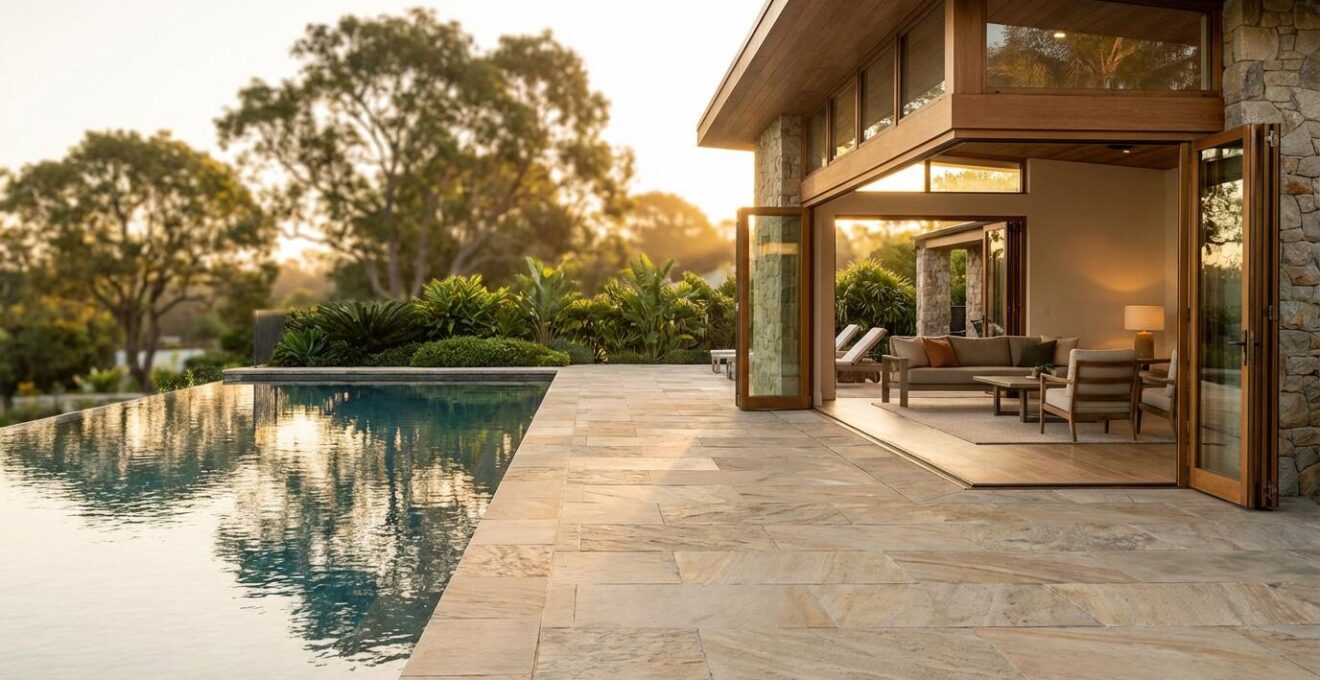
Designing a true pool house isn’t about adding amenities; it’s about architecting a seamless lifestyle extension of your main home.
- Prioritize the intentional flow between wet/dry and public/private zones to enhance both safety and luxury.
- Achieve architectural cohesion through material echoing and sightlines, not just matching paint.
Recommendation: Focus on creating ‘transformational spaces’ with smart glazing and systems that adapt from a private retreat to an entertainment hub.
For many families, the idea of a pool house evokes images of a simple changing cabana and a place to store floats. But what if it could be more? The shift towards holistic outdoor living has elevated the humble pool house into a potential second home—a fully equipped, architecturally significant space that extends your lifestyle right to the water’s edge. This isn’t just about adding a kitchenette or a bathroom; it’s about a fundamental rethinking of the space as a destination in its own right.
The common advice to use durable materials and match your home’s paint is just the starting point. The real challenge, and the greatest opportunity, lies in crafting a seamless transition between your primary residence and this new hub of relaxation and entertainment. The key is to stop thinking of it as an accessory and start designing it with the same intentionality as your main house. This means architecting for the flow of life—from wet to dry, private to public—and creating a space that is as functional as it is beautiful.
This guide moves beyond the basics to explore the core architectural principles that transform a poolside structure into a true second home. We will delve into strategic zone planning for safety, visual continuity for seamless transitions, and the smart technologies that make year-round enjoyment possible. Prepare to see your backyard in a new light.
Contents: Designing Your Pool House as a Second Home
- Why separating the changing room from the kitchenette prevents slip accidents?
- How to choose flooring that connects the living room to the pool deck visually?
- Bi-fold or Sliding Doors: Which Glazing Maximizes the Open-Air Feel?
- The humidity mistake that causes mold in your pool house furniture
- When to open the pool house to transform the garden into a reception hall?
- How to Achieve Architectural Harmony Between Your Home and Pool Without Major Renovations?
- How to Eliminate Trip Hazards Between the Coping and Decking?
- How to Manage Your Pool Chemistry from Your Office Desk?
Why separating the changing room from the kitchenette prevents slip accidents?
The most fundamental principle in designing a functional pool house is the concept of “lifestyle zoning.” This goes far beyond a simple wet/dry division; it’s about creating dedicated zones for distinct activities to ensure safety, comfort, and utility. The primary reason to separate the changing room from the kitchenette is to mitigate the single greatest hazard in a poolside environment: slips and falls on wet surfaces. Dripping bodies and wet feet should never mix with the primary circulation paths of the living and cooking areas. According to some analyses, more than 40 people die by drowning every hour globally, often after slipping on wet floors near water.
By creating a dedicated “wet zone” that serves as an antechamber for changing and showering, you contain water at its source. This area should have its own direct access from the pool deck, feature highly slip-resistant flooring, and be equipped with robust ventilation. The kitchenette, bar, and living areas form the “dry zone,” which should remain a sanctuary from puddles and moisture. This separation isn’t just a safety feature; it’s a statement of luxury. It allows for the use of more comfortable and aesthetically pleasing finishes in the main living space without the constant worry of water damage or accidents, truly allowing the space to function as a second home.
Action Plan: Implementing Wet and Dry Zone Separation
- Zoning Layout: Designate a clear “wet” changing/showering area with direct pool access, physically separated from the “dry” living/kitchenette zone.
- Material Boundaries: Use distinct, high-traction flooring like textured flagstone or rubberized mats in the wet zone, visually and tactilely separating it from the main living area flooring.
- Physical Barriers: Create a subtle physical separation, such as a single step down into the changing area or a raised threshold, to contain water.
- Targeted Ventilation: Install a high-capacity exhaust fan specifically within the changing room to manage humidity at its source, independent of the main living space’s climate control.
- Transition Points: Place rubberized mesh mats or teak slats at the doorway between the wet and dry zones to capture excess water from feet and swimwear.
How to choose flooring that connects the living room to the pool deck visually?
Creating a “seamless threshold” is the secret to making a pool house feel like a natural, open-air extension of the garden rather than a separate building. Flooring is the single most important element in achieving this visual flow. The goal is to select materials that can either be used continuously from the interior living space to the exterior pool deck or have such closely matched outdoor-rated counterparts that the transition is virtually invisible. This technique tricks the eye into seeing one large, unified space, especially when the doors are open, dramatically increasing the perceived size and luxury of your outdoor living area.
Porcelain tiles are a popular and effective choice, as many manufacturers offer the same design in both a smooth, honed finish for indoors and a high-traction, textured finish for outdoors. This allows for perfect color and pattern continuity. Natural stone like travertine or limestone can be treated similarly, with a polished interior finish and a flamed or bush-hammered exterior finish for grip. Even concrete can be poured and stained to create a consistent look. As an example of high-end execution, Studio McGee’s acclaimed pool house project used luxury vinyl plank flooring indoors to achieve an elevated aesthetic, paired with exterior materials and lighting that maintained a consistent visual language, effectively blurring the indoor-outdoor line.
To make an informed decision, it’s crucial to compare the properties of each material. This analysis, based on common industry data, highlights the key factors for achieving that coveted indoor-outdoor connection, as detailed in a comparative analysis of pool-safe flooring.
| Flooring Type | Indoor Finish | Outdoor Finish | Slip Resistance (COF) | Visual Continuity |
|---|---|---|---|---|
| Porcelain Tiles | Honed/Natural | Textured/Grip | 0.60+ wet | Excellent – same series |
| Natural Stone | Polished | Flamed/Bush-hammered | 0.55+ wet | Very Good |
| Concrete | Smooth sealed | Aggregate exposed | 0.50+ wet | Good with staining |
| Wood/Composite | Hardwood planks | Composite decking | 0.45+ wet | Moderate – similar grain |
Bi-fold or Sliding Doors: Which Glazing Maximizes the Open-Air Feel?
The choice of glazing is the defining architectural gesture of a pool house. It dictates the relationship between the interior and the exterior and is the primary tool for achieving a true “open-air” feeling. While both bi-fold and sliding doors can create large openings, they offer fundamentally different experiences. Sliding doors, especially pocket versions that disappear completely into the walls, offer the ultimate in clean lines and unobstructed views when closed. They create a “picture frame” effect, beautifully framing the landscape.
However, for maximizing the sensation of a completely open, wall-less structure, bi-fold doors are unparalleled. When fully retracted, they accordion-stack to one or both sides, capable of opening up nearly 90% of the wall’s width. This act of “removing the wall” completely dissolves the barrier between the living room and the pool deck, creating a single, expansive entertainment space. This is the essence of transformational design—the ability to fundamentally change the nature of the space with a single action.
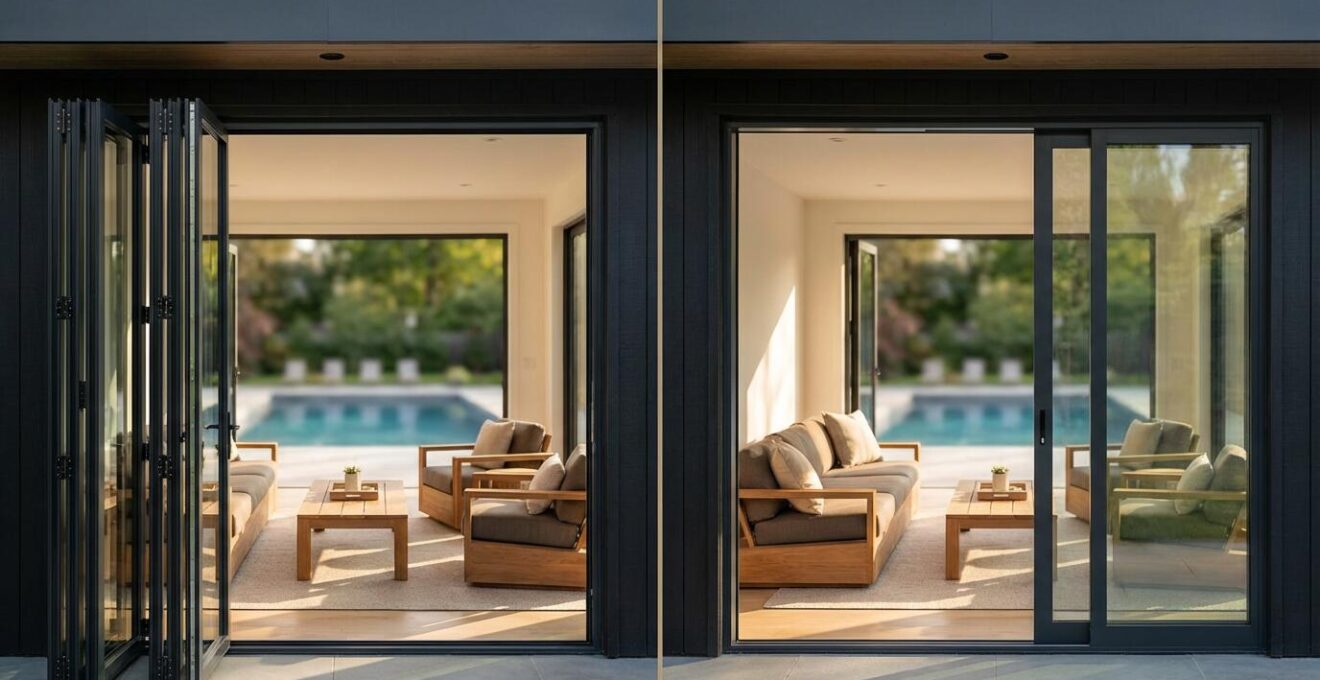
The visual above perfectly contrasts the two experiences. On one side, the sliding doors offer a sleek, modern, and wide-open view. On the other, the bi-fold system demonstrates its ability to completely erase the boundary. The decision often comes down to the desired aesthetic: the seamless elegance of a hidden slider versus the dramatic, transformative effect of a fully opened bi-fold wall. As one designer noted in a high-profile project, the choice is integral to the overall concept.
We opted for NanaWall bifold doors as concrete flooring extends indoors, with Summer Classics’ Monaco chaises imparting resort style
– Amanda Orr, LUXE Interiors + Design Magazine
The humidity mistake that causes mold in your pool house furniture
The most insidious threat to the longevity and luxury of your pool house is not foot traffic or sun exposure, but something invisible: humidity. The single biggest mistake homeowners make is failing to implement a dedicated environmental control system. A pool house is a uniquely challenging environment, constantly battling high humidity from wet swimmers, evaporation from the pool, and temperature fluctuations. Simply opening a window is not a solution; it’s an invitation for problems. Without active management, ambient humidity will settle into furniture, textiles, and wood, creating a perfect breeding ground for mold and mildew.
This is what turns a beautiful second home into a musty shed. The solution is to treat the pool house’s HVAC and dehumidification with the same seriousness as your main home. A dedicated, whole-home style dehumidifier with a humidistat is not a luxury—it is essential. Experts recommend maintaining a consistent relative humidity to prevent mold growth and protect your investment in high-quality furnishings. This proactive approach to air quality is what separates a mere cabana from a true residential structure.
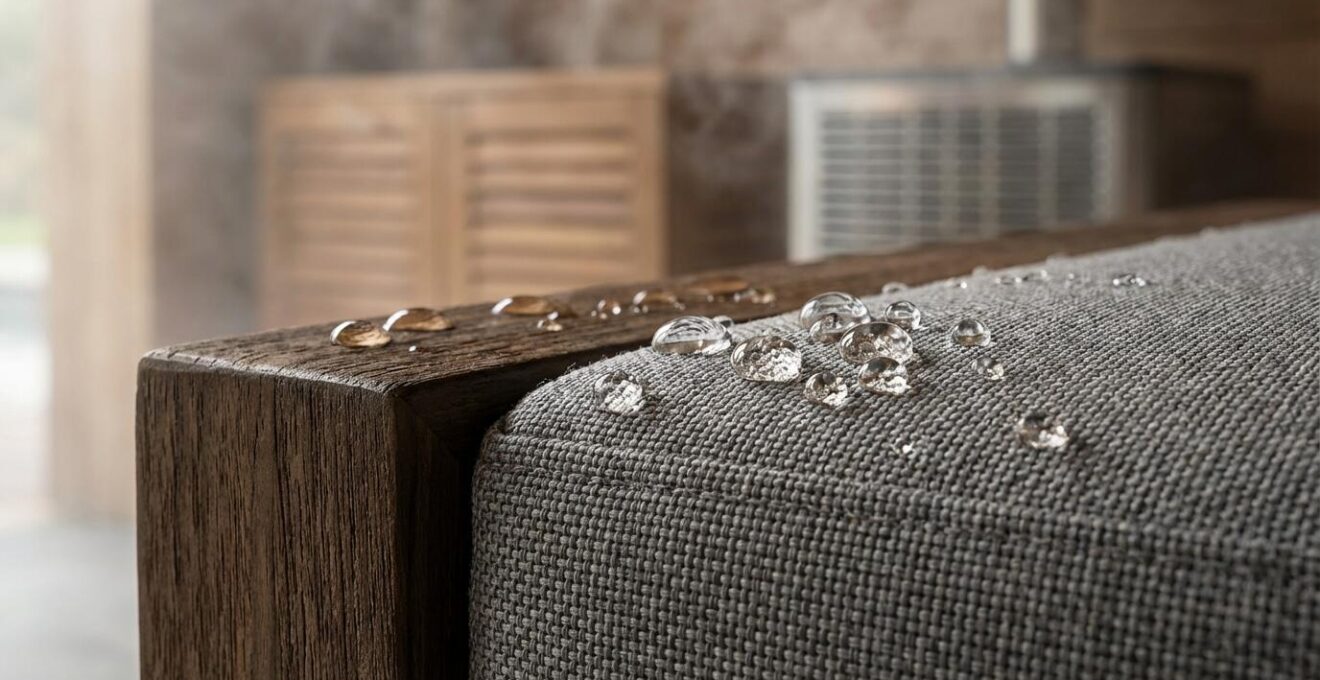
Beyond the mechanical systems, your choice of materials plays a crucial role in this battle. You must design for resilience. Select high-performance fabrics specifically treated for mold and mildew resistance. Opt for solid wood furniture made from naturally resilient species like teak or ipe, which can withstand moisture better than veneered or particle board pieces. Combining smart material choices with active climate control creates a robust defense against the damaging effects of humidity.
- Install a dedicated whole-home dehumidifier with humidistat control.
- Select performance fabrics treated for mold and mildew resistance (e.g., Sunbrella).
- Choose solid wood furniture (teak, ipe) over veneered pieces.
- Install louvered cabinet doors for air circulation.
- Add low-wattage dehumidifier rods in closed storage spaces.
- Use powder-coated metal or marine-grade stainless steel for frames.
When to open the pool house to transform the garden into a reception hall?
A masterfully designed pool house possesses a “transformational” quality—the ability to shift its purpose from a private family space to a grand public venue. The key to this transformation isn’t just about having the right features, but about understanding the timing and sequence of events that turn your garden into an elegant reception hall. The pivotal moment is often sunset. This is when the dynamic between the indoor and outdoor spaces dramatically reverses. During the day, the focus is on the sun and the pool; as evening falls, the pool house itself becomes the glowing heart of the event.
As the sun sets, interior lighting takes over, turning the pool house into a warm, inviting lantern that draws guests in. This is the moment to fully open the bi-fold or sliding doors, physically and psychologically merging the interior lounge with the exterior deck and lawn. One case study highlighted a design where Marvin sliding doors opened completely, allowing modular sofas to be reconfigured for guest flow, turning the space from a daytime lounge into an evening party hub with the press of a button on a smart home system. The transformation is an orchestrated event, a piece of theater that elevates the hosting experience.
To execute this flawlessly, a clear timeline is essential. The transition from a casual poolside afternoon to a sophisticated evening reception requires deliberate action.
- 4:00 PM: Clear everyday items (pool toys, towels) to designated, hidden storage areas.
- 5:00 PM: Reconfigure modular furniture to optimize for guest circulation and conversation zones.
- 5:30 PM: Set up the kitchen island or a dedicated bar as the central serving station with glassware and refreshments.
- 6:00 PM (or as guests arrive): Open all bi-fold or sliding doors completely to create the seamless indoor-outdoor space.
- 6:30 PM (at sunset): Activate your pre-programmed “Party Scene” lighting, which should include landscape lighting to define the garden space.
- 7:00 PM: Turn on the integrated outdoor audio system to a level that creates ambiance without overwhelming conversation.
How to Achieve Architectural Harmony Between Your Home and Pool Without Major Renovations?
The ultimate sign of a well-conceived pool house is when it feels like it has always been there, a natural and integral part of the main property. This sense of “architectural cohesion” is crucial for elevating the pool house from an outbuilding to a true part of the home estate. While a full-scale architectural match can be complex, you can achieve a powerful sense of harmony without major renovations by focusing on the principle of “material echoing.” This involves identifying 2-3 key materials, colors, or forms from your main house and thoughtfully repeating them in the pool house design.
This doesn’t mean you have to build a miniature replica of your home. Instead, it’s about creating a visual dialogue. If your main house features a prominent stone fireplace, use that same stone for a feature wall or the base of the pool house bar. If your home has distinctive dark bronze window frames, using the same color and style on the pool house windows and doors will create an instant, powerful connection. The goal, as one builder noted, is to create an illusion of history and permanence: “The homeowners’ wish was to make it appear as if the addition had always been a part of the existing home.” This is achieved through these subtle but deliberate echoes.
You can create this visual link through several targeted, high-impact techniques that don’t require restructuring your main home. Success lies in consistency.
- Match the trim colors between the pool house and the main home’s window and door frames.
- Use the identical roofing material (shingles, metal, or tiles) on both structures.
- Repeat a key stone or brick element from the main house’s facade or chimney on the pool house.
- Install exterior lighting fixtures (sconces, path lights) from the same design family on both buildings.
- Create a continuous pathway from the main house to the pool house using the same pavers or stone.
- Plant a consistent variety of hedges or specimen trees to act as a visual connector between the two zones.
How to Eliminate Trip Hazards Between the Coping and Decking?
While grand architectural concepts are vital, the functionality of a second home also lies in the meticulous handling of details, especially those related to safety. A primary point of failure in many pool installations is the transition between the pool coping (the edge stone or tile) and the surrounding deck. Even a slight height difference, caused by settling over time, creates a significant trip hazard. Eliminating this risk is paramount in a space designed for relaxation and family life. The goal is to create a perfectly flush, zero-threshold transition where the deck flows uninterrupted to the water’s edge.
This requires a combination of modern materials and proper construction techniques. The use of large-format porcelain pavers or cantilevered decking, where the deck material extends slightly over the pool shell, can create a visually seamless and physically safe edge. However, the success of this depends entirely on the stability of the sub-base and the slip resistance of the material itself. Safety is not optional; in fact, The 2024 International Swimming Pool & Spa Code mandates a Minimum Dynamic Coefficient of Friction of 0.55 for outdoor pool decks to prevent slips. Choosing materials that meet or exceed this standard is a non-negotiable starting point.
Successful real-world implementations, such as those guided by stringent regulations like the Florida building code, demonstrate that a zero-threshold design is achievable and durable. Projects that use large-format pavers installed over a properly compacted sub-base have shown minimal differential settling over many years, effectively engineering the trip hazard out of existence. This attention to detail at the micro-level is what supports the macro-level vision of a safe, luxurious, and truly functional second home.
Key Takeaways
- Lifestyle Zoning is Paramount: A successful pool house is not an open-plan shed; it’s a home with intentionally separated zones for wet changing, dry living, and active cooking to maximize safety and comfort.
- Design for Seamless Thresholds: The true feeling of luxury comes from erasing the boundary between inside and out. Use continuous flooring and expansive glazing to create one unified, expansive living space.
- Embrace Transformational Design: A great pool house adapts on demand. Plan for its dual purpose as a private family retreat and a public entertainment venue through modular furniture, smart lighting, and fully opening doors.
How to Manage Your Pool Chemistry from Your Office Desk?
The final pillar in elevating a pool house to a second home is embracing automation. The luxury of a second home is the promise of relaxation, not a second job. A sparkling, perfectly balanced pool is central to this experience, but traditional pool maintenance is a constant, time-consuming chore. Modern smart automation systems completely transform this dynamic, allowing you to monitor and manage every aspect of your pool—from chemistry and temperature to pumps and lighting—from an app on your phone, whether you’re at your office desk or on vacation.
These integrated systems use sensors to provide real-time data on pH and sanitizer levels, and can automatically activate chemical feeders to dose the pool with precisely what it needs, when it needs it. This not only ensures a healthier and more comfortable swimming environment but also prevents the common problems of over-chlorination or algae blooms that can arise from manual, intermittent testing. It’s the ultimate expression of a “lock-and-leave” lifestyle, ensuring your waterside retreat is always perfectly prepared for your arrival. Several leading systems offer comprehensive control, turning pool management into a task that takes seconds, not hours.
The market for pool automation is robust, with several key players offering systems that integrate seamlessly with your smart home. This comparison, based on data from industry experts like those at Pleasant Run Structures, outlines the features of the leading options.
| System | Features | Remote Control | Price Range | Integration |
|---|---|---|---|---|
| Hayward OmniLogic | Chemistry, pump, heater, lights | Full app control | $2,500-$4,000 | Alexa, Google Home |
| Pentair IntelliCenter | All equipment + water features | Web & mobile app | $2,000-$3,500 | Smart home systems |
| Jandy iAquaLink | Complete pool/spa control | iOS/Android apps | $1,800-$3,000 | Voice assistants |
Setting up such a system involves a series of technical steps that bridge the physical pool equipment with the digital interface, but the result is total control and peace of mind. This is how you ensure your second home truly serves your lifestyle, not the other way around.
By moving beyond the concept of a simple cabana and embracing these principles of lifestyle zoning, architectural cohesion, and smart automation, you can create a pool house that is not just an accessory, but a vital and fully-realized second home. Begin today to envision the seamless lifestyle that awaits at your own water’s edge.