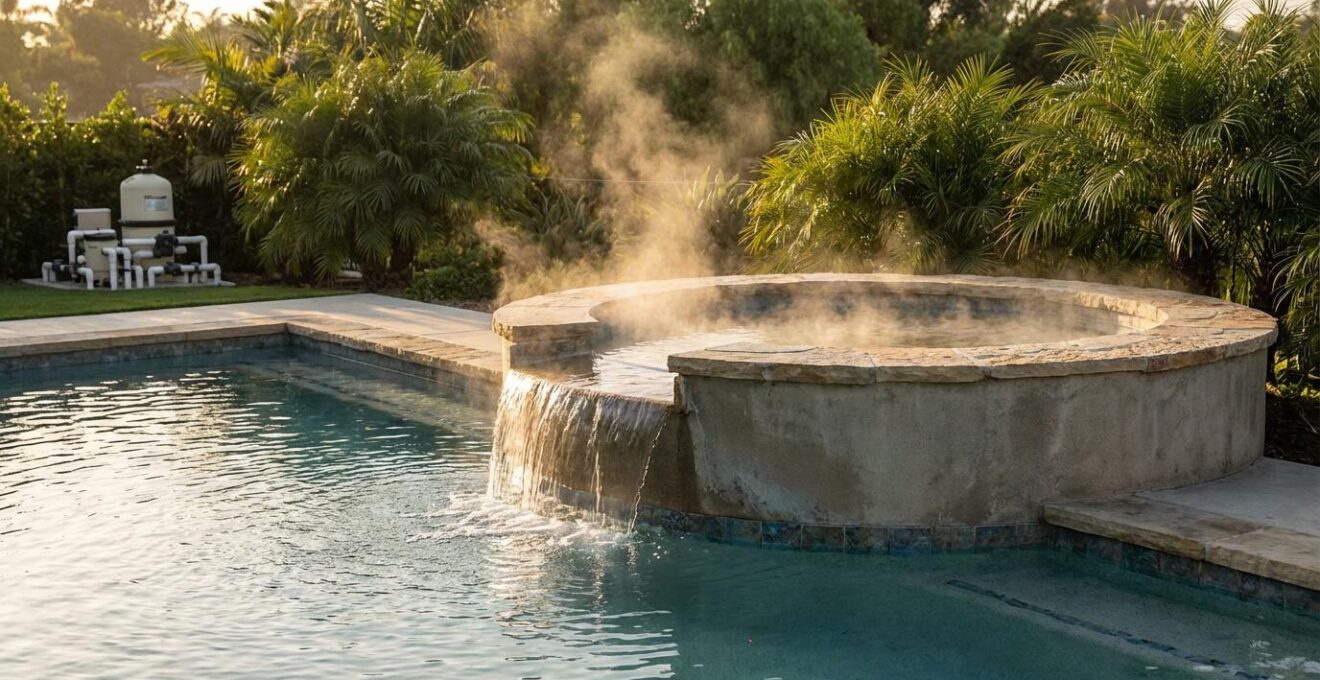
Maintaining a 12°C temperature difference between a pool and a conjoined spa isn’t magic; it’s a matter of mastering hydraulic isolation and thermal management.
- Effective heating relies on creating a dedicated, isolated water circuit for the spa using motorized valve actuators.
- Heat loss through spillover effects (“thermal bridging”) and faulty check valves are the primary reasons a spa fails to maintain temperature.
Recommendation: Shift focus from the heater’s raw power to the efficiency of the entire hydraulic system, particularly valve operation and pump speed settings, to achieve consistent dual-zone temperatures.
For many pool owners, the promise of a combined pool and spa system is the best of both worlds: a refreshing 26°C pool for daytime fun and a therapeutic 38°C spa for evening relaxation. Yet, the reality is often a frustrating battle against physics, where the spa struggles to get hot or mysteriously loses its heat overnight. The common advice to simply “use spa mode” overlooks the complex engineering required to maintain such a significant temperature differential within a single body of water.
The core challenge is not merely about heating water, but about controlling where heat goes and preventing it from escaping. This involves a precise dance of hydraulics and thermodynamics. The system must be able to completely isolate the spa’s smaller volume of water, heat it rapidly, and then hold that temperature against constant thermal pressures. Factors like the design of a raised versus level spa, the integrity of a small component like a check valve, and the programming of water flow all play a more significant role than the heater’s maximum BTU rating alone.
This article moves beyond the control panel buttons to demystify the underlying principles. We will dissect the hydraulic and thermodynamic logic that governs dual-temperature systems. By understanding how valve actuators create hydraulic isolation, why spillovers are a significant source of heat loss, and how modern pumps and heaters work in tandem, you can diagnose inefficiencies and truly master your backyard oasis.
To fully grasp how to achieve and maintain this temperature separation, we will explore the critical mechanical and physical processes involved. The following sections break down each component of the system, from the sources of heat loss to the hardware that makes dual-zone climate control possible.
Summary: Mastering Dual-Temperature Pool and Spa Systems
- Why does the spillover effect cool down your spa water?
- How to program valves to switch from “Pool Mode” to “Spa Mode”?
- Raised or Level Spa: Which Design is Easier to Enter and Exit?
- The check valve failure that drains your spa into the pool overnight
- When to activate the spa mode to be ready for an 8 PM soak?
- Why Spillover Spas Are the Ultimate Focal Point for Flat Yards?
- How Variable-Speed Pumps Pay for Themselves in Less Than 24 Months?
- Why Inverter Heat Pumps Are Worth the Extra Upfront Cost for Large Pools?
Why Does the Spillover Effect Cool Down Your Spa Water?
The cascading water from a spillover spa is a beautiful aesthetic feature, but it’s also a highly effective—and often unintentional—heat exchanger. The primary reason a spa rapidly loses heat during spillover operation is due to evaporative cooling, which is massively accelerated by the increased surface area and agitation of the falling water. In fact, according to research from AquaCal, 75% of a pool’s heat loss is due to evaporation. When water flows over the spillway, it’s like running your heating system while leaving a window wide open in winter.
This phenomenon is a direct consequence of thermodynamics. Energy is required to change water from a liquid to a gas (evaporation), and that energy is drawn directly from the water in the form of heat. The spillover effect dramatically increases the water’s contact with the air, maximizing the rate of evaporation and, consequently, the rate of heat loss. Every litre of water that tumbles into the cooler 26°C pool is replaced by a litre from the main pool, actively diluting the spa’s hard-earned heat.
Therefore, while the spillover is active, you are not just heating the spa; you are contributing heat to the entire pool system. The heater must work continuously to counteract this constant thermal drain, leading to significantly higher energy consumption. Limiting the spillover feature to short, specific periods is the most effective strategy to manage this inherent inefficiency and keep the spa at its target temperature without excessive cost.
How to Program Valves to Switch from “Pool Mode” to “Spa Mode”?
The ability to switch between heating the pool and the spa lies in a concept called hydraulic isolation. This isn’t just a setting; it’s a physical rerouting of water flow managed by motorized valve actuators (MVAs). A typical shared system uses at least two three-way MVAs on the suction and return lines to create distinct water circuits. “Programming” the switch is about telling the automation controller which circuit to activate.
Here’s how the logic works:
- Pool Mode: The suction-side valve pulls water from the pool’s skimmer and main drain, while the return-side valve sends heated and filtered water back to the pool jets. The spa is part of this large loop, staying at the same temperature as the pool.
- Spa Mode: The controller signals the MVAs to rotate. The suction-side valve now pulls water exclusively from the spa drains, and the return-side valve sends heated water exclusively to the spa jets. This creates a small, closed loop, allowing the heater to raise the temperature of the spa’s much smaller water volume efficiently. A 400,000 BTU heater can raise a 2,200-gallon spa by 14°C in about an hour in this mode.
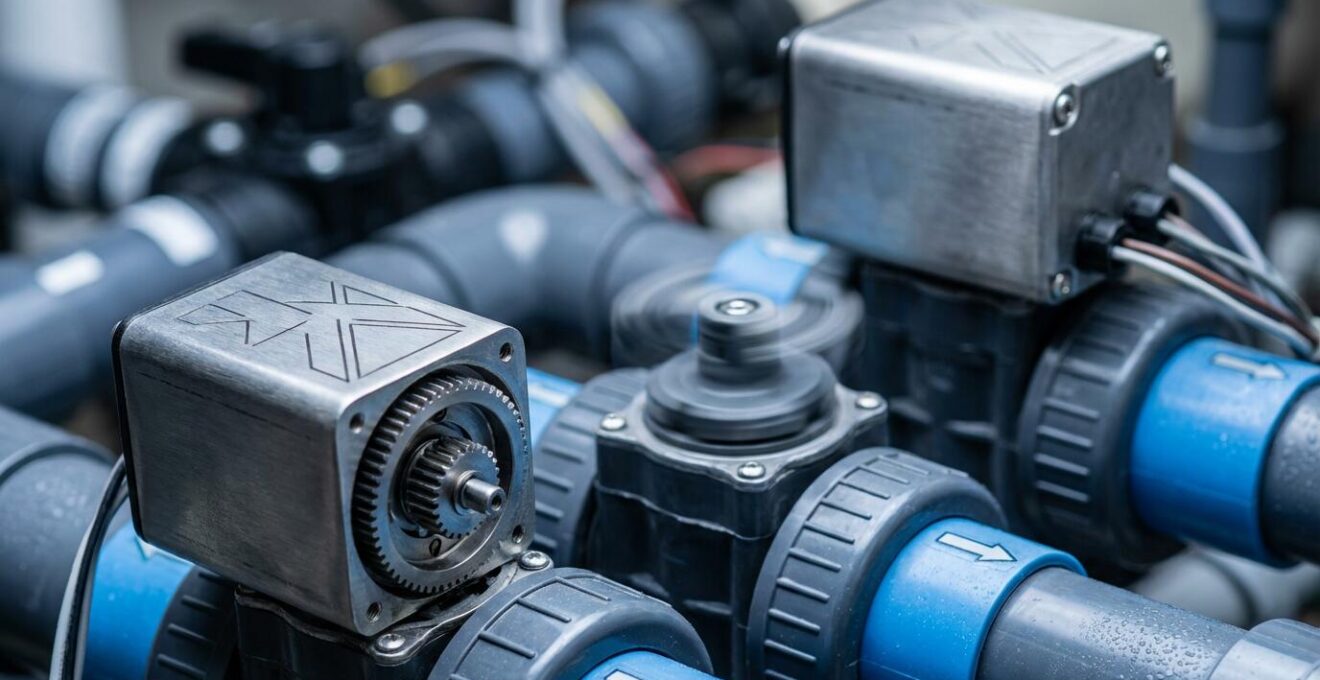
As the illustration shows, these actuators are the mechanical heart of the system. They physically turn the valves to direct water flow. Modern automation systems manage this logic automatically when you select “Spa Mode,” sending a 24 VAC signal to the correct MVA terminals. The programming involves setting the desired temperature and schedule, and the controller executes the necessary valve actuation to achieve it. Understanding this mechanical action is key to troubleshooting issues where the spa fails to isolate and heat properly.
Raised or Level Spa: Which Design is Easier to Enter and Exit?
While ease of entry is a subjective and important consideration—a level or “flush” spa offers seamless entry, while a raised spa provides a convenient seating wall for ingress—the more critical difference from a heating perspective is thermal efficiency. A raised spa is inherently more efficient to keep at 38°C due to a principle called thermal bridging. A flush spa, being structurally part of the pool deck and shell, has more surface area in direct contact with the cooler surrounding pool water and earth.
This direct contact creates a “bridge” for heat to conduct away from the spa into the colder mass of the pool structure and ground. It’s like trying to keep a cup of coffee hot by placing it on a block of ice. In contrast, a raised spa has its own separate wall structure. This creates a physical air gap or structural separation between the hot spa water and the cooler pool body, significantly reducing this conductive heat loss.
This insight is crucial for managing heating costs. As industry expert Swimming Pool Steve notes in his guide on shared systems:
A raised spa’s separate wall structure minimizes ‘thermal bridging’ – heat loss to the surrounding cooler pool water and earth – making it inherently more efficient to keep at 38°C
– Swimming Pool Steve, Shared Pool & Spa Systems Guide
Therefore, while a level spa might offer a sleeker look and easier access for some, it will demand more energy to maintain its temperature compared to a raised spa. The raised design provides superior thermal isolation, a key factor in a dual-temperature environment.
The Check Valve Failure That Drains Your Spa Into the Pool Overnight
One of the most common and baffling problems in a pool-spa combo is finding the spa’s water level significantly lower in the morning, with the pool level slightly higher. This is almost always caused by a failed check valve on the spa’s return line. The check valve is a one-way gate designed to allow water to flow *into* the spa but prevent it from flowing back *out* when the pump is off. When the spa water is higher than the pool water (as in a raised spa), gravity is constantly trying to equalize the levels.
There are two main types of check valves used in pool plumbing: spring-loaded and flapper-style. A spring-loaded valve uses a spring to hold a disc shut against the backflow pressure. A flapper valve uses a hinged gate. Both can fail. The spring can weaken or break, or debris can get caught in the flapper, preventing it from sealing completely. When this seal is compromised, water can slowly siphon from the spa back into the pool overnight, taking all its expensive heat with it.
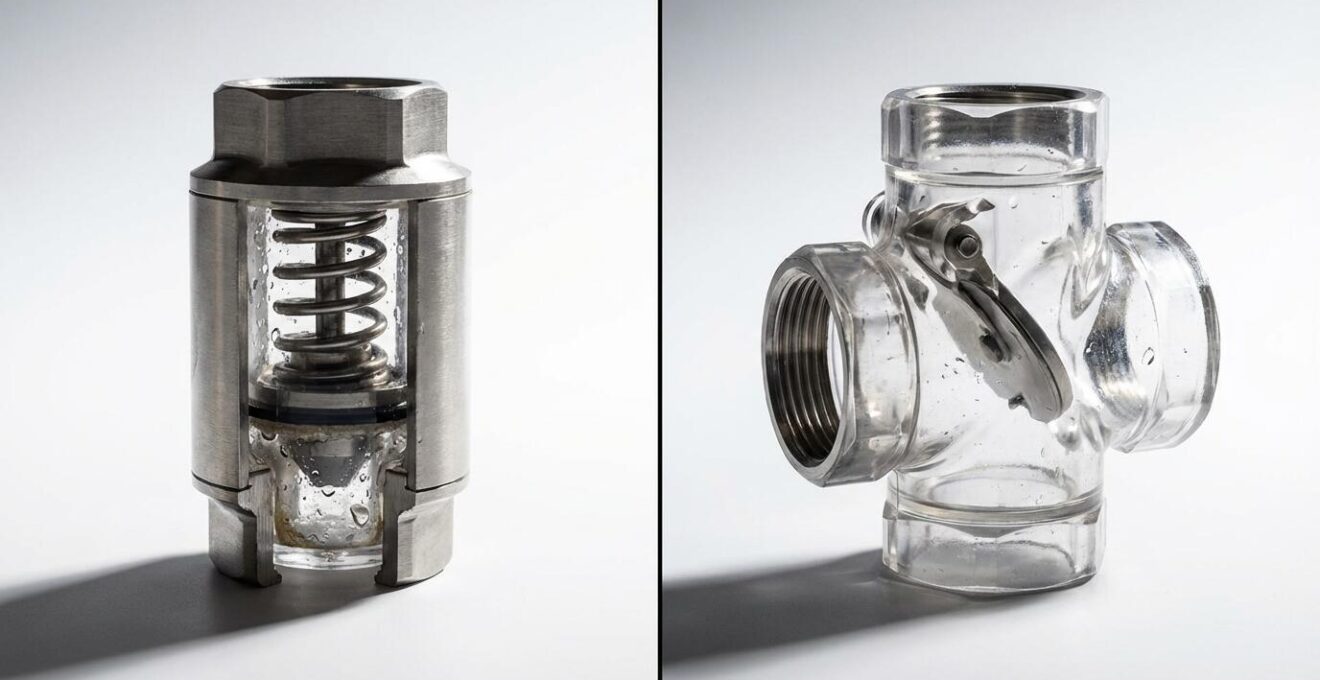
This silent, slow leak not only drains the spa but also forces the system to refill it with cold pool water and reheat it from scratch the next day, leading to a massive waste of energy. Fortunately, diagnosing a faulty check valve is a straightforward process.
Action Plan: DIY Check Valve Leak Diagnostic Test
- Mark Level: With the system off, place a piece of waterproof tape on the spa wall precisely at the water line.
- Wait: Leave all pool and spa equipment turned off overnight (at least 8-10 hours).
- Inspect: Check the water level in the morning. A drop of more than an inch is a clear indicator of a leak in the system.
- Add Dye: To confirm the source, add a few drops of dark food coloring to the spa water near the return jets (with the pump still off).
- Observe: Watch the pool returns closely. If you see the colored water appearing in the pool, you have confirmed that the check valve is failing and allowing backflow.
When to Activate the Spa Mode to Be Ready for an 8 PM Soak?
Timing the activation of “Spa Mode” is a calculation based on three factors: the volume of your spa, the starting water temperature, and the power of your heater (measured in BTUs for gas heaters or performance at a given temperature for heat pumps). You cannot expect an instant temperature rise; the process requires planning. For a typical heat pump, a significant temperature increase takes time; manufacturer specifications state that heat pumps require 45-60 minutes to heat a spa by 20°F (11°C).
For example, if your pool water is at 26°C and you want your spa at 38°C, you need to achieve a 12°C rise. Based on the manufacturer’s data, you should plan for at least 60 to 75 minutes of dedicated heating time. If your starting pool temperature is lower, say 22°C on a cooler day, the required heating time could extend to 90 minutes or more. It is always better to overestimate the time needed.
Modern automation systems can simplify this process significantly. Advanced controllers, like those from Arctic Heat Pumps, allow you to program a desired outcome: “I want the spa at 38°C by 8 PM.” The system then uses sensors to measure the current water temperature and automatically calculates the required start time, activating the valve actuators and heater accordingly. These systems use a 24 VAC output to control the actuator valves, switching them to their Normally Closed (NC) and Normally Open (NO) positions to perfectly isolate the spa circuit for the heating cycle. Without such automation, manual calculation and activation are necessary.
Why Spillover Spas Are the Ultimate Focal Point for Flat Yards?
In a flat landscape, a spillover spa provides a powerful vertical element and a dynamic focal point that a simple pool cannot. The sound of cascading water, the visual texture of the spillway (be it a smooth sheet or a rocky waterfall), and the interplay of light on the moving surface create a multi-sensory anchor for the entire backyard design. It introduces motion and sound into an otherwise static environment, elevating the pool from a mere body of water to a living water feature.
However, this premier aesthetic comes at a direct and quantifiable energy cost. As discussed, the spillover effect is a major driver of heat loss. The decision to run this feature continuously for visual appeal versus only during spa use is a significant financial one. The cost of maintaining temperature is not linear; energy efficiency studies reveal that raising pool temperature by one degree increases energy costs by up to 30%. This effect is magnified when constantly battling the cooling effect of a spillover.
The trade-off between visual impact and operational cost is a strategic choice every owner must make. The table below, based on energy consumption principles, outlines the relationship between different spillover operation schedules and their resulting impact on heating costs.
| Spillover Operation Mode | Visual Appeal | Heat Loss Rate | Monthly Cost Impact |
|---|---|---|---|
| Continuous (24/7) | Maximum aesthetic impact | 3-4°F per hour | +40-60% heating costs |
| Evening Only (4 hours) | High during peak usage | 2-3°F per hour | +15-25% heating costs |
| 15-min Intervals | Moderate scenic effect | 1-2°F per hour | +8-12% heating costs |
| Special Events Only | Minimal daily impact | <1°F per hour | +3-5% heating costs |
Ultimately, a spillover spa’s role as a focal point is undeniable, but it must be managed with an understanding of its thermodynamic consequences. Programming the spillover to run for short, high-impact periods (e.g., during parties or evening relaxation) offers a smart compromise between aesthetics and efficiency.
How Variable-Speed Pumps Pay for Themselves in Less Than 24 Months?
A variable-speed pump (VSP) is not a luxury but a fundamental component for an efficient dual-temperature pool and spa. A single-speed pump is a blunt instrument, always running at a high, energy-intensive speed, whether it’s filtering the pool or trying to power spa jets. A VSP, by contrast, is a precision tool that allows you to match the flow rate exactly to the task at hand, generating massive energy savings.
The payback comes from running the pump at much lower speeds for the majority of its operating time. Pool filtration, which runs for 8+ hours a day, only requires a low flow rate. According to the pump affinity law, reducing a pump’s speed by half reduces its energy consumption by a factor of eight. This is where the savings accumulate. You run the pump at a low RPM for general filtration, then ramp it up to a medium speed for spa heating (to ensure adequate flow through the heater), and only use the maximum speed for short periods when spa jets are active.
Case Study: VSP Optimization in a Dual-Temp System
A case study of a 2,500-gallon swim spa highlighted the dramatic savings. Initially, constant-speed operation for heating consumed 30 kW per day. By implementing a VSP and optimizing its schedule—running at a low 750 RPM for basic filtration, a medium 2,000 RPM for spa heating cycles, and a high 3,000 RPM only for powering jets—the owner reduced energy consumption dramatically while maintaining optimal performance for each function. This strategic use of variable speeds resulted in a complete payback on the pump’s initial cost in just 18 months.
This level of control is what makes VSPs indispensable for a pool-spa combo. They provide the quiet, low-cost circulation needed for the pool and the powerful flow required for the spa, all from a single, highly efficient motor. The initial investment is quickly recovered through significantly lower electricity bills.
Key Takeaways
- Hydraulic isolation via motorized valves is the non-negotiable foundation for creating a separate, heatable spa zone.
- A raised spa design is inherently more energy-efficient than a flush design due to the mitigation of “thermal bridging.”
- Efficient equipment, specifically variable-speed pumps and inverter heat pumps, provides the necessary control and power to manage dual temperatures without excessive energy waste.
Why Inverter Heat Pumps Are Worth the Extra Upfront Cost for Large Pools?
For a large pool combined with a spa, an inverter heat pump offers a level of efficiency and flexibility that standard or even multi-stage heaters cannot match. The core value of an inverter is its ability to modulate its power output continuously, much like the accelerator in a car. This is a stark contrast to a single-speed heater that can only run at 100% power (full throttle) or be off (parked). This capability is crucial in a dual-temperature application.
The efficiency of a heat pump is measured by its Coefficient of Performance (COP), which is the ratio of heat energy produced to electrical energy consumed. According to Department of Energy data, heat pumps have COPs ranging from 3.0 to 7.0, meaning they produce 3 to 7 units of heat for every unit of electricity they consume, translating to 300-700% efficiency. Inverter models operate at their highest COP when running at low speeds to simply *maintain* temperature.
This is where the “sip versus gulp” analogy becomes powerful. The inverter can run at a very low, quiet, and ultra-efficient 20-30% capacity for most of the day, “sipping” energy to maintain the large 26°C pool. Then, when “Spa Mode” is activated, it can instantly ramp up to 100% capacity, “gulping” energy to deliver the powerful heat output needed for the demanding task of rapidly heating the spa to 38°C.
An inverter heat pump can ‘sip’ energy, running at a low 20-30% capacity to efficiently maintain the pool at 26°C, while retaining the ability to ‘gulp’ energy at 100% power for the demanding task of heating the spa to 38°C
– Arctic Heat Pumps, The Ultimate Guide to Energy-Efficient Pool Heating in 2024
This dual capability—high-efficiency maintenance and high-power rapid heating—makes an inverter heat pump the ideal engine for a dual-temperature system. The extra upfront cost is an investment in lower long-term operating costs and superior performance, delivering both a comfortable pool and a hot spa on demand.
By understanding your pool and spa not as a single entity but as an integrated system of hydraulic circuits and thermal zones, you gain true control. The key to achieving that perfect 38°C soak in your 26°C oasis lies not in a more powerful heater, but in a more intelligent and efficient system. Take the time to analyze your valve operations, diagnose potential leaks, and optimize your pump schedules. This engineering-led approach will transform your system from a source of frustration into a reliable and efficient source of relaxation.