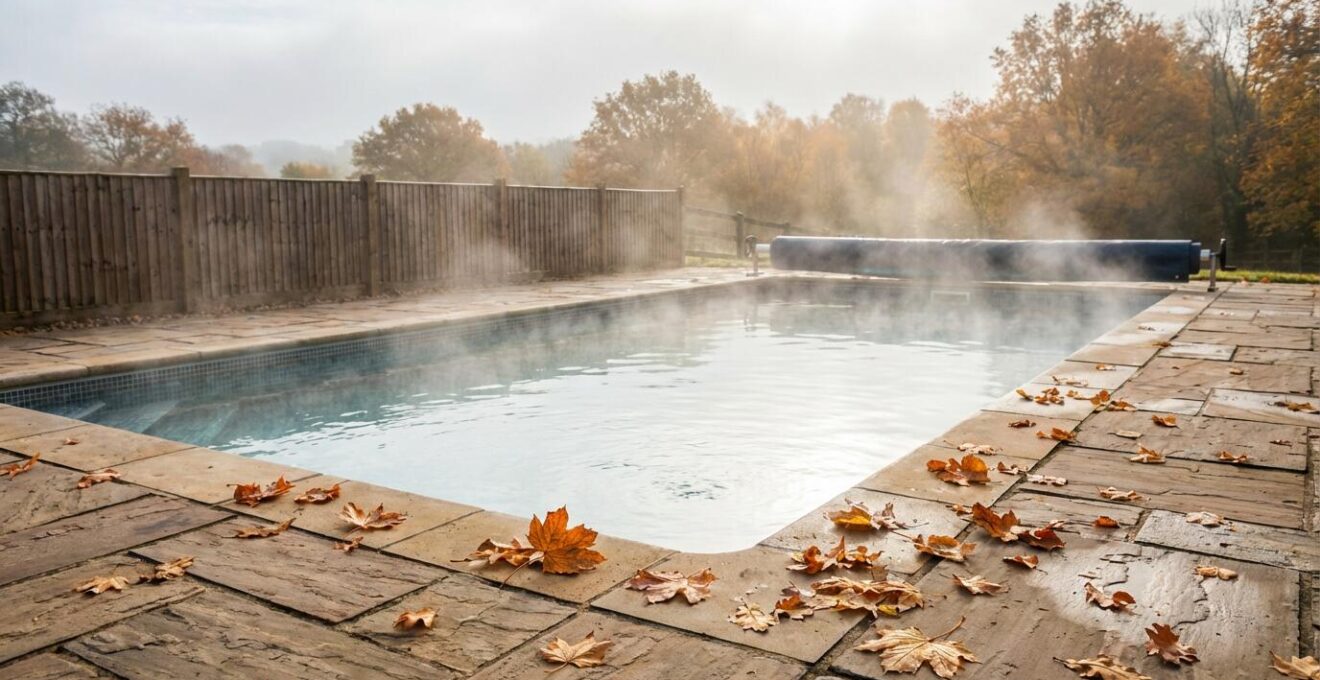
In summary:
- Focus on preventing heat loss (evaporation, wind) before generating heat; this is the core principle of thermal efficiency.
- Choose a gas heater for rapid, on-demand weekend heating; use an electric heat pump for steady, continuous temperature maintenance.
- Correctly size your heater by factoring in autumn’s lower ambient temperatures to avoid critical underperformance when you need it most.
- Implement a dual-cover system (an ASTM-rated safety cover plus a solar blanket) for maximum heat retention and unparalleled child safety.
The first crisp October breeze signals the end of the swimming season for most pool owners. The dream of extending summer into autumn quickly collides with the reality of frigid water and skyrocketing energy bills. Many resort to common but often incomplete solutions: throwing on a basic solar cover or running a heater non-stop, only to be shocked by the cost. This approach is like trying to fill a leaky bucket with a firehose—inefficient, expensive, and ultimately frustrating.
The common advice often misses the fundamental engineering principle at play. Maintaining a warm pool in a temperate climate is not a battle of brute-force heating; it is a meticulous exercise in thermal dynamics management. The secret to an affordable 28°C swim in October lies in systematically identifying and plugging every thermal leak before you even consider generating a single BTU of new heat. It’s about working smarter, not harder, by treating your pool as a complete thermal system.
This guide abandons generic tips in favor of a cost-conscious, technical framework. We will first dissect the primary mechanisms of heat loss that silently drain your pool’s warmth and your wallet. Then, we will conduct a cost-benefit analysis of heating technologies tailored to specific usage patterns. Finally, we will outline strategic operational tactics that allow you to invest energy with precision, ensuring your pool is perfectly warm for that sunny autumn weekend without financial regret.
This article provides a structured path to mastering your pool’s thermal efficiency. By following these engineering-led strategies, you will understand exactly where your energy is going and how to control it. The following sections break down each critical component of this system, from surface-level physics to advanced heating technology.
Contents: Maintaining Pool Temperature Efficiently in Autumn
- Why does your pool lose 60% of its heat through the surface overnight?
- How to install windbreaks that reduce thermal loss by 20%?
- Gas vs Electric Heat Pump: Which is Cheaper for Weekend-Only Swimmers?
- The BTU calculation mistake that leaves you with a cold pool in spring
- When to start heating your pool to be ready for the first warm weekend?
- Why Inverter Heat Pumps Are Worth the Extra Upfront Cost for Large Pools?
- Which Isothermal Cover Best Protects Children While Retaining Heat?
- How Inverter Technology Reduces Your Pool’s Carbon Footprint by 40%?
Why does your pool lose 60% of its heat through the surface overnight?
The single largest contributor to overnight heat loss in an outdoor pool is not the cold air or the ground; it is evaporation. As water turns into vapor, it requires a significant amount of energy, which it draws directly from the remaining pool water in the form of heat. This process, known as latent heat of vaporization, is relentless and is the primary reason your pool’s temperature plummets after sunset. While factors like radiation to the cold night sky and convection play a role, their impact is secondary to the massive thermal drain caused by water leaving the surface.
From a thermal dynamics perspective, an uncovered pool is an open system hemorrhaging energy. Technical analyses confirm the scale of this issue. According to an ENERGY STAR technical reference, while heat loss is a combination of evaporation, convection, radiation, and conduction, evaporation is the dominant mechanism for outdoor pools. This is not a minor factor; recent calculations show that 70% of pool heat loss occurs directly through this process. Therefore, the first and most critical step in any cost-effective heating strategy is to physically block evaporation.
Ignoring this fundamental principle means any heat you add with a heater is effectively being vented into the atmosphere. A pool cover acts as a vapor barrier, dramatically reducing this primary source of loss. Understanding that you are fighting evaporation first and cold temperatures second is the foundational mindset shift required to heat your pool affordably in the cooler months. Without addressing surface loss, you are simply paying to heat the air above your pool.
How to install windbreaks that reduce thermal loss by 20%?
While evaporation is the primary mechanism of heat loss, wind is its powerful accelerant. Wind moving across the surface of the pool dramatically increases the rate of evaporation, stripping heat away much faster than on a calm day. From an engineering standpoint, the wind acts as a conveyor belt, constantly replacing the moist, saturated air layer just above the water with drier air, which encourages even more water to evaporate. This effect is not trivial; studies demonstrate that a mere 5 mph breeze can increase evaporation rates by 15%, compounding your heating costs.
Therefore, a strategic windbreak is not a cosmetic addition but a critical piece of thermal insulation. By reducing or eliminating wind exposure, you directly reduce evaporative heat loss, which in turn lessens the workload on your heating system. The most effective windbreaks are those that are tall enough and dense enough to disrupt airflow at the pool’s surface. This can be achieved through both structural and natural means.
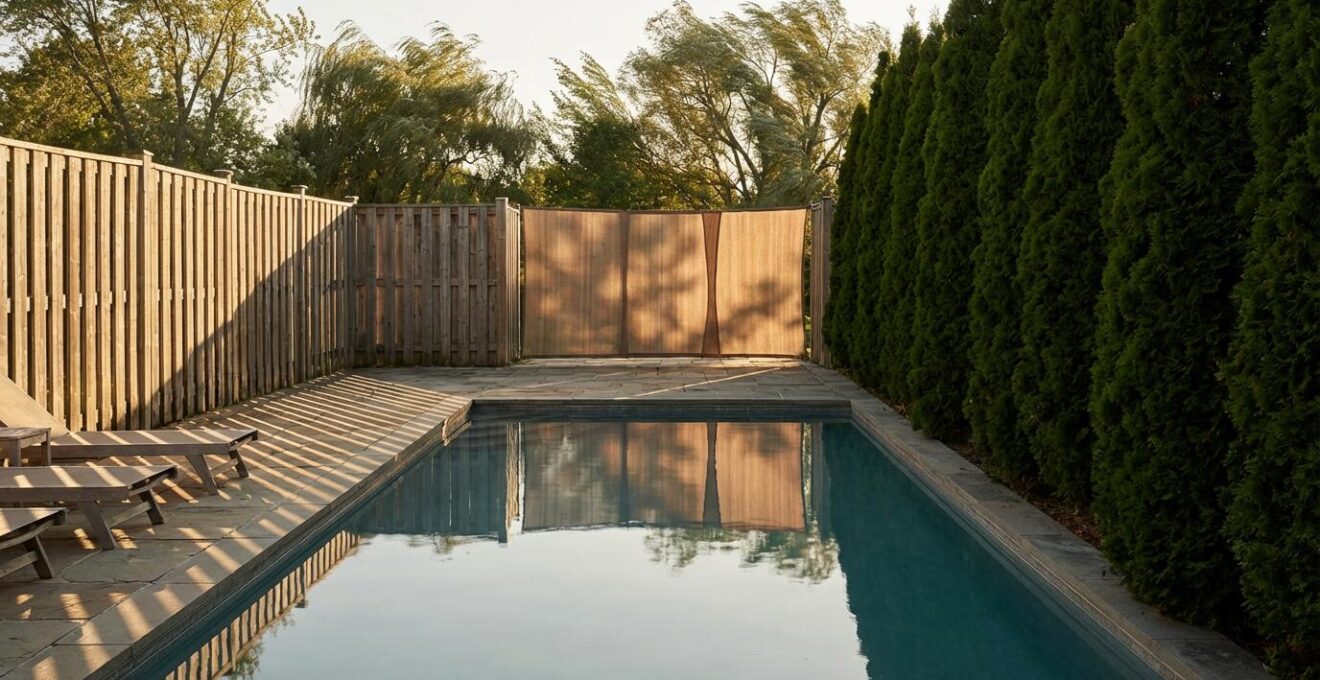
The goal is to create a pocket of still air around the pool. As the illustration shows, this can be done with solid fences, dense hedges, or even specialized screens. Each option offers a different balance of effectiveness, cost, and aesthetics, but all share the same objective: neutralizing wind’s impact on your energy budget. Below are specific strategies to implement an effective windbreak system.
Action Plan: Implementing Effective Windbreaks
- Assess Wind Direction: Identify the prevailing wind direction on your property to position barriers for maximum impact.
- Select Barrier Type: Choose between a solid 6-foot privacy fence (up to 18% BTU requirement reduction), dense hedges like Thuja, or lattice/textile screens (around 9% reduction) based on your budget and aesthetic preference.
- Optimize Placement: Install the windbreak as close to the pool as is practical to create a calm zone directly over the water surface, ensuring it is high enough to block wind effectively.
- Consider a Pool Enclosure: For the ultimate solution, a full pool enclosure creates a greenhouse effect, virtually eliminating wind and evaporative loss for year-round swimming potential.
- Measure Impact: After installation, monitor your heater’s run time or your energy bills to quantify the reduction in heating load, confirming the ROI of your windbreak.
Gas vs Electric Heat Pump: Which is Cheaper for Weekend-Only Swimmers?
Once you have minimized passive heat loss, the next engineering decision is selecting the right active heating technology. The choice between a gas heater and an electric heat pump is not about which is “better” overall, but which is mathematically superior for your specific usage pattern. For the “weekend-only swimmer” who requires rapid, on-demand heating, the analysis is clear. As the technical team at Aaron Pools & Spas notes:
Gas heaters are ideal if you want on-demand heat, as they can quickly warm your pool regardless of air temperature
– Aaron Pools & Spas Technical Team, Aaron Pools & Spas Heating Guide
This speed is the critical variable. A gas heater functions like a tankless water heater, burning fuel to directly heat water that passes through it. Its performance is independent of the ambient air temperature, allowing it to raise pool temperature by several degrees in a matter of hours. In contrast, an electric heat pump works like a reverse air conditioner, extracting heat from the surrounding air and transferring it to the pool water. This process is slower and highly dependent on the air temperature, often taking 1-2 days to achieve the desired warmth.
For a swimmer who decides on Friday afternoon they want a warm pool for Saturday morning, a gas heater is the only viable option. While its hourly operating cost is higher, you only run it for the short period needed. A heat pump, while cheaper per hour, would need to run for 24-48 hours straight, making it less economical for intermittent, on-demand use. The following comparative analysis breaks down the key performance and cost metrics.
| Feature | Gas Heater | Electric Heat Pump |
|---|---|---|
| Heating Speed | Quick (hours) | Slow (1-2 days) |
| Best For | On-demand weekend heating | Continuous temperature maintenance |
| Operating Cost | Higher per hour ($4-8/hr) | Lower per hour ($1-3/hr) |
| Initial Cost | $1,500-$3,000 | $3,000-$5,000 |
| Weather Dependency | Works in all temperatures | Less efficient below 45°F (7°C) |
| Weekend-Only Efficiency | Excellent – rapid heating | Poor – slow response time |
The BTU calculation mistake that leaves you with a cold pool in spring
One of the most common and costly errors in pool heating is under-sizing the heater, a mistake rooted in a misunderstanding of BTU (British Thermal Unit) ratings and ambient temperature. A BTU is the amount of energy required to raise one pound of water by one degree Fahrenheit. When you purchase a heater, its BTU rating tells you its maximum heating power. However, for an electric heat pump, this rating is not a constant; it is critically dependent on the outside air temperature.
The mistake is sizing a heat pump based on its performance in warm summer air. As autumn approaches and temperatures drop, the heat pump has less thermal energy to extract from the air, and its output plummets. In fact, critical calculations reveal that heat pump capacity decreases by 30-50% as ambient temperatures fall below 45°F (7°C). A unit rated at 120,000 BTU in 80°F (27°C) weather might only produce 60,000 to 80,000 BTU on a cool October morning.
If your calculation was based on the summer rating, your heater will be severely undersized for shoulder-season use. It will run continuously without ever reaching the target temperature, leaving you with a lukewarm pool and a massive electricity bill. The correct engineering approach is to calculate your BTU requirement based on your desired temperature rise and pool size, and then select a heat pump whose output matches that requirement at the *lowest anticipated ambient temperature* you plan to swim in. This ensures the unit has enough power to do its job efficiently when you need it most, even if it seems oversized for mid-summer use.
When to start heating your pool to be ready for the first warm weekend?
Owning the right equipment is only half the battle; operating it with strategic timing is what controls the cost. The question of when to start heating for an October weekend is a problem of thermal banking. You need to deposit enough heat into the massive thermal mass of your pool water so that it reaches your target temperature at the right time, without wasting energy by starting too early or too late.
The key is to work backward from your desired swim time and be proactive. Given that an appropriately sized heat pump can take one to three days to raise the temperature significantly, you cannot wait until the weekend arrives. A 2024 analysis from pool supply experts confirms this. For those in milder southern and coastal regions, starting the process in mid-to-late October is often sufficient. The core strategy involves monitoring the 5-day weather forecast closely. Identify a target weekend with favorable conditions (sun, low wind) and begin the heating process 2 to 3 days in advance.
This allows the heater to work gradually and efficiently, especially during the warmer daytime hours when its performance (Coefficient of Performance or COP) is at its peak. Starting the heater on a Wednesday or Thursday for a Saturday swim is a common and effective strategy. This approach avoids the massive energy spike of trying to heat the pool rapidly from a very cold state, instead using a slow and steady “deposit” of thermal energy. Always ensure your solar cover is on during this entire pre-heating period to retain every bit of energy you add.
Why Inverter Heat Pumps Are Worth the Extra Upfront Cost for Large Pools?
For pool owners committed to consistently extending their swimming season, particularly those with larger pools, the discussion shifts from standard heaters to advanced inverter technology. While the upfront cost is higher, an inverter heat pump represents a superior long-term investment from both a financial and performance perspective. Unlike traditional single-speed heaters that operate on a simple on/off cycle (running at 100% capacity or 0%), an inverter-driven pump has a variable-speed compressor.
This allows it to modulate its power output precisely. When initially heating the pool, it can run at full capacity for speed. Once the target temperature is reached, it throttles down, running at a very low, continuous speed (e.g., 20-30% capacity) just to offset heat loss. This is vastly more efficient than the constant on/off cycling of a standard unit, which creates energy-wasting peaks and valleys in temperature. The result is significant, with industry data confirming energy savings of 30 to 40 percent annually compared to traditional heat pumps. For a large pool, these savings can offset the initial cost within a few seasons.
Furthermore, their performance in colder weather is superior. As a report from the RMI highlights, this technology is designed for resilience: inverter-driven pumps can increase their speed to maintain heating capacity as the outdoor temperature drops. This intelligent self-regulation ensures they deliver consistent heat when standard pumps struggle, making them far more reliable for October and even November swimming. They are also significantly quieter, operating at a low hum rather than the disruptive roar of a single-speed unit at full blast.
Which Isothermal Cover Best Protects Children While Retaining Heat?
The role of a pool cover is twofold: thermal efficiency and safety. While a standard “bubble” solar blanket is excellent for heat retention, it offers zero protection against accidental drowning, making it an incomplete solution for families with children. From an engineering and safety standpoint, the optimal solution is not one cover, but a dual-system approach that combines an ASTM-rated safety cover with a lightweight solar blanket.
The primary layer is the safety cover. This is a robust, tensioned cover made of solid vinyl or mesh that is anchored to the pool deck. It is specifically designed to meet ASTM F1346-91 standards, meaning it can support the weight of an adult, effectively sealing off the pool and preventing any person or pet from falling into the water. This provides the non-negotiable safety element.
The secondary layer, used underneath the safety cover, is the solar blanket. This is the “bubble wrap” style cover, typically made of UV-stabilized polyethylene. Its primary function is thermal. It floats on the water’s surface, transferring the sun’s radiant energy into the water and, most importantly, acting as a vapor barrier. Testing demonstrates that solar blankets prevent up to 95% of pool water evaporation, which is the main source of overnight heat loss. This dual-system strategy is endorsed by industry professionals as the best-of-both-worlds solution.
Expert Recommendation: The Two-Cover System for Safety and Efficiency
In a guide for Homes & Gardens, pool care expert Alicia Toedter from Leslie’s recommends precisely this dual system. She advises using an ASTM-rated safety cover as the primary barrier for ultimate protection. Underneath, a solar blanket can be deployed to trap the sun’s warmth and, more critically, prevent evaporation by up to 95%. This layered approach ensures that the pool meets the highest child safety standards while also maximizing thermal retention, providing a comprehensive solution that doesn’t compromise on either front.
To Remember
- Evaporation is your primary enemy, responsible for up to 70% of heat loss.
- A windbreak is not optional; it’s a critical component that can reduce thermal loss significantly.
- Your heater’s BTU rating must be calculated for your *coldest* expected ambient temperature, not the average.
How Inverter Technology Reduces Your Pool’s Carbon Footprint by 40%?
Beyond the direct financial savings, adopting modern heating technology like an inverter heat pump has a significant positive environmental impact. The primary way it reduces your pool’s carbon footprint is through radical gains in energy efficiency. By precisely matching its output to the heating demand, an inverter pump avoids the massive energy waste associated with the constant on/off cycling of older systems. This reduction in electricity consumption directly translates to a lower carbon footprint, especially in regions where the grid is still reliant on fossil fuels.
The efficiency gains are not theoretical. Electrification of heating, when done with high-efficiency devices like inverter pumps, is a proven strategy for decarbonization. For instance, real-world measurements confirm a 41% reduction in carbon footprint was achieved by users who adopted heat pump technology in early 2024. This aligns perfectly with the 30-40% annual energy savings these units provide. By consuming less energy to achieve the same result, you are directly responsible for fewer carbon emissions.
The potential for large-scale impact is even more dramatic. A case study by Schneider Electric demonstrated how integrating HVAC&R elements into a centralized system with a reversible CO2 heat pump led to a staggering 70% reduction in energy consumption at a commercial property. While a residential pool is a different scale, the principle holds: intelligent, integrated, and efficient thermal management technology is a powerful tool for carbon reduction. Choosing an inverter pump is not just an investment in your comfort and budget; it is a tangible step toward a more sustainable home.
By applying these thermal efficiency principles, you can move from costly guesswork to a predictable and affordable extended swimming season. The next logical step is to perform a thermal audit of your own pool setup to identify the most impactful and cost-effective upgrades for your specific environment.
Frequently Asked Questions about Inverter Pool Heaters
How much quieter are inverter heat pumps?
Inverter heat pumps are significantly quieter than their single-speed counterparts. Because they can run at very low RPMs to maintain temperature, their outdoor noise levels can be as low as 50 dB, which is comparable to a quiet conversation. This makes them ideal for residential areas where noise can be a concern.
What is the actual energy reduction?
Compared to gas boilers or older fixed-speed electric systems, inverter heat pumps can reduce annual energy consumption by 25-40%. This is achieved by eliminating inefficient on/off cycles and instead running continuously at a very low, energy-sipping power level to precisely match the pool’s heat loss.
What temperature range can they operate in?
Modern inverter heat pumps are designed for four-season performance. High-end models are capable of operating efficiently in a wide range of ambient temperatures, typically from -20°C to 45°C (-4°F to 113°F). This robust operational range makes them a reliable choice for extending the swimming season deep into autumn.