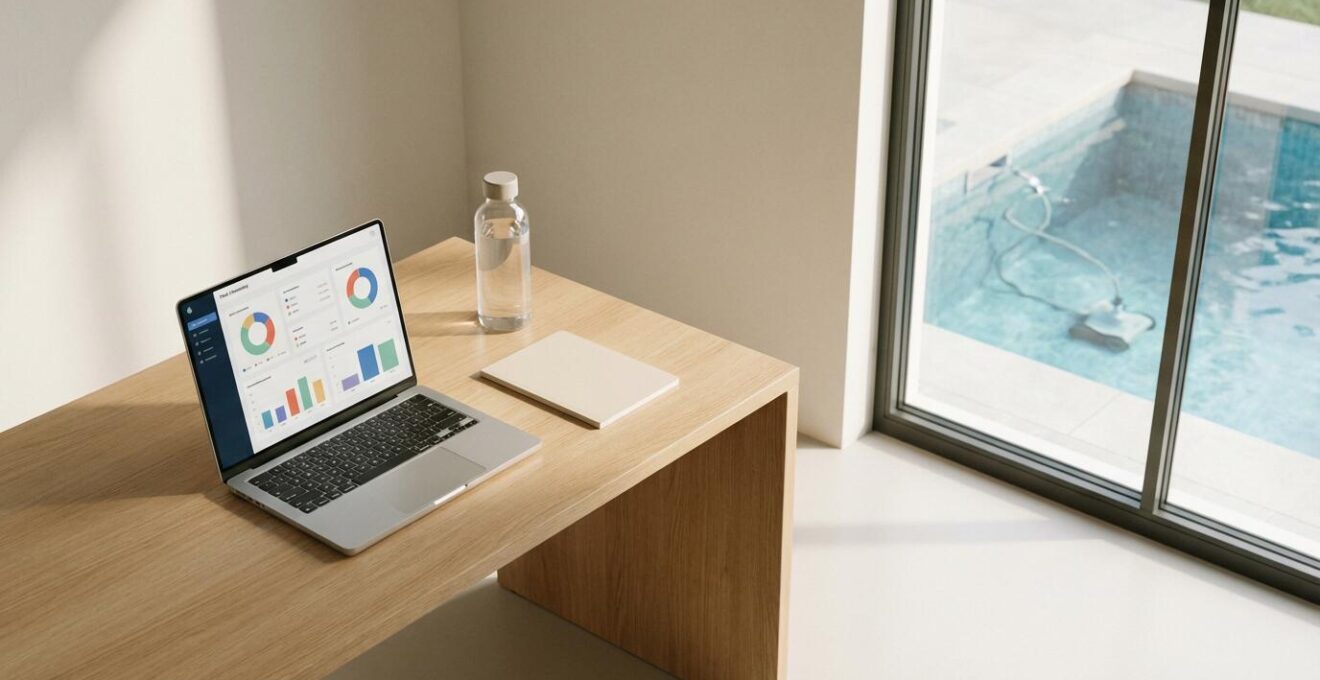
Contrary to popular belief, effective smart pool management isn’t about remotely turning things on and off; it’s about building an autonomous ecosystem that anticipates issues before they become costly problems.
- Proactive alerts for chemical imbalances can prevent irreversible equipment damage, saving you thousands.
- A properly configured system uses real-time data to manage itself, from chemical dosing to running the pump on free solar energy.
Recommendation: Shift your mindset from reactive remote control to designing a proactive, self-sufficient “digital sentry” for your pool to achieve true peace of mind.
As a busy professional, the nagging thought, “Is everything okay with the pool?” can undermine a productive workday or a relaxing vacation. You invested in a pool for enjoyment, not as a second job that requires daily, in-person chemical tests and equipment checks. The mental load of potential issues—cloudy water before a weekend party, a broken pump while you’re miles away, or costly corrosion silently eating away at your heater—is a constant, low-level stressor. You’ve probably heard about smart pool systems, envisioning them as a simple app to turn lights on or start the pump. This is the common understanding, but it barely scratches the surface.
The standard approach to automation often stops at basic scheduling and remote-control functions. This is helpful, but it’s fundamentally reactive. It still requires you to notice a problem and then use the app to try and fix it. But what if the true power of a smart pool wasn’t just giving you a remote control, but removing you from the equation almost entirely? The key is to stop thinking about individual smart devices and start designing a holistic, proactive ecosystem—a digital sentry that doesn’t just report problems but actively prevents them. This system monitors, analyzes, and acts on its own, based on a constant stream of data about your pool’s health.
This guide will walk you through the strategic components of building such a system. We’ll explore how intelligent alerts can become your first line of defense against expensive repairs. We will then cover how to seamlessly integrate your pool into your smart home for effortless control, and make the critical decision between proprietary apps and flexible third-party hubs. We will also pinpoint the connectivity pitfalls that can render your investment useless and dive into the science of precise, automated chemical management. Finally, we’ll show you how this intelligent system not only protects your pool but also pays for itself, by synchronizing with solar power and using advanced freeze protection, ultimately proving its value far beyond simple convenience.
In this comprehensive guide, we’ll break down exactly how to transition from basic remote control to a truly intelligent, self-managing pool. The following sections detail the essential strategies and technologies that make this possible.
Summary: Beyond Remote Control: How to Build a Truly Smart Pool That Manages Itself
- Why push notifications for low pH can save your heater from corrosion?
- How to control your pool lights and jets using Alexa or Siri?
- Manufacturer App or Third-Party Hub: Which Offers Better Flexibility?
- The Wi-Fi mistake that renders your smart pool equipment useless
- When to program ORP sensors to dose chlorine for maximum accuracy?
- How to Sync Your Pool Pump with Solar Panels to Run for Free?
- How to Protect Your Vacation Home Pool from Freezing While You Are Away?
- How Variable-Speed Pumps Pay for Themselves in Less Than 24 Months?
Why push notifications for low pH can save your heater from corrosion?
A notification on your phone that says “Low pH” might seem like a minor inconvenience. In reality, it’s a critical warning from your pool’s digital sentry that could save you thousands of dollars. The most vulnerable—and expensive—component at risk is your pool heater. The delicate copper and cupronickel heat exchangers inside are highly susceptible to corrosion from acidic water. When pH drops below the ideal range, the water becomes aggressive, literally dissolving the heater from the inside out. Industry monitoring confirms that pH levels outside the 7.2-7.8 range can reduce heater lifespan by up to 50%. A $5,000 heater failing in four years instead of eight is a direct, preventable financial loss.
This is where a proactive ecosystem moves beyond simple alerts. A basic system tells you there’s a problem; a truly smart one gives you contextual, tiered warnings and can even take corrective action. Instead of a single “low pH” alarm, an advanced setup can be configured to notify you with a “Warning” when pH drifts to 7.1 and a “Critical” alert if it hits 6.9, simultaneously notifying your pool service professional. For ultimate peace of mind, the system can be programmed to automatically dose a specific amount of pH increaser or soda ash to counteract the drift, sending you a confirmation that the action was taken.
This level of automation transforms a reactive notification into a proactive asset protection strategy. It’s not just about knowing the pH is low; it’s about your system identifying a trend, understanding the financial risk to your equipment, and executing a pre-approved solution without you ever having to open an app. This is the first and most crucial step in reducing your mental load and safeguarding your investment.
Action Plan: Configuring Your Advanced pH Monitoring System
- Set Dual-Threshold Alerts: Program your system with two levels of notification: a ‘Warning’ when pH drifts slightly (e.g., below 7.2) and a ‘Critical’ alert for dangerous levels (e.g., below 7.0) that may trigger automated actions.
- Monitor Rate of Change: Configure an alert for rapid pH shifts (e.g., a drop of more than 0.2 in two hours), as this can indicate an equipment issue or a significant chemical event.
- Create a “Heater Health” Index: Work with an integrator to link pH, ORP, and salt level data into a single composite score, providing an at-a-glance view of corrosive conditions.
- Enable Confirmed Dosing: Program the system to automatically dose corrective chemicals (like acid or soda ash) but require it to send a confirmation notification to your phone detailing the action taken.
- Review Pattern Reports: Use the system’s logs to review weekly or monthly pH graphs. Recurring patterns can help you identify underlying issues, like the impact of heavy rain or high bather loads.
How to control your pool lights and jets using Alexa or Siri?
While protecting your equipment is the primary function of a smart pool ecosystem, the lifestyle benefits are what you’ll enjoy every day. Integrating your pool with a voice assistant like Amazon Alexa or Apple’s Siri transforms your backyard from a space you manage into an environment that responds to you. This moves beyond fumbling for your phone in the dark or going inside to flip a switch. It’s about seamless, hands-free control that elevates your experience.
Imagine this: you’re entertaining guests, and as dusk settles, you simply say, “Alexa, turn on the pool lights.” The underwater lights fade in, the landscape lighting around the deck illuminates, and the spa jets start bubbling. This level of integration is achieved by connecting your pool automation controller to your home’s smart hub. Most modern controllers (from brands like Pentair, Hayward, and Jandy) have “skills” for Alexa or compatibility with platforms like Apple HomeKit, allowing you to create custom commands and scenes.

As the image above illustrates, the right ambiance is about more than just on/off. You can create scenes like “Party Mode” that activates a vibrant color-changing light show and turns on the waterfall, or “Relax Mode” that sets the lights to a calm blue and heats the spa. For more advanced users, platforms like IFTTT (If This Then That) unlock even greater creativity. One homeowner, for example, created a routine where saying “Alexa, next color” triggers a sequence that quickly powers the lights off and on, which signals the controller to cycle to the next pre-programmed color. It’s a clever workaround that delivers a custom feature without complex wiring. This is where your smart pool becomes an integral part of your smart home lifestyle.
Manufacturer App or Third-Party Hub: Which Offers Better Flexibility?
When building your pool’s smart ecosystem, you’ll face a fundamental architectural choice: do you rely solely on the manufacturer’s dedicated app (like Pentair’s Home app or Hayward’s OmniLogic), or do you integrate your equipment into a more powerful, universal third-party smart home hub (like Home Assistant, Hubitat, or Control4)? This decision dictates the flexibility, power, and long-term viability of your system.
A manufacturer’s app offers simplicity. It’s designed to work perfectly with its own brand of equipment, the setup is relatively straightforward, and it’s supported by the company. For many users, this is enough. However, you are locked into that brand’s ecosystem. If you want to integrate a device from another brand, you’re often out of luck. Furthermore, you are at the mercy of the manufacturer’s long-term support; if they decide to discontinue the app or server, your “smart” pool could be rendered dumb overnight.
A third-party hub, on the other hand, is built on the principle of open connectivity. These platforms are designed to talk to devices from hundreds of different brands, including your pool equipment, smart blinds, outdoor speakers, and security cameras. The setup is more complex and may require a professional integrator, but the result is a single, unified system where your pool is just one part of a larger home automation strategy. You can create intricate automations that a manufacturer’s app could never handle, such as flashing the pool lights red if a security camera detects motion at night. The system is also yours, often running locally in your home, making it more private and immune to a company’s business decisions.
The choice ultimately depends on your goals. For plug-and-play control of a single-brand system, the manufacturer app is convenient. For ultimate power, flexibility, and future-proofing, a third-party hub is the superior long-term investment. This comparative analysis highlights the key trade-offs you’ll need to consider.
| Criteria | Manufacturer App | Third-Party Hub |
|---|---|---|
| Setup Complexity | Simple (2-4 hours) | Complex (6-12 hours) |
| Long-term Support | Risk of discontinuation | Community-driven |
| API Access | Usually closed | Open & flexible |
| Cybersecurity | Regular updates | User responsibility |
| Cost | $500-1500 | $200-800 + time |
| Integration Options | Limited to brand | Universal |
The Wi-Fi mistake that renders your smart pool equipment useless
You can invest in the most advanced automation controller and a state-of-the-art variable-speed pump, but if your Wi-Fi is unreliable, your smart pool is nothing more than expensive, disconnected hardware. The single biggest mistake homeowners make is assuming the same Wi-Fi network that streams movies in the living room will be robust enough for critical equipment located outdoors, often surrounded by concrete and electrical interference. This is a recipe for constant disconnections, missed alerts, and a system that fails when you need it most.
The equipment pad is a hostile environment for wireless signals. To build a truly reliable system, you need a dedicated network strategy. The first step is to create a separate, dedicated 2.4GHz network exclusively for your pool equipment and other outdoor IoT devices. The 2.4GHz band offers better range and wall-penetration than the 5GHz band, which is crucial for reaching the equipment pad. Isolating these devices on their own network prevents them from competing for bandwidth with your laptops, phones, and streaming devices, dramatically increasing reliability.
Next, you must install an outdoor-rated Wi-Fi access point (AP) within clear line-of-sight of the equipment pad, ideally no more than 50 feet away. This ensures a strong, stable signal where it’s needed most. For true peace of mind, especially for professionals who travel, two more layers of redundancy are essential. First, configure your system for local control, ensuring that basic schedules (like filtration and freeze protection) will continue to run even if the internet connection goes down. Second, connect your automation controller and modem/router to an Uninterruptible Power Supply (UPS). A 1500VA UPS can keep your system online during brief power outages, preventing it from losing its connection and schedule. Industry standards suggest that speeds of at least 3 Mbps upload and download are required at the equipment pad for reliable communication, a benchmark your indoor router may not meet.
When to program ORP sensors to dose chlorine for maximum accuracy?
At the heart of a self-managing pool is the concept of data-driven dosing. Instead of blindly adding chlorine on a fixed schedule or relying on imprecise floating dispensers, a smart system uses an Oxidation-Reduction Potential (ORP) sensor to continuously measure the sanitizer’s effectiveness in real-time. ORP, measured in millivolts (mV), provides a direct reading of your water’s oxidizing power—its ability to destroy contaminants. This is a far more accurate measure of sanitation than a simple chlorine parts-per-million (PPM) test. The goal is to program your system to maintain a stable ORP level, typically between 650mV and 750mV, by automatically dosing small amounts of liquid chlorine or activating a salt chlorine generator as needed.
However, programming the system isn’t as simple as setting a target and letting it run. The biggest factor that can distort ORP readings is Cyanuric Acid (CYA), also known as stabilizer. While CYA is essential for protecting chlorine from being destroyed by sunlight, high levels can “buffer” or mask the true effectiveness of the chlorine, leading to an artificially low ORP reading. Your sensor might read 600mV, prompting the system to add more and more chlorine, even if the PPM level is already very high. This leads to over-chlorination, wasted chemicals, and potential damage to equipment and surfaces.

The key to accuracy is programming your ORP controller to account for CYA. As a best practice, you should manually test your CYA level monthly and keep it below 50 ppm. Then, you or your integrator must adjust the ORP target in the system based on that CYA reading. A higher CYA level requires a higher ORP target to achieve the same level of sanitation. This periodic calibration ensures your automated dosing remains precise and efficient, preventing the system from chasing a misleading number.
Expert Insight: Compensating for Cyanuric Acid in ORP Programming
According to chemical monitoring experts, a failure to account for Cyanuric Acid (CYA) can render ORP-based automation inaccurate. High CYA levels artificially suppress ORP readings, making the water appear less sanitized than it is. The best practice, outlined in a deep dive on automation controllers, is to maintain CYA levels below 50 ppm. For optimal accuracy, the ORP target setpoint in the controller must be manually adjusted based on the latest CYA test results. For example, a pool with 20 ppm of CYA might achieve effective sanitation at 680mV, while a pool with 50 ppm of CYA might require a target of 720mV to achieve the same result. This dynamic adjustment is crucial for precise, data-driven dosing.
How to Sync Your Pool Pump with Solar Panels to Run for Free?
One of the most compelling financial benefits of a fully integrated smart pool ecosystem is the ability to practice energy arbitrage—using real-time data to run your most energy-intensive equipment when electricity is cheapest, or even free. The pool pump is a primary candidate for this strategy. By syncing your variable-speed pump with a rooftop solar panel system, you can program it to run primarily during peak sun hours, effectively operating on 100% free, renewable energy.
This goes far beyond a simple timer. A smart energy monitor, connected to both your solar array and your pool controller, tracks second-by-second solar production and household consumption. You can then create a rule: “Only run the pool pump when solar generation exceeds household demand by 1,500 watts.” This ensures you’re using surplus energy that you would otherwise sell back to the grid, often at a lower rate than you pay for it. The system becomes even more intelligent with a variable-speed pump (VSP). Instead of a simple on/off command, the controller can modulate the pump’s RPMs in direct response to available solar power. On a bright, sunny day, the pump might run at 3,000 RPM for maximum filtration. If clouds roll in and solar output drops, the system can automatically lower the pump speed to 1,500 RPM to match the available power, ensuring it continues to run without ever drawing from the grid.
To implement this, you first need to properly size your solar array. Running a typical 1.5HP pump requires a significant amount of power. According to 2024 solar installation calculations, you’d likely need about seven 300W panels dedicated just for the pump, including a buffer for efficiency losses. By programming the system to “over-filter” during these free energy periods—running the pump longer or at a higher speed than minimally required—you can also “bank” thermal energy on sunny days, helping to keep the water warmer naturally and reducing the load on your heater. This strategic use of free energy is a cornerstone of making your smart pool an investment that actively saves you money.
How to Protect Your Vacation Home Pool from Freezing While You Are Away?
For a busy professional with a vacation home, the threat of a winter freeze is a major source of anxiety. A single night of sub-freezing temperatures with a non-circulating pool can lead to catastrophic damage: cracked pipes, a destroyed pump, and a filter split wide open, resulting in tens of thousands of dollars in repairs. Traditional freeze protection relies on a simple, single-point sensor that turns the pump on continuously when the air temperature drops below a set point (e.g., 38°F). This is a brute-force method that is both energy-intensive and has a single point of failure. A modern, proactive ecosystem offers a far more intelligent and resilient solution.
A truly smart freeze protection system uses a multi-layered strategy built on redundancy and failsafes. It starts with redundant sensors: one for air temperature, one for water temperature, and another placed directly on the equipment pad. The system cross-references these inputs to get a complete picture of the conditions. But it doesn’t stop there. By integrating with weather forecast APIs, the system can anticipate a freeze front 48 hours in advance, giving it—and you—time to prepare. Instead of running the pump continuously, it can use an intelligent pulse mode, circulating water for just 15 minutes every hour that the temperature is below the threshold. This dynamic approach can reduce energy consumption by over 60% compared to continuous operation, while still providing full protection.
The most important element for a remote homeowner is confirmation and alerts. You can configure a “heartbeat” notification that sends you a text or email every 6-12 hours, simply saying “System Status: OK,” for constant peace of mind. If the system detects a critical failure—like a loss of power or a pump that fails to turn on during a freeze event—it can escalate alerts from an email to an SMS and finally to an automated phone call to you or your local property manager. As a final failsafe, a smart plug connected to a simple heat lamp can be placed near the equipment, programmed to turn on as a last-ditch effort to keep the pump from freezing solid if all other circulation fails. This multi-layered, intelligent defense is the only way to truly protect your investment from afar.
Key takeaways
- A smart pool ecosystem is a proactive “digital sentry,” not just a reactive remote control.
- Reliable connectivity through a dedicated network and power backup is the non-negotiable foundation of the entire system.
- The biggest financial returns come from leveraging data to protect expensive equipment (heaters) and using free energy (solar) to operate high-consumption devices (pumps).
How Variable-Speed Pumps Pay for Themselves in Less Than 24 Months?
The single most impactful upgrade you can make to your pool, both in terms of energy savings and enabling a smarter ecosystem, is installing a variable-speed pump (VSP). While their upfront cost is higher than traditional single-speed pumps, the return on investment is so significant that the pump often pays for itself in under two years. The logic is simple: a single-speed pump is either off or running at 100% power, like flooring the gas pedal every time you drive. A VSP, however, can be programmed to run at very low speeds for long periods, which is dramatically more energy-efficient.
The physics of water flow—known as the Pump Affinity Law—states that if you cut a pump’s speed in half, you reduce its energy consumption by nearly 87%. By running a VSP at a low RPM for 12 hours a day instead of a single-speed pump at full blast for 8 hours, you can achieve the same (or better) water turnover and filtration for a fraction of the cost. The constant, gentle circulation also improves chemical distribution, leading to a 20-30% reduction in chemical usage and clearer water. This efficiency is the primary driver of the rapid ROI.
But the savings go beyond just the electricity bill. The reduced strain on the equipment means a VSP has a lifespan of 10-15 years, compared to 5-8 years for a single-speed pump. The lower flow rate is also gentler on your filter, extending its life and reducing the frequency of replacement. When integrated into a smart system, a VSP unlocks even more savings. It can be programmed to run at its lowest speeds during peak electricity rate hours and ramp up only during off-peak times or when surplus solar power is available, potentially adding another 40% in savings through time-of-use optimization. This comprehensive cost reduction is clearly demonstrated when comparing the two technologies side-by-side.
The financial case for a variable-speed pump is undeniable. It’s the engine of a modern, efficient pool, and the data from a detailed cost analysis makes the decision clear.
| Factor | Single-Speed Pump | Variable-Speed Pump |
|---|---|---|
| Annual Energy Cost | $1,200-1,800 | $300-500 |
| Equipment Lifespan | 5-8 years | 10-15 years |
| Chemical Usage | Baseline | 20-30% reduction |
| Filter Replacement | Annual | Every 2-3 years |
| Time-of-Use Optimization | Not possible | Up to 40% additional savings |
Ultimately, building a truly smart pool is an investment in technology that delivers an even greater investment in peace of mind. By shifting from reactive control to a proactive, self-managing ecosystem, you free yourself from the daily burden of pool maintenance and protect your property from costly, preventable damage. For a busy professional, this is the ultimate luxury: the ability to know, without a doubt, that your pool is perfectly balanced, safe, and ready for you to enjoy at a moment’s notice—all without lifting a finger.