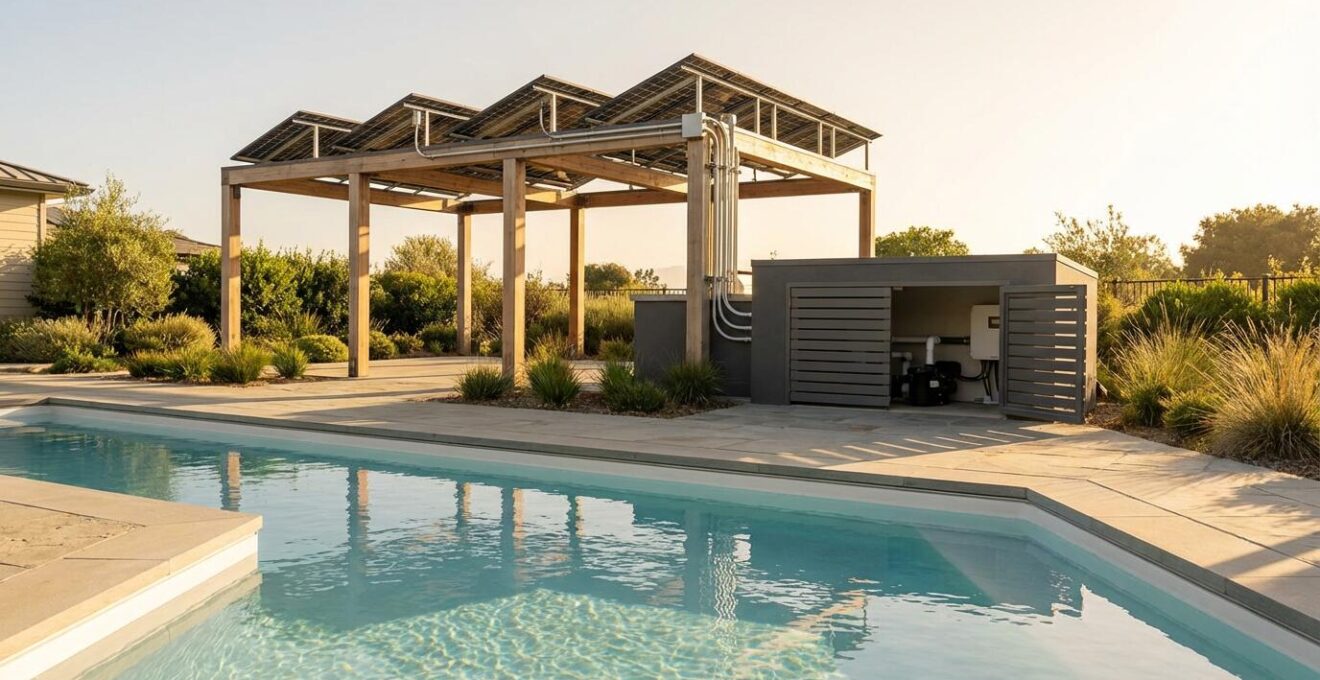
The secret to a zero-cost pool isn’t just using solar panels; it’s transforming your pool into an intelligent, grid-interactive energy asset for your entire home.
- Instead of simple timers, smart orchestration uses real-time data (weather, grid prices) to make decisions.
- Your pool can function as a “thermal battery,” storing free solar energy as heat to reduce costs.
Recommendation: Shift your mindset from “saving on the pump” to “leveraging the entire pool ecosystem” to achieve total energy independence.
For eco-smart homeowners, the swimming pool often represents a frustrating paradox. It’s a source of joy and relaxation, but also a significant and relentless drain on your home’s energy budget. You’ve invested in solar panels to achieve energy autonomy, yet the pool pump and heater continue to be major power consumers, often running at inconvenient or expensive times. The conventional wisdom suggests using simple timers to align pump operation with peak sunlight, but this is a blunt instrument in a world that demands surgical precision.
This approach merely scratches the surface of what’s possible. It treats the pool as a dumb load to be managed, not as an active component of your home’s energy strategy. What if the very thing that consumes energy could become a key to unlocking greater savings and resilience? What if your pool could intelligently decide when to run, how fast to run, and even store excess energy for later use? This is the difference between simple automation and true system orchestration.
The real breakthrough lies in shifting your perspective. Instead of just aiming to run your pool for free, the goal is to integrate it so deeply into your home’s smart grid that it becomes a dynamic energy asset. This article will guide you through this paradigm shift. We will explore how to create a fully orchestrated system that not only zeroes out your pool’s energy costs but also enhances your security, lifestyle, and overall energy independence.
This guide provides a comprehensive roadmap for transforming your pool into a cornerstone of your smart energy ecosystem. From selecting the right control platform to implementing advanced security protocols and leveraging your pool as a thermal battery, you’ll discover the strategies to achieve complete energy autonomy.
Summary: How to Orchestrate Your Pool for True Energy Autonomy
- Why syncing pool lights with garden audio creates an immersive atmosphere?
- How to trigger outdoor cameras automatically when the pool cover opens?
- Control4 or Home Assistant: Which Platform Handles Complex Pool Logic Best?
- The network security flaw in cheap smart pool controllers
- When to run high-load pool equipment to benefit from time-of-use tariffs?
- Why Inverter Heat Pumps Are Worth the Extra Upfront Cost for Large Pools?
- How to Use Pool Lighting Colors to Reduce Stress After Work?
- Unlocking the Full 80% Carbon Reduction Potential Through Smart Orchestration
Why syncing pool lights with garden audio creates an immersive atmosphere?
Creating an immersive backyard experience is not merely about synchronizing lights and music; it’s about intelligent system orchestration. A truly smart system doesn’t just play a “Party” scene. It layers sensory inputs, responding to the environment and your behavior. Imagine lights that subtly shift in color and intensity to match the tempo of your music, or a “Sunset Lounge” scene that automatically activates based on the astronomical clock, dimming the lights and starting a chill-out playlist as dusk settles. This level of sophistication transforms your pool area from a static space into a living, breathing environment.
This dynamic atmosphere is a direct result of a system that understands context. It can pre-charge your home’s battery system during peak solar hours, ensuring you have ample free energy for an entire evening of entertainment without ever touching the grid. Advanced setups can even integrate weather data, adjusting scenes automatically based on the evening temperature or forecast. For example, a cooler evening might trigger warmer light tones and a more subdued audio profile.
The core components of such a system include:
- A central smart home hub (like Home Assistant) capable of communicating across different protocols (Z-Wave, Zigbee, Wi-Fi).
- Smart, color-capable pool and landscape lights (e.g., Philips Hue or dedicated pool lighting systems).
- An integrated outdoor audio system (e.g., Sonos or a multi-zone amplifier).
- Sensors and data feeds, such as weather APIs and energy monitors.
When these elements are orchestrated, the result is an atmosphere that feels intuitive and magical. It’s an environment that anticipates your needs and enhances your experience, all while running on clean, self-generated energy. A California homeowner demonstrated this by installing solar panels and a battery system that not only covers their pump’s needs but also powers their entire evening entertainment setup, achieving complete energy independence.
How to trigger outdoor cameras automatically when the pool cover opens?
For an energy-autonomous home, security is not an add-on; it’s a core component of resilience. A truly smart pool security system moves beyond simple alerts to a tiered, automated response system. The goal is cyber-physical resilience—a system that not only detects threats but also acts intelligently to deter them and preserve its own operational integrity. The instant an automated pool cover is opened unexpectedly, it should trigger a cascade of pre-programmed actions, demonstrating a proactive security posture.
This is far more advanced than a simple notification. A well-orchestrated system uses logic to escalate its response. For instance, the initial trigger (cover opening) might send a silent snapshot to your phone. If motion is then detected near the pool’s edge within 60 seconds, the system could escalate by activating all landscape lights to 100% brightness. If advanced AI object detection identifies a human figure lingering near the water for more than 10 seconds, it could trigger an audible siren or a pre-recorded voice warning. This tiered approach minimizes false positives while ensuring a robust response to genuine threats.
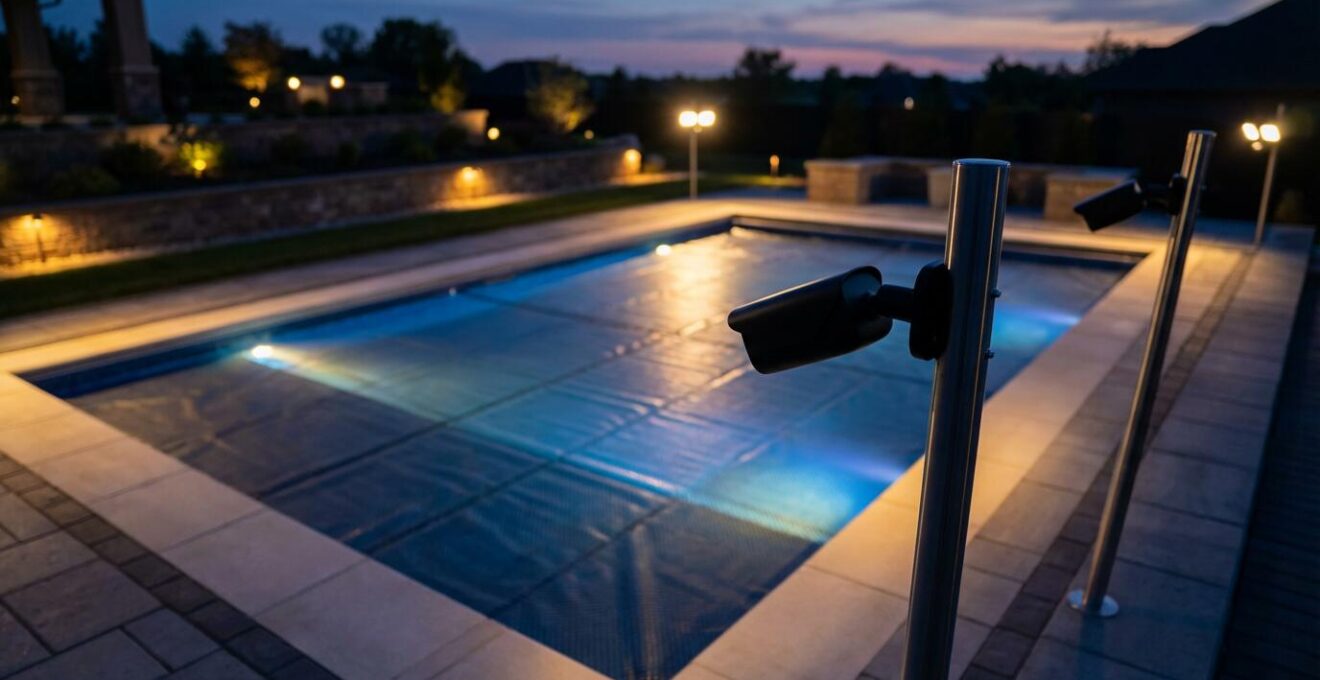
As the visual shows, this creates an invisible network of protection. To prevent nuisance alerts, intelligent filters are crucial. For example, you could program the system to only trigger a full alert if both the pool cover sensor and a nearby gate sensor are activated within a short timeframe. Furthermore, true autonomy requires power resilience. A dedicated Uninterruptible Power Supply (UPS) for your security hub, cameras, and sensors is essential, ensuring your protective layer remains active even during a power outage.
Action Plan: Tiered Security Response Setup
- Primary Trigger: Configure the pool cover sensor to send an immediate mobile notification with a snapshot when opened unexpectedly.
- Secondary Response: Program the system to activate all landscape lights at full brightness if motion is detected near the pool within 60 seconds of the primary trigger.
- AI-Powered Escalation: Use cameras with human detection to activate an audible siren or voice warning if a person is detected near the water’s edge for over 10 seconds.
- False Positive Filters: Require a combination of triggers (e.g., cover sensor AND gate sensor) within a 60-second window to initiate a high-level alert.
- Power Backup Strategy: Install a UPS for all critical security components (cover sensor, cameras, hub) and configure it to shed non-critical loads during an outage.
Control4 or Home Assistant: Which Platform Handles Complex Pool Logic Best?
The brain of your autonomous pool ecosystem is its control platform. This choice dictates the level of intelligence and flexibility your system will have. While professionally installed, closed-ecosystem platforms like Control4 offer a polished user experience, they often fall short when it comes to the complex, multi-variable logic required for true energy orchestration. Open-source platforms like Home Assistant, on the other hand, provide unparalleled power for homeowners willing to invest in a more customized setup.
The fundamental difference lies in how they handle data and device integration. A system like Control4 operates within a curated ecosystem, which can be limiting and expensive when you need to integrate specialized equipment like a variable-speed pump (VSP) and a solar inverter from different brands. As one expert on the DIY Solar Forum notes, this often requires “more expensive, specific drivers to achieve… granular control.” In contrast, Home Assistant’s open-source nature allows it to communicate directly with thousands of devices via their APIs, enabling real-time, data-driven decisions without costly middleware. This is the key to unlocking advanced strategies like dynamic load shaping.
Home Assistant can directly use an inverter’s API data to set a VSP’s RPM, versus how a system like Control4 might require more expensive, specific drivers to achieve the same granular control.
– DIY Solar Forum Community, DIY Solar Pool Pump Build Discussion
The real power of a platform like Home Assistant becomes apparent when you start integrating external data feeds for predictive control. You can pull in multiple free weather forecasts to decide if pre-heating the pool with excess solar is a good idea, or even integrate real-time grid electricity pricing to execute energy arbitrage strategies. This level of complex logic is where closed systems struggle. The following table highlights the key differences for pool automation.
| Feature | Control4 | Home Assistant |
|---|---|---|
| Dynamic Load Management | Requires expensive drivers for VSP control | Direct API integration with inverters for real-time RPM adjustment |
| Weather Forecast Integration | Limited to certified weather services | Multiple free weather API options for predictive heating |
| Multi-brand Equipment Support | Curated ecosystem, higher cost | Open platform supporting WiFi sensors, Pentair pumps, SolarEdge inverters |
| Energy Price Integration | Basic time-of-use scheduling | Real-time grid pricing feeds for arbitrage decisions |
| Initial Cost | $3,000-10,000+ with professional installation | $200-500 DIY or $1,500-3,000 professional |
The network security flaw in cheap smart pool controllers
In the pursuit of energy autonomy, it’s tempting to opt for inexpensive, off-the-shelf smart pool controllers. However, these devices often represent the weakest link in your home’s digital fortress. Many are designed with convenience as the primary goal, neglecting fundamental principles of network security. This creates a significant vulnerability, undermining the very cyber-physical resilience you aim to build. A compromised pool controller could provide a backdoor into your entire home network, exposing everything from personal data to other smart home devices.
The most common flaw is a lack of network isolation. These devices are often designed to connect directly to your main home Wi-Fi network and communicate with cloud servers in unknown locations, with minimal security oversight. This is a critical risk. If a vulnerability is found in the device’s firmware or its cloud service, an attacker could potentially gain access to your network. True energy independence requires not just freedom from the grid, but also security from digital threats.
A robust security posture for your pool’s IoT devices is non-negotiable. The strategy is to treat them as untrusted devices and build a secure perimeter around them. This involves several key steps:
- Network Segmentation: The most critical step is to create a separate VLAN (Virtual Local Area Network) exclusively for your pool equipment and other IoT devices. This isolates them from your main network where sensitive data (computers, phones) resides.
- Internet Access Control: Block the pool controller’s internet access directly at your router. Its functions should be controlled locally by your secure smart home hub (like Home Assistant), which acts as a trusted gateway.
- Secure Gateway: Use your smart home hub as a firewall. It can communicate with the pool controller on the isolated VLAN and safely expose only the necessary controls to your main network or a secure remote access portal.
- Strong Encryption: Ensure the IoT network segment is protected with the latest WPA3 encryption standard.
- Firmware Vigilance: Regularly check for and apply firmware updates for all network-connected pool equipment, as these often contain critical security patches.
By implementing this “zero-trust” approach, you can safely integrate any smart pool controller, harnessing its capabilities without exposing your home to unnecessary risk. Your energy autonomy becomes robust and secure from all angles.
When to run high-load pool equipment to benefit from time-of-use tariffs?
The ultimate expression of pool orchestration is not just running it for free with solar, but using it to perform real-time energy arbitrage. This strategy transforms your pool from a simple load into an active financial asset that intelligently interacts with the grid. Instead of a fixed schedule, your system should decide in real-time whether it’s more profitable to use solar energy to run the pump, sell that excess solar back to the grid at a high peak rate, or store it in your home battery.
This requires a system that can process multiple data points simultaneously: your real-time solar production, your home battery’s state of charge, the current time-of-use electricity price, and the feed-in tariff you receive for exporting power. With this data, the system can make sophisticated financial decisions. For example, on a sunny afternoon when grid prices are high, it might be more profitable to export all your solar power and delay the pool’s heating cycle until the off-peak “super cheap” rates kick in after midnight, drawing from the grid when it costs next to nothing.

The key to this strategy is leveraging your pool as a massive thermal battery. The immense volume of water can store vast amounts of thermal energy with very slow dissipation. A smart system can take advantage of this by “overheating” the pool by a degree or two during periods of excess, free solar energy. This stored heat acts as a buffer, reducing the need for the heater to run during more expensive evening hours. One case study showed a pool owner achieving a 50-80% cost reduction by implementing this arbitrage system. This is only possible with a variable-speed pump, where even small adjustments have a huge impact; reducing pump speed by half can achieve an approximate 87% energy reduction.
Case Study: Real-Time Energy Arbitrage
A homeowner implemented an automated system monitoring solar production, battery charge, and real-time electricity prices. The system intelligently decides to run the pump on solar, sell excess energy to the grid, or delay operation to off-peak hours. By using the pool as a ‘thermal battery’—overheating it by 1-2 degrees with excess midday solar—they store free energy to offset evening heating needs, slashing overall costs significantly.
Why Inverter Heat Pumps Are Worth the Extra Upfront Cost for Large Pools?
In a fully orchestrated pool system, the pump is the muscle, and an inverter-driven variable-speed pump (VSP) is a highly intelligent and responsive one. While the upfront cost is higher than a single-speed pump, it’s a foundational investment for achieving true energy autonomy. The reason is simple: an inverter pump allows for dynamic load shaping. Instead of being a binary “on/off” device, it can precisely modulate its power consumption in real-time to match available energy.
When paired with a solar array, this capability is transformative. On a bright, sunny day, the pump can run at high speed for maximum filtration. As clouds roll in and solar production drops, a smart controller can instantly tell the pump to slow down, reducing its power draw to match the lower solar output. This ensures the pump runs continuously on free energy without ever needing to draw from your battery or the grid. This granular control is where the savings are generated. In fact, modern solar pump inverters achieve over 99% MPPT efficiency, ensuring almost every watt generated is put to use. The pumps themselves are also hyper-efficient, with some modern inverter pumps achieving an 87% efficiency rating.
The benefits of inverter technology extend far beyond simple solar matching, especially for off-grid or battery-backup systems:
- Soft Start Capability: Inverter pumps ramp up speed gradually. This “soft start” prevents the massive inrush current typical of single-speed pumps, which can often trip battery inverters or place a heavy, sudden load on your system.
- Silent Operation: For tasks like overnight temperature maintenance or gentle filtration, the pump can run at an extremely low, inaudible speed, enhancing the tranquility of your home.
- Extended Lifespan: The brushless motors in inverter pumps are designed for longevity, with lifespans of 20,000-30,000 hours compared to the 2,000-5,000 hours of a conventional brushed motor.
- Smart Load Management: An inverter pump is a team player in your home’s energy ecosystem. It can automatically reduce its consumption when it detects another high-load appliance (like an EV charger) turning on, helping to manage your total household power draw.
An inverter heat pump isn’t just a more efficient component; it’s the enabling technology that makes advanced energy orchestration strategies possible. It’s the difference between a system that reacts and one that intelligently responds.
How to Use Pool Lighting Colors to Reduce Stress After Work?
The true power of a smart home is its ability to enhance human well-being. By orchestrating your pool’s ecosystem, you can create a personalized “end-of-day” ritual designed to actively reduce stress. This goes far beyond simply turning on some blue lights. A bio-adaptive lighting automation uses data and timing to create an environment that helps your body and mind transition from a state of high alert to one of relaxation.
This automation can be triggered automatically. By linking your smart home platform to your work calendar or your phone’s GPS, the “Reduce Stress” scene can begin the moment you leave the office. As you arrive home, the system is already at work. This isn’t just one action, but a sequence of orchestrated events. As one home automation expert puts it, the system should engage the entire ecosystem.
The ‘Reduce Stress’ automation shouldn’t just be lights. It should trigger the entire ecosystem: lower the noisy variable speed pump to a silent, low-flow mode, start a calming playlist on garden speakers.
– Home Automation Expert, Advanced Pool Automation Strategies
The lighting itself can be programmed with biological principles in mind. The sequence could start with a 30-minute transition from bright, cool white light to calming blues and cyans, mirroring the natural progression of a sunset. Following a day of staring at screens, specific frequencies of soft green light can be used to help reduce eye strain. As bedtime approaches, the system can shift to warm amber and red tones, which are known to avoid suppressing the body’s natural melatonin production, helping you prepare for a more restful sleep.
A complete bio-adaptive routine could include the following programmed steps:
- Automatic Trigger: Scene activates based on a calendar event ending or GPS data showing you are heading home.
- Sunset Simulation: A slow, 30-minute fade from bright white to deep blues and cyans.
- Eye Strain Reduction: A phase using soft green light frequencies post-sunset.
- Pre-Sleep Mode: A final shift to warm amber/red tones in the hour before your typical bedtime.
- Ecosystem Coordination: The variable speed pump simultaneously shifts to a silent, low-flow mode, and integrated garden speakers begin playing a calming, ambient playlist.
This is the ultimate expression of an orchestrated home: technology that works silently in the background not just to save energy, but to actively improve your quality of life.
Key Takeaways
- Think of your pool as a “thermal battery” capable of storing free solar energy as heat, not just a load to be powered.
- True autonomy comes from “orchestration”—making real-time decisions based on multiple data points—not just “automation” based on a simple timer.
- Cyber-physical resilience is non-negotiable; securing your pool’s smart devices on an isolated network is as important as locking your front door.
Unlocking the Full 80% Carbon Reduction Potential Through Smart Orchestration
While inverter technology in a pool pump is a massive leap forward, viewing it in isolation misses the bigger picture. On its own, an inverter pump can significantly reduce energy consumption. However, the true potential for carbon reduction is only unlocked when this efficient hardware is governed by intelligent system orchestration. The technology itself might promise a 40% reduction, but it’s the smart logic controlling it that pushes that figure towards its maximum potential.
When an inverter pump is combined with solar panels and a smart controller that practices dynamic load shaping and energy arbitrage, the results are compounded. Industry analyses show that this holistic approach is what truly makes a difference, confirming that when paired with smart orchestration and solar, inverter pumps can achieve a 70-80% carbon reduction. This is because the system is no longer just efficient; it’s strategic. It uses the “right amount of energy at the right time for the right job.”
A perfect illustration of this principle is a system that modulates pump speed based on the task at hand. It doesn’t need to run at full power all day. A DIY case study demonstrated a system that used only 150W for gentle overnight circulation, 400W for daily filtration during peak sun, and ramped up to its full 1200W capacity only when necessary for demanding tasks like vacuuming or running a heater. This intelligent, tiered approach to power usage is the essence of smart reduction.
Case Study: The “Right Speed for the Right Job”
A DIY solar installation powered a 1200W DC pump. The smart controller automatically modulated the pump’s speed based on available sunlight, dropping from 12.5 amps in full sun to just 3 amps during cloud cover. By matching speed to the task (low for circulation, medium for filtration, high for cleaning), operating costs plummeted by $60/month, leading to an 18-month payback period on the solar investment.
Achieving a truly “free” and carbon-neutral pool is not about a single device. It is about creating a symbiotic ecosystem where efficient hardware (inverter pumps), clean energy generation (solar panels), and intelligent decision-making (a smart hub) work in concert. This is the path to complete energy autonomy.
To begin your journey toward energy autonomy, the first step is to audit your current system and identify the opportunities for smarter orchestration. Evaluate your pump, your control system, and your network security to build a roadmap for your home’s energy future.