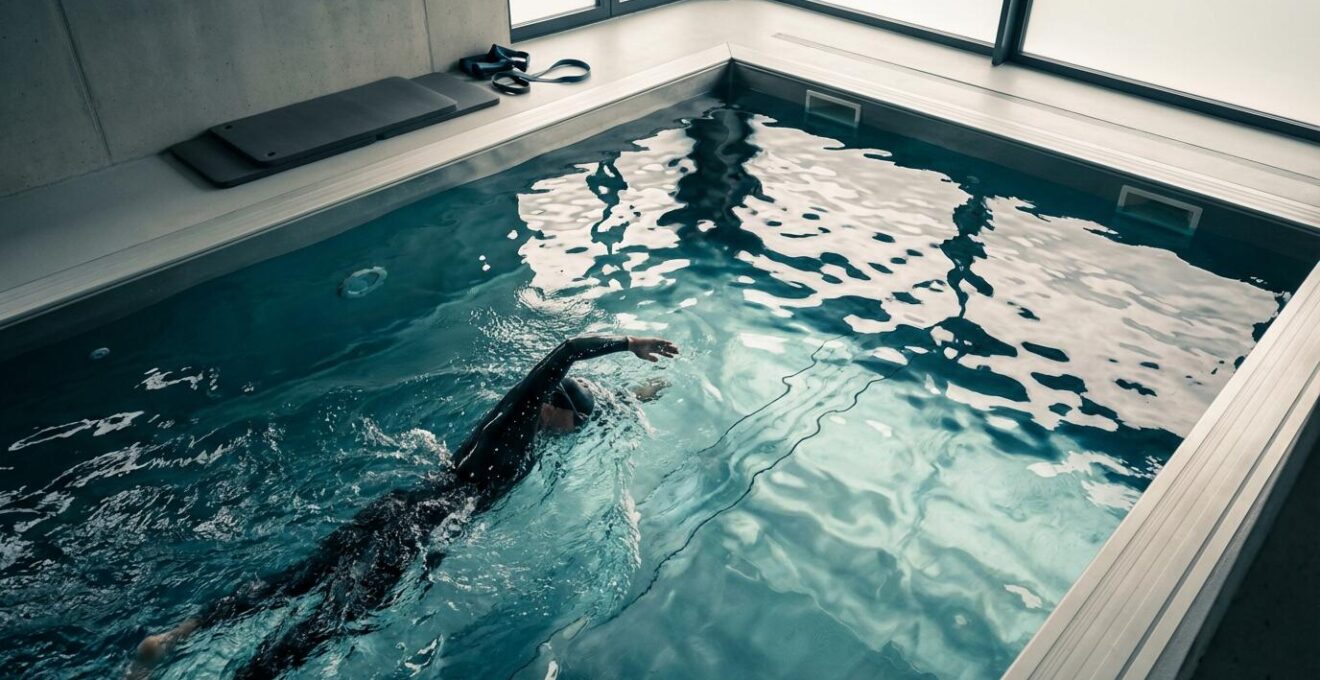
A 4-meter pool isn’t a training compromise; it’s a high-performance lab that builds elite swimmers faster than a traditional pool.
- The constant current provides amplified, real-time feedback that exposes and corrects stroke flaws instantly.
- Advanced systems allow for precise simulation of open-water race conditions, from drafting to choppy water.
Recommendation: Shift your focus from logging junk miles to mastering intensity, technique, and recovery within your perfectly controlled training environment.
For any serious triathlete, the swim leg is a battle of technique, endurance, and strategy. The common belief is that this requires endless laps in a 50-meter pool. So, the idea of training in a 4-meter backyard pool might sound like a significant downgrade—a last resort for the space-constrained athlete. Many articles will tell you to just “swim against the current” or “do some intervals,” treating it as a simple substitute for a real pool. This approach misses the revolutionary potential sitting in your backyard.
But what if this compact environment wasn’t a compromise at all? What if, instead, it was a hyper-focused performance laboratory? The secret lies not in simply resisting the water, but in understanding how the constant, uniform current becomes your most honest and demanding coach. This environment creates what we can call proprioceptive amplification—an immediate and unforgiving feedback loop that forces you to feel and correct every inefficiency in your stroke, something easily masked by the stop-and-start nature of lap swimming.
This guide isn’t about simply surviving your training in a small pool. It’s about leveraging its unique properties to hardwire perfect technique, build unshakeable open-water resilience, and fine-tune your recovery. We will deconstruct how to optimize your current, avoid common intensity mistakes, and use your pool’s features to become a stronger, more efficient triathlete. We will explore everything from the biomechanics of current-based training to the critical role of a quiet environment and targeted hydrotherapy in your quest for peak performance.
Summary: From Stroke Mechanics to Race Simulation: Your Complete Guide
- Why does swimming against a current improve your stroke efficiency?
- How to position the turbine to create a turbulence-free swimming channel?
- Turbine or Jet Pump: Which System Provides a Smoother Swim Current?
- The intensity mistake that leads to exhaustion within 5 minutes
- When to vary current speed to simulate open water conditions?
- Why Magnesium Pools Are the New Standard for Wellness Retreats at Home?
- Why a Silent Filtration System is Crucial for Courtyard Pools?
- How Venturi Jets Multiply Massage Pressure Without Extra Energy?
Why does swimming against a current improve your stroke efficiency?
Swimming against a current fundamentally changes the training dynamic from logging distance to mastering form. In a traditional pool, momentum can mask technical flaws. In a counter-current pool, the water flow is constant and unforgiving; any break in your form, any weakness in your catch, or any asymmetry in your pull is instantly revealed as you get pushed backward. This isn’t just resistance training; it’s a real-time diagnostic tool. A meta-analysis of thirteen studies involving 267 competitive swimmers confirmed that resistance training yields significant improvements in stroke efficiency, and a swim current is the ultimate form of applied resistance.
This amplified feedback loop accelerates the process of neural grooving. Your body is forced to find the most efficient path through the water to maintain its position. This is where you truly learn to “anchor” your forearm and hand, using them to pull your body past the water, rather than just pushing water backward. It’s a subtle but profound shift in mechanics that translates directly to open-water speed.
Professional triathlete Lionel Sanders provides a powerful example of this principle in action. While training in his Endless Pool, he used the immediate feedback to identify and correct a critical flaw: his hands were crossing the centerline of his body on entry. This is a common mistake that creates drag and snaking movement. By seeing and feeling the current push him sideways the moment he made the error, he was able to make daily, incremental corrections, ingraining a more powerful and direct stroke into his muscle memory.
How to position the turbine to create a turbulence-free swimming channel?
The goal of a swim current system is not to create a firehose of chaotic water but a smooth, wide, and deep “river” of laminar flow. Achieving this depends almost entirely on the correct positioning of the turbine. A poorly aimed current creates turbulence, eddies, and surface chop that make for a frustrating and unproductive swim. Your objective is to establish a turbulence-free swimming channel that is wider than your body and deeper than your stroke. This provides the clean water resistance needed for effective training, without the distraction of splashing water in your face or your hips swaying uncontrollably.
To achieve this, the core of the current should generally be aimed at the upper-middle third of the water column. If the current is too high, it will create surface waves and splash in your face. If it’s too low, it won’t engage your core and upper body effectively. The key is to create a powerful, non-turbulent flow that you can press your chest and core into, promoting a stable, downhill swimming posture.
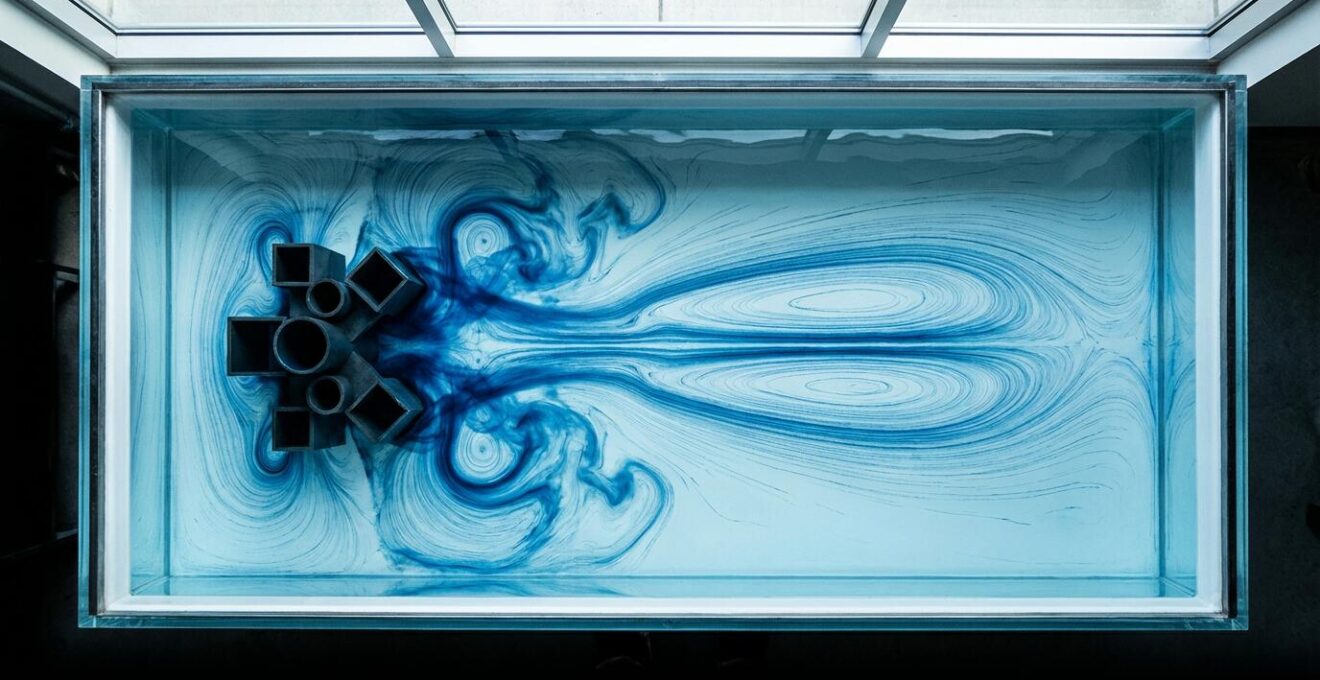
The overhead view above illustrates the ideal outcome: a central channel of smooth current with return channels on the sides. This setup ensures your body remains stable and centered. If you find your hips are swaying, it often means you are missing this lateral flow stabilization, which can sometimes be corrected by offsetting the turbine’s aim just slightly to one side. Dialing in the perfect position is a process of small adjustments and testing, but the payoff is a pristine swimming experience. The following guide can help troubleshoot common issues.
This table outlines solutions to the most frequent turbulence problems, linking them to their technical causes. A methodical approach to these adjustments will transform your pool into a perfect training ground.
| Problem | Solution | Technical Reason |
|---|---|---|
| Water splashing in face | Lower turbine’s vertical angle by 10-15° | Current too high in water column |
| Hips swaying uncontrollably | Offset turbine slightly to create return channel | Missing lateral flow stabilization |
| Eddies along pool walls | Aim core current at upper-middle third of water | Coandă Effect causing surface adhesion |
| Narrow swim channel | Widen turbine outlet or reduce flow speed | Excessive velocity creating jet stream |
Turbine or Jet Pump: Which System Provides a Smoother Swim Current?
When it comes to creating a quality swim current, not all systems are created equal. The primary distinction lies between jet pump systems and modern turbine systems. While jet pumps are common, they often produce a narrow, turbulent, and bubbly stream of water. For a triathlete focused on technique, this is problematic. You end up fighting bubbles and turbulence rather than engaging with a solid, predictable column of water. It’s like trying to run on uneven, shifting sand versus a firm track.
Turbine systems, on the other hand, are engineered to move a large volume of water at a lower velocity. This is the key to creating a smooth, deep, and wide current that mimics the feel of an open-water river. Studies show that turbine systems produce water flow wider than your body and deeper than your stroke, which is essential for proper body alignment and a full, effective pull. This creates the feeling of swimming in truly moving water, allowing for a much more realistic and beneficial training experience.
The experience of triathlete Ryan, who is visually impaired, highlights this difference perfectly. When comparing systems, he needed a current that was powerful and predictable. He noted that with a turbine, “There are zero bubbles there. Zero. No turbulence.” He found that the jet systems he tried simply lacked the smooth power required for serious swim training. For athletes who rely on sensory feedback—which is every swimmer, to some degree—a clean, bubble-free current is non-negotiable. The turbine provides that smooth canvas on which to perfect your stroke, offering the hydrodynamic stability needed for high-level training.
The intensity mistake that leads to exhaustion within 5 minutes
The most common mistake athletes make when first using a counter-current pool is cranking the speed up too high. It’s a natural impulse: more resistance must equal a better workout. But this “go hard or go home” mentality is counterproductive. It turns your swim into a desperate, anaerobic fight for survival, where technique collapses and exhaustion sets in within minutes. You’re not training for a 100-meter sprint; you’re building endurance for a triathlon. The goal is to find your Endurance Base Pace—a sustainable, conversational effort (Zone 2) where you can hold perfect form for extended periods.
As professional triathlete Lionel Sanders found, the key is consistency and repetition. He noted on his personal training blog after dialing in his technique:
Within two weeks I was grooving the changes, and by race week they were beginning to ingrain in the muscle memory.
– Lionel Sanders, Personal Training Blog
This “grooving” of changes is impossible at maximum intensity. It requires swimming at a controlled pace where you can focus on the sensory feedback the current is providing. By calibrating your effort correctly, you can complete long, technique-focused sessions that build both aerobic capacity and flawless mechanics. For athletes using tethers, the same principle applies: avoid maximum tension, which turns the swim into a pure strength exercise, and instead find the “sweet spot” of tension that allows you to remain stationary with good form.
Your Action Plan: Calibrating Perceived Exertion
- Begin at the lowest current setting for an initial 2-minute assessment to establish a baseline feel.
- Increase speed by one increment every 2 minutes until you find the pace that feels like Zone 2 or a conversational effort.
- Mark this as your ‘Endurance Base Pace’ for all distance and long training sessions.
- For tether users: Find the ‘sweet spot’ tension—just enough to remain stationary without excessive strain.
- Avoid maximum tension or speed, which turns swimming into an unsustainable strength exercise and degrades technique.
When to vary current speed to simulate open water conditions?
Once you’ve established your Endurance Base Pace, the next step is to use the variable speed of your current system to simulate the chaotic, unpredictable nature of an open-water race. A real race is never a steady-state effort. It involves surges at the start, drafting off other swimmers, sighting in choppy water, and a final sprint to the finish. Your 4-meter pool is the perfect environment to rehearse every one of these scenarios with unparalleled precision. Many triathletes report that the adjustable current provides a remarkable simulation of real open-water conditions.
The key is to move beyond steady swimming and incorporate structured interval sets that mimic race dynamics. For example, you can practice a “Race Start Simulation” by beginning with a 90-second surge at a high intensity (Zone 4/5) before settling back into your base pace. Or, you can work on “Drafting Intervals” by alternating between your base pace and a slightly lower speed to simulate the energy-saving effect of swimming behind someone, followed by a short burst to practice overtaking.
One of the most valuable simulations is “Sighting Under Duress.” In this drill, you increase the current speed for 5 seconds while performing two quick sighting lifts. This trains you to maintain your form and core stability while looking up in challenging conditions, a skill that can save you significant time and energy on race day.
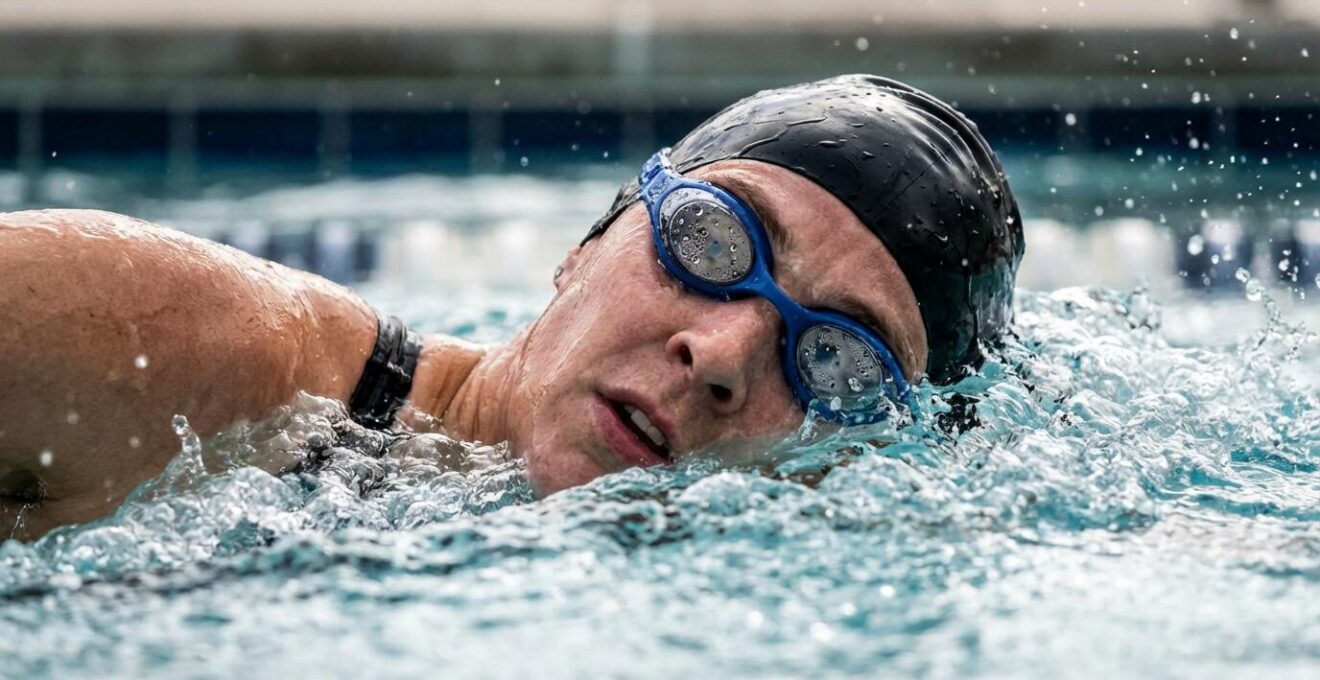
Here are some specific training sets to incorporate into your routine:
- Race Start Simulation: 90 seconds at Zone 4/5, then drop to Zone 2 base pace for 5-10 minutes.
- Drafting Intervals: Alternate 45 seconds at a lower speed (simulating a draft) with a 15-second surge to overtake. Repeat 8-10 times.
- Sighting Under Duress: Every 30 seconds of a 5-minute block, perform 2 sighting lifts while simultaneously increasing the current speed for 5 seconds.
- Choppy Water Simulation: Use a random speed setting (if available) or manually change the speed every 20-30 seconds to mimic unpredictable waves.
- Sprint Finish: In the final 2-3 minutes of your main set, progressively build the speed every 60 seconds to a maximum sustainable pace.
Why Magnesium Pools Are the New Standard for Wellness Retreats at Home?
For a triathlete, training is only half the battle; recovery is the other half. This is where the chemistry of your pool water becomes a powerful tool. While traditional chlorine or saltwater pools are effective for sanitation, magnesium-enriched pools are emerging as the new standard for athletes seeking a wellness-focused experience. A magnesium pool isn’t just about swimming; it’s about creating a therapeutic environment that accelerates recovery and soothes the body after intense workouts.
Magnesium is absorbed transdermally (through the skin), and it plays a crucial role in over 300 biochemical reactions in the body, including muscle function, nerve transmission, and energy production. For an athlete, its most important benefits are its anti-inflammatory and muscle-relaxant properties. Soaking in magnesium-enriched water can help reduce the delayed onset muscle soreness (DOMS) that is all too familiar to triathletes.
Furthermore, the water in a magnesium pool feels noticeably softer and silkier. It’s less harsh on the skin and eyes compared to heavily chlorinated water, making for a much more pleasant and luxurious experience. This shift turns your post-workout swim or soak from a chore into a restorative ritual. As confirmed by studies on athletes, magnesium acts as an antioxidant and anti-inflammatory agent, helping to clear metabolic waste products from the muscles and reduce inflammation. This leads to faster recovery, allowing you to train harder and more consistently.
Why a Silent Filtration System is Crucial for Courtyard Pools?
In the confined space of a courtyard or small backyard, acoustic tranquility is a precious commodity. The constant hum and gurgle of a noisy pool filtration system can transform a potential oasis into a source of chronic, low-level stress. For a triathlete, mental energy is just as important as physical energy, and a noisy environment can drain your motivation before you even get in the water. As one visually impaired triathlete, Ryan, put it when describing the mental fatigue of a noisy training space:
By the time you get to the pool, you’ve got this huge set in front of you, but mentally, I just want to close my eyes and take a nap. It really kills your motivation.
– Ryan (visually impaired triathlete), Endless Pools Blog on Mental Energy and Training
This highlights a critical, often-overlooked aspect of training: the environment’s impact on your mental state. A silent filtration system eliminates this distracting “noise floor,” preserving the courtyard as a peaceful retreat and ensuring your mental energy is focused on the workout, not on tuning out background noise. This is especially vital for the kind of deep, focused work required to improve swimming technique.
Moreover, a quiet environment enables a higher level of sensory calibration. You can actually hear your stroke. Lionel Sanders famously used this auditory feedback to his advantage, slowing his pace down to hear the difference between a clean, efficient hand entry—a “zip” sound—and a sloppy, energy-wasting “slap.” This level of auditory detail is impossible to perceive with a loud pump running. A silent system isn’t just a luxury; it’s a performance-enhancing tool that allows for deeper focus and a more refined connection with your technique.
Key Takeaways
- A counter-current pool provides instant, amplified feedback that is superior to lap swimming for technique correction.
- The quality of the swim depends on a smooth, wide, non-turbulent current, achieved through proper turbine choice and positioning.
- Training intensity must be carefully calibrated to an aerobic “Endurance Base Pace” to build endurance and hardwire muscle memory.
How Venturi Jets Multiply Massage Pressure Without Extra Energy?
After a grueling brick workout, targeted recovery is essential. This is where the hydrotherapy features of your swim spa become a critical part of your training arsenal. Many high-performance spas utilize Venturi jets, a clever piece of engineering that delivers a powerful massage without requiring an extra energy-guzzling pump. Understanding how they work reveals why they are so effective for athletic recovery.
The Venturi effect is a principle of fluid dynamics. A Venturi jet works by funneling the moving water through a constricted cone shape. As the water is forced through this narrowing, its speed increases, which in turn causes a drop in pressure. This pressure drop creates a vacuum that draws in surrounding air through a small port. The air mixes with the high-velocity water stream, creating a powerful, bubbling jet of water that feels much stronger than a stream of water alone. This “multiplication” of pressure is achieved purely through physics, not by adding more horsepower.
For a triathlete, this targeted pressure is perfect for post-workout hydro-massage. It helps to increase blood flow to sore muscles, flush out lactic acid, and reduce inflammation. Studies demonstrate that targeted recovery protocols reduce muscle soreness by 1-2 units on a 6-point scale, and hydrotherapy is a cornerstone of such protocols. By positioning your body to allow the Venturi jets to work on key muscle groups like the lats, traps, and calves, you can significantly accelerate your recovery time.
Here is a simple, triathlete-specific routine to follow post-workout:
- Position jets at shoulder level for 3 minutes, targeting your lats and rear deltoids.
- Adjust to mid-back height for 3 minutes to work on the rhomboids and trapezius.
- Lower the jets to target your triceps and forearms for 2 minutes on each arm.
- Use a lower jet setting on rest days for gentle, active recovery without workout stress.
- Combine this routine with magnesium-enriched water for an even greater recovery benefit.
- Complete the entire routine within 30 minutes of your workout for optimal effect.
By shifting your perspective and using your 4-meter pool as the advanced training tool it is, you unlock a new level of performance. To build a truly comprehensive training plan, begin by creating your own personalized recovery protocol based on these hydrotherapy principles.