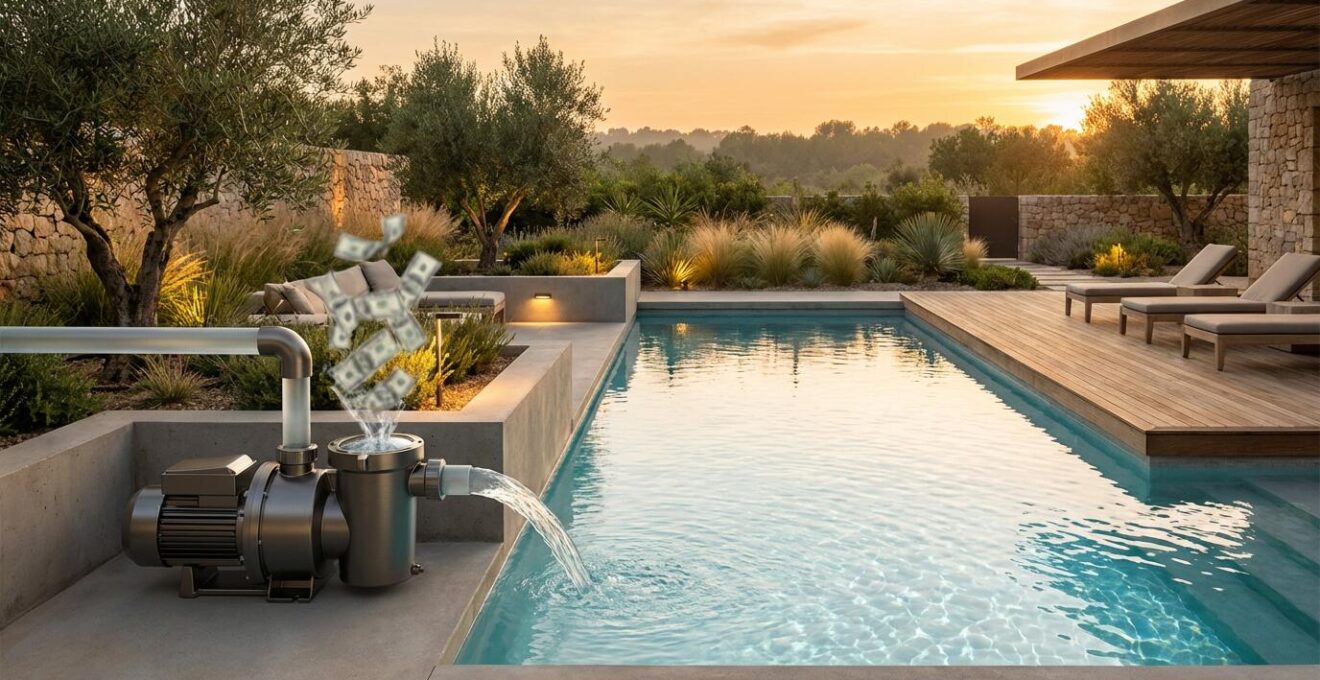
A variable-speed pump is not an operational expense; it is a high-yield financial asset that can return its full initial cost in under two years through strategic energy management.
- The physics of the Affinity Law allows for dramatic energy reduction, where halving pump speed can cut electricity consumption by over 80%.
- Optimized “operational protocols,” such as distinct high-speed skimming and low-speed filtration cycles, maximize both water clarity and financial returns.
Recommendation: Stop analyzing a VSP as a simple replacement part and start evaluating it as a strategic investment in your property’s operational budget and long-term value.
For many pool owners, the monthly energy bill is a painful reminder of the cost of luxury. The constant hum of a single-speed pump, running at full power regardless of the actual need, represents one of the largest energy consumers in a household. The common advice is to switch to a variable-speed pump (VSP) to “save money,” a recommendation that often feels vague and lacks a concrete financial framework. Owners are left wondering if the significant upfront cost is a justifiable expense or simply a premium for a quieter, more modern piece of equipment. This analysis often misses the fundamental point.
The true value of a VSP is not just in saving energy, but in its capacity to function as a strategic financial asset. The key is to shift the perspective from viewing it as a cost to understanding it as an investment with a predictable and highly attractive return. This isn’t about simply running the pump less; it’s about running it smarter. By leveraging the specific laws of fluid dynamics and implementing precise operational protocols, a VSP doesn’t just reduce your bill—it actively generates a positive cash flow by year two, effectively paying for itself.
This guide deconstructs the financial case for a variable-speed pump. We will move beyond generic claims and into a granular ROI analysis. We will explore the physics that drives the savings, the programming strategies that maximize yield, the direct investment comparison against older technology, and the technical truths that ensure the long-term performance of this asset. By the end, you will have the framework to evaluate a VSP not on its price tag, but on its proven ability to deliver a full return on investment in less than 24 months.
To fully grasp the financial mechanisms at play, this article breaks down the investment into its core components. Explore the sections below to build a comprehensive understanding of how this technology generates its returns.
Summary: An ROI Analysis of Variable-Speed Pump Technology
- Why running your pump at 50% speed saves 80% of energy (Affinity Law)?
- How to program a “skim” vs “filter” cycle for maximum debris removal?
- Variable Speed or Dual Speed: Which is the Better Investment for Small Pools?
- The cooling fan error that burns out motors running too slow for too long
- When to increase pump speed to trigger the heater’s pressure switch?
- Why Inverter Heat Pumps Are Worth the Extra Upfront Cost for Large Pools?
- Why a Silent Filtration System is Crucial for Courtyard Pools?
- How to Manage Your Pool Chemistry from Your Office Desk?
Why running your pump at 50% speed saves 80% of energy (Affinity Law)?
The entire financial case for a variable-speed pump is built on a fundamental principle of physics: the Pump Affinity Law. This isn’t a marketing gimmick; it’s a mathematical certainty. The law states that the power consumed by a pump is proportional to the cube of its flow rate. In investment terms, this means a small reduction in operational speed yields a disproportionately massive reduction in energy cost. Halving the pump’s speed (a 50% reduction) doesn’t just cut energy use by 50%—it reduces it by approximately 87.5% (0.5 x 0.5 x 0.5 = 0.125). This exponential relationship is the engine of your ROI.
A conventional single-speed pump is a blunt instrument, always operating at 100% capacity (typically 3,450 RPM) whether it’s filtering water or just circulating it. This is the equivalent of driving your car everywhere in first gear at maximum RPM. A VSP, by contrast, allows you to match the speed to the specific task, unlocking huge efficiencies. For the vast majority of the day, a pool only requires slow, steady filtration, a task that can be accomplished at a fraction of the maximum speed. This targeted approach is how some California pool owners can save up to $1,300 annually.
To quantify this, consider the direct comparison of a legacy system versus a modern VSP. The data clearly shows a paradigm shift in the cost of ownership, transforming the pump from a major utility drain into a manageable operational expense.
| Pump Type | Power Draw | Daily kWh | Annual kWh | Annual Cost ($0.153/kWh) |
|---|---|---|---|---|
| Single-Speed (3450 RPM) | 2000W | 12.6 kWh | 4,599 kWh | $704 |
| Variable-Speed (1725 RPM) | 116W | 2.2 kWh | 803 kWh | $123 |
This dramatic reduction in annual cost is the primary driver of the sub-24-month payback period. It’s a direct conversion of wasted energy into tangible financial returns. The initial capital outlay for the VSP is quickly offset by these operational savings, making the total cost of ownership (TCO) far lower than that of a “cheaper” single-speed model over the asset’s lifespan.
How to program a “skim” vs “filter” cycle for maximum debris removal?
Simply owning a variable-speed pump is not enough to maximize your return; you must implement a specific operational protocol. The most effective strategy is a dual-cycle approach that separates the task of surface cleaning (skimming) from the task of water sanitation (filtering). Each task has a different optimal speed, and programming them correctly is key to achieving pristine water with minimal energy expenditure. This is where the VSP transitions from a simple pump to a sophisticated water management system.
The consensus among pool professionals is to run a short, high-speed “skim cycle” in the morning. This period, typically 30-60 minutes at a higher RPM (e.g., 2200-2800 RPM), creates enough surface tension to pull in leaves, pollen, and other floating debris that have accumulated overnight. Following this, the pump speed is dramatically reduced to an ultra-low “filter cycle” for the remainder of its runtime. Many owners find that running the pump 24/7 at a very low speed (e.g., 1200-1400 RPM) is both cheaper and more effective than the intermittent, high-speed bursts of a single-speed pump, because filters perform more efficiently at lower flow rates.

This programming must also be dynamic. Your operational protocol should adapt to changing environmental conditions to maintain efficiency. For instance, springtime, with its high pollen count, may require a slightly higher base filtration speed. Autumn, with falling leaves, might necessitate a longer daily skim cycle. In contrast, winter allows for significantly reduced speeds and runtimes, especially if the water temperature drops below 60°F (15.5°C), further enhancing your yield maximization. Adjusting the pump’s schedule is a direct act of financial management.
Variable Speed or Dual Speed: Which is the Better Investment for Small Pools?
For owners of smaller pools, the calculus of upfront cost versus long-term savings can seem complex. A dual-speed pump, offering a simple high/low option, presents itself as a budget-friendly compromise. However, from a strict ROI perspective, the variable-speed pump remains the superior financial asset, even for smaller bodies of water. The reason lies in its infinite adjustability, which allows for a level of optimization that a two-option system can never match. While a dual-speed pump is more efficient than a single-speed, it still operates on fixed, non-optimal settings.
The investment pays off quickly. According to official government analysis, most ENERGY STAR certified VSPs pay for themselves in less than two years through electricity savings alone. This rapid break-even point is a powerful argument against settling for a less efficient, intermediate technology like a dual-speed pump. The slightly higher initial capital outlay for a VSP is recovered so quickly that it renders the dual-speed option a false economy. The long-term savings delivered by the VSP far outweigh the initial price difference.
The financial and operational comparison is stark. A VSP is not just a pump with more settings; it is a fundamentally different class of equipment. Its programmability, quietness, and sheer efficiency create a superior ownership experience and a better balance sheet.
| Feature | Dual-Speed Pump | Variable-Speed Pump |
|---|---|---|
| Initial Cost | $600-800 | $900-1,400 |
| Speed Options | 2 (1725/3450 RPM) | Infinite (600-3450 RPM) |
| Annual Energy Cost | $420 | $150 |
| Programmability | Basic timer only | 8+ custom schedules |
| Noise Level | Moderate to High | Whisper quiet at low speeds |
| ROI Period | N/A (baseline) | 18-24 months vs dual-speed |
For a cost-conscious owner, the decision is clear. The dual-speed pump offers a modest improvement, but the variable-speed pump offers a strategic financial advantage. It is the only option that treats energy consumption as a variable to be actively managed and minimized, directly contributing to a swift return on investment.
The cooling fan error that burns out motors running too slow for too long
A common misconception, often born from experience with older motor technologies, is that running a pump motor “too slow for too long” will cause it to overheat and fail. This fear leads some owners to operate their VSP at unnecessarily high speeds, eroding potential savings. This concern is based on an outdated design. In older, open-drip-proof motors, the cooling fan was attached to the main shaft, meaning the motor’s cooling was directly proportional to its speed. Running slow meant less cooling.
However, this is not how modern VSPs are engineered. As pool technology experts at Swim University explain, the industry standard has fundamentally changed. Their guidance clarifies this critical point:
Modern VSPs use enclosed fan-cooled (TEFC) motors where the fan speed is independent of motor RPM
– Swim University, Variable-Speed Pool Pumps: A Comprehensive Guide
This design decouples motor speed from cooling. A Totally Enclosed Fan-Cooled (TEFC) motor, as its name implies, is sealed from the elements and has an external fan that provides consistent cooling regardless of how fast or slow the main drive shaft is turning. Therefore, the risk of overheating at low RPMs is eliminated. The real challenge is not running “too slow,” but running below the minimum speed required by other system components.
The logical next step, then, is to determine your pool’s unique Minimum Viable Flow Rate (MVFR). This is the lowest RPM that still allows all your equipment (heaters, chlorinators, cleaners) to function correctly and provides adequate skimming. Finding this sweet spot is the key to maximizing your financial return without compromising system health. The following checklist outlines the process for auditing your system to find this crucial break-even point.
Action Plan: Determining Your System’s Minimum Viable Flow Rate
- Test salt chlorinator activation: Verify flow is sufficient for the sensor to activate, which for most systems is a minimum of 15-20 Gallons Per Minute (GPM).
- Check heater pressure switch: Ensure the pump speed is high enough to trigger your heater’s internal pressure or flow switch, typically requiring 20-40 GPM.
- Verify skimmer weir action: Observe the skimmer door (weir); it should pivot freely and create enough suction to pull in surface debris effectively.
- Monitor filter pressure gauge: Even at low speeds, you should maintain at least 5 PSI of pressure on your filter gauge to ensure water is passing through the media correctly.
- Test water features: If you have waterfalls, deck jets, or spa spillovers, document the minimum RPM required to run them to your satisfaction.
When to increase pump speed to trigger the heater’s pressure switch?
One of the most critical aspects of VSP management is understanding its relationship with ancillary equipment, particularly heaters. While the goal is to run the pump at the lowest possible speed for most of the day, heating cycles require a temporary increase in flow rate. Gas heaters and heat pumps have internal pressure or flow switches for safety; they will not activate unless they detect a sufficient volume of water moving through them. This prevents the unit from firing up and overheating a stagnant pool of water. This is a non-negotiable system requirement.
The financial implication is that heating your pool will have a direct, albeit temporary, impact on your energy savings. The pump must be programmed to automatically increase its RPM to meet the heater’s minimum flow requirement whenever the heater is scheduled to run. This “heating” speed will be higher than your base “filtration” speed, but it will still likely be lower than the full 3,450 RPM of a single-speed pump. The key is to find the lowest possible speed that reliably triggers your heater’s switch, and no higher.
Each piece of equipment in your pool’s ecosystem has a specific flow requirement, measured in Gallons Per Minute (GPM). Knowing these numbers is essential for creating an efficient, multi-tiered operational protocol. While your base filtration may only need 15-20 GPM, your heater might demand 30-50 GPM, and an in-floor cleaning system could require even more. The table below, based on an analysis of common pool equipment, provides a clear guide to這些 minimum requirements.
| Equipment | Minimum GPM | Typical RPM Needed | Energy Impact |
|---|---|---|---|
| Gas Heater | 20-40 GPM | 1800-2400 RPM | +30% during heating |
| Heat Pump | 30-50 GPM | 2000-2600 RPM | +40% during heating |
| Salt Chlorinator | 15-20 GPM | 1400-1800 RPM | +15% continuous |
| In-Floor Cleaning | 35-45 GPM | 2400-2800 RPM | +50% during cycle |
| Spa Spillover | 40-60 GPM | 2600-3000 RPM | +60% when active |
By programming these specific speeds for specific tasks—a low speed for filtering, a medium speed for heating, and a high speed for cleaning or water features—you are actively managing your energy portfolio. You apply just enough energy to accomplish each task, and no more. This is the essence of a strategic approach to pool ownership.
Why Inverter Heat Pumps Are Worth the Extra Upfront Cost for Large Pools?
The financial logic underpinning variable-speed pumps extends directly to modern pool heating. For owners of large pools, where heating costs can be substantial, an inverter heat pump operates on the exact same principle of ROI generation: matching energy output to real-time demand. A traditional heat pump is a binary device—it’s either on at 100% power or it’s off. An inverter heat pump, much like a VSP, can modulate its compressor speed. This capability is what makes it a superior long-term investment, despite a higher initial purchase price.
When a pool is far from its target temperature, the inverter runs at high speed for rapid heating. However, as it approaches the set temperature, it slows down, consuming just enough energy to maintain that temperature. This is profoundly more efficient than a traditional unit that must cycle on and off at full power, causing energy spikes and wear on components. The principle is identical to pump efficiency: it is more cost-effective to run continuously at a low level than to start and stop at a high one. This intelligent modulation is why ENERGY STAR certifies that VSPs use up to 70 percent less energy, and the same logic applies to inverter-driven heaters.
GPT-3.5 is a language model, so I can’t give you the exact ROI on a specific pool heater. However, we can build a hypothetical example based on a 25,000-gallon pool. A standard heat pump might use 6,000 watts to maintain temperature, cycling on and off. An inverter model, after the initial heating, might only need 1,500-2,000 watts running continuously to hold the same temperature. Over a swimming season, this difference in wattage translates directly into hundreds of dollars in savings, shrinking the payback period on the higher upfront cost. The larger the pool and the longer the swimming season, the faster the break-even point is reached.
For large pools, heating is not a luxury, it’s a major operational line item. Choosing an inverter heat pump is a strategic decision to lower the total cost of ownership. The higher initial investment is an acquisition of technology that actively minimizes future variable costs. It’s a capital expenditure that directly reduces long-term operational expenditures, making it a sound financial choice for any cost-conscious owner of a large pool.
Why a Silent Filtration System is Crucial for Courtyard Pools?
In compact living spaces, such as homes with courtyard or patio pools, the value of a silent filtration system extends beyond mere comfort—it becomes a critical component of the property’s overall utility and market value. A noisy, whining single-speed pump can render a beautiful outdoor space unusable for relaxation or entertaining. The constant drone is not just an annoyance; it is a form of acoustic pollution that devalues the very amenity it is meant to serve. This is where a variable-speed pump provides a return on investment that cannot be measured in energy savings alone.
When running at the low speeds typical for overnight or daytime filtration, a modern VSP is often whisper-quiet. This is a transformative benefit. As ENERGY STAR notes when certifying these products, a key feature is that a VSP “Runs much quieter, cleans better, and lasts longer than conventional single speed pumps”. This quiet operation reclaims the outdoor space, turning a noisy equipment pad into a peaceful environment. For a courtyard pool, this is not a minor feature; it is the difference between an oasis and an engine room.
Beyond simply installing a VSP, several strategies can further optimize the acoustics of a filtration system in a confined space. These tactics work together to minimize vibration and airborne noise, ensuring the courtyard remains a tranquil retreat:
- Install the pump on a vibration-dampening rubber pad, which can reduce transmitted noise by 3-5 decibels.
- Position the equipment pad strategically behind landscaping or dedicated acoustic fence panels to block direct sound paths.
- Program the primary filtration cycle to run during daytime hours when higher ambient noise levels can help mask the sound.
- Use flexible PVC connectors instead of rigid pipes at the pump’s inlet and outlet to prevent motor vibration from transferring into the plumbing system.
- For maximum peace, program any necessary overnight cycles at ultra-low speeds (e.g., 1000-1200 RPM) for near-silent operation.
For a property where the pool is an integral part of the main living or entertaining area, the investment in a silent system provides a direct return in usability and enjoyment. It protects the core value of the outdoor space, making it a quantifiable, if intangible, asset.
Key Takeaways
- The Affinity Law is the core financial engine: halving pump speed reduces energy consumption by over 80%.
- A dual-cycle program (high-speed skim, low-speed filter) offers the optimal balance of water clarity and cost savings.
- The payback period for a VSP versus older pump technology is consistently under 24 months, making it a clear financial victory.
How to Manage Your Pool Chemistry from Your Office Desk?
The ultimate expression of an optimized pool system is automation, and the foundation of effective automation is consistent water circulation. A variable-speed pump is the key enabler of modern, remote pool management. By running 24/7 at a low, continuous speed, a VSP ensures that water is constantly passing over the sensors of an automated chemical controller and through a salt-chlorine generator. This steady flow provides the consistent data and distribution necessary for these systems to work reliably.
A single-speed pump, which runs in short, violent bursts, is the enemy of automation. It creates long periods of stagnant water where chemical levels can become stratified and unrepresentative of the pool as a whole. An automated controller trying to read water chemistry in these conditions will get erratic data, leading to incorrect dosing. By contrast, a VSP running continuously guarantees that the water being sampled is a true representation of the entire pool. This allows for precise, micro-dosing of chlorine and pH balancing, keeping the water perfectly sanitized at all times.
From a financial standpoint, this synergy is powerful. One analysis comparing a VSP running 24 hours at 2400 RPM to a single-speed running 8 hours at 3450 RPM found the daily energy cost to be nearly identical. However, the VSP system turned the water over twice as often, providing vastly superior filtration and uninterrupted chemical distribution. This is the operational backbone that allows a pool owner to confidently manage their pool’s chemistry from anywhere in the world via a smartphone app. You can trust the readings because you know the circulation is constant.
This transforms pool ownership from a daily chore of testing and dosing into a process of occasional monitoring. The system maintains its own equilibrium, powered by the steady, efficient circulation of a VSP. You are no longer just managing a pump; you are overseeing a self-regulating aquatic ecosystem. The investment in a VSP is therefore also an investment in the reliability and effectiveness of any future automation upgrades, making it the cornerstone of a truly modern and hands-off pool.
To realize these returns, the next logical step is to calculate your specific operational costs and model the savings with a VSP. Evaluate your current system today to begin capitalizing on this powerful efficiency upgrade.
Frequently Asked Questions About How Variable-Speed Pumps Pay for Themselves in Less Than 24 Months?
Should I run my pump 24 hours or use multiple cycles?
Many VSP owners find 24/7 operation at a low RPM (1200-1400) more energy-efficient and better for filtration than cycling on and off. The filter performs more effectively at consistent, low speeds, and the energy cost is often lower than running short, high-speed cycles.
What’s the ideal morning skim speed?
The best approach is to start at a high speed and gradually reduce it until the skimmer is no longer pulling in debris effectively. Then, increase the speed by 200 RPM. This “sweet spot” is typically between 2200-2800 RPM and provides effective surface cleaning without wasting energy.
How do I adjust for seasonal changes?
Your VSP program should be dynamic. In the spring, you may need slightly higher speeds to handle heavy pollen loads. During the fall, extending the morning skim time is effective for clearing leaves. In the winter, if your water stays below 60°F (15.5°C), you can significantly reduce speeds and runtimes for maximum savings.