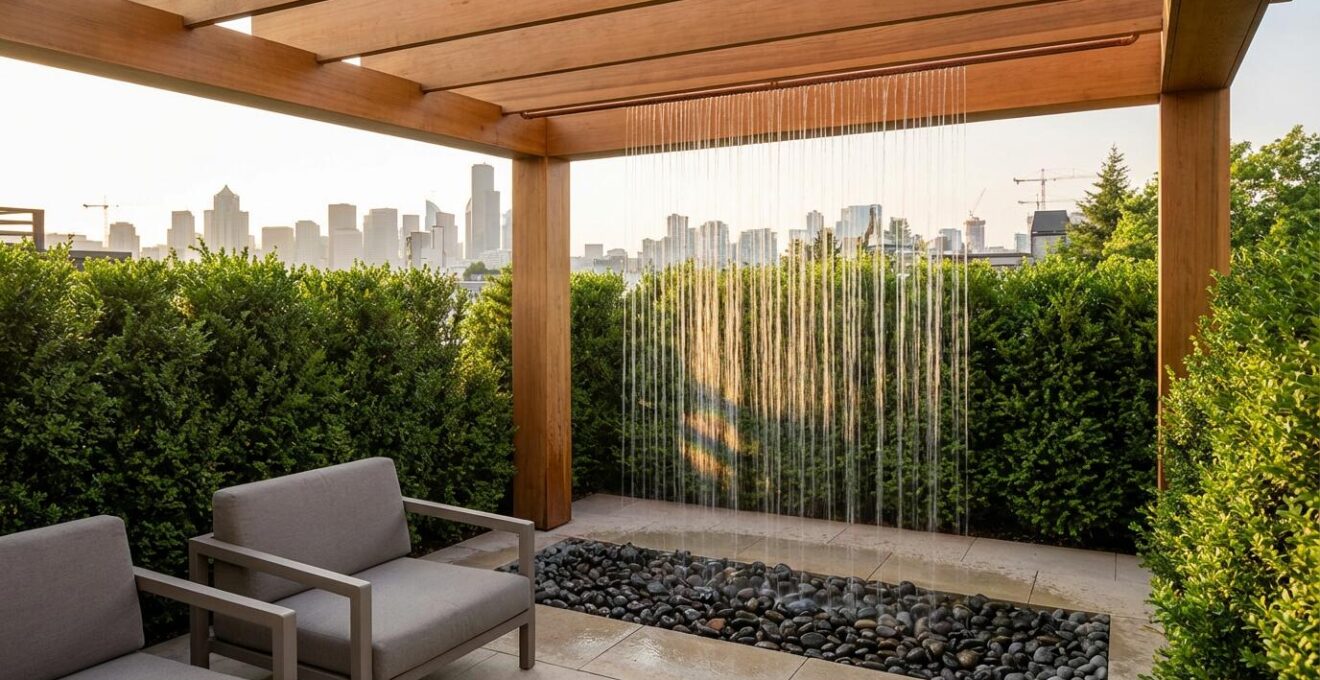
The key to silencing city noise isn’t just adding water; it’s about engineering its sound to create a precise acoustic barrier.
- The pitch and volume of a water curtain can be tuned by adjusting flow rates to specifically mask traffic frequencies.
- Material choices like stainless steel versus copper dramatically alter the water’s sonic character and longevity.
- A silent filtration system is non-negotiable, as a loud pump will defeat the entire purpose of the feature.
Recommendation: Treat your water feature as a tunable acoustic instrument, not just a passive decoration, to truly reclaim your backyard’s serenity.
The persistent hum of traffic, the distant wail of a siren, the general cacophony of the concrete canyon—these are the unwelcome soundtracks for many city dwellers. In the quest for a tranquil backyard oasis, many turn to water features, hoping the gentle sound of bubbling water will offer some relief. The common approach involves a small, decorative fountain, which often adds another layer of noise rather than subtracting from the existing problem. This method fundamentally misunderstands the physics of sound.
The reality is that effectively blocking urban noise is not a matter of decoration, but of acoustic engineering. A water curtain, when properly designed, ceases to be a mere ornament and becomes a powerful tool for sound sculpting. The secret lies in understanding that you are not just “drowning out” noise. You are strategically replacing erratic, jarring frequencies with a consistent, broad-spectrum sound—a form of white noise—that the human brain can easily interpret as background and ignore. It’s about creating a sonic barrier that absorbs, refracts, and masks the auditory chaos of the city.
This guide deconstructs the water curtain as a piece of acoustic technology. We will explore how to integrate it structurally, combat environmental factors, select materials for their sonic properties, and, most importantly, how to tune its performance to create an environment of engineered serenity. We will move beyond the superficial to give you the technical understanding needed to transform your urban backyard into a true sanctuary.
This article breaks down the essential engineering and design considerations for creating a water curtain that effectively masks urban noise. From structural integration to acoustic tuning, here is your roadmap to a quieter outdoor space.
Summary: A Technical Guide to Urban Sound Masking with Water Features
- How to integrate a water curtain into a pergola beam?
- Why does the wind blow your water curtain onto the deck and how to stop it?
- Stainless Steel or Copper: Which Fixture Ages Better in Modern Gardens?
- The filtration oversight that blocks your curtain flow after one week
- When to adjust flow rate to change the pitch of the falling water?
- Why Spillover Spas Are the Ultimate Focal Point for Flat Yards?
- Why a Silent Filtration System is Crucial for Courtyard Pools?
- How to Block the Neighbor’s View of Your Pool Immediately?
How to integrate a water curtain into a pergola beam?
Integrating a water curtain directly into a pergola beam transforms a standard garden structure into a dynamic acoustic sculpture. However, this move requires forethought beyond simple aesthetics; it’s a structural engineering challenge. The primary concern is load management. The beam must support not only its own weight but also the “dead load” of the water-filled weir, the plumbing, and the dynamic load of the water itself. A typical setup adds a uniform live load of 20 PSF (pounds per square foot), necessitating significant reinforcement of standard pergola designs.
The process involves more than just hanging a trough. The beam itself must be prepared to handle constant moisture. This means either using a hollow, non-corrosive metal beam or thoroughly waterproofing a wooden one. For wood, this involves applying a waterproof membrane or marine-grade sealant to all surfaces within the splash zone to prevent rot and degradation. Supply lines, typically 3/4-inch PVC, must be routed cleanly, either through hollow channels within the beam or secured in a discreet conduit along its length. Reinforcing connection points with steel brackets is crucial to handle the unique stresses imposed by the water feature.
Ultimately, a successful integration is invisible. The plumbing is hidden, the structure appears effortless, and the water seems to emerge magically from the architecture itself. This seamlessness is a hallmark of high-end acoustic landscape design, where the technology serves the sensory experience without calling attention to itself.
Action Plan: Pergola Water Curtain Feasibility Audit
- Structural Load Assessment: Consult a structural engineer to verify if the existing or planned pergola beam can support the combined weight of water, weir, and equipment (approx. 20 PSF extra load).
- Waterproofing & Material Check: Inspect the beam material. Is it a non-corrosive metal, or does it require the application of a comprehensive marine-grade sealant and waterproof membrane?
- Plumbing Route Planning: Map the path for the 3/4-inch supply lines and any electrical conduit. Can they be hidden within a hollow beam or must they be concealed externally?
- Reinforcement Point Identification: Pinpoint all connection points between the water curtain weir and the beam, as well as beam-to-post connections, to mark them for reinforcement with steel brackets.
- Acoustic Amplification Check: Determine the placement for acoustic dampening material behind the curtain to prevent sound loss and amplify the desired masking effect towards the listening area.
Why does the wind blow your water curtain onto the deck and how to stop it?
A water curtain is a sheet of falling water, and like any sheet, it can be caught by the wind. This phenomenon, known as wind drift, is the primary nemesis of a clean, effective water feature. The result is not just a messy, soaked deck but a complete breakdown of the acoustic barrier. As the water sheet is broken apart into mist and spray, its cohesive sound-masking properties are lost, replaced by a weak and ineffective spatter. The problem is one of surface area and adhesion; a wide, thin sheet of water presents a large sail area for the wind to act upon.
The engineering solution is to reduce the water’s susceptibility to wind without compromising its visual or acoustic effect. The most elegant method is the use of nearly invisible guide wires. These are tensioned stainless steel or monofilament lines that run from the upper weir to the lower basin. Through the principle of water adhesion, the falling streams cling to these guides, maintaining their vertical path even in moderate breezes. This preserves the integrity of the “curtain” and ensures the water impacts the basin as intended, maximizing the sound generation.

As the illustration demonstrates, the interaction between water and wire is a subtle but powerful piece of fluid dynamics. Another strategy involves architectural integration. As seen in a project by designer Kyle Peek, incorporating the curtain into a freestanding pavilion can be highly effective. The pavilion’s roof not only conceals the plumbing but also acts as a large-scale windbreak and sound amplifier, sheltering the water flow and directing the resulting soundscape towards the patio. By anticipating the impact of wind, you can design a system that is both resilient and acoustically powerful.
Stainless Steel or Copper: Which Fixture Ages Better in Modern Gardens?
The material of your water curtain’s weir and basin is more than a visual choice—it’s an acoustic one that defines the feature’s long-term character. The two primary contenders for modern designs are 316-grade stainless steel and copper. Each offers a distinct journey in aging and sound production. Stainless steel is the material of modern minimalism; its promise is consistency. It resists corrosion, maintains its shine with minimal annual cleaning, and produces a crisp, bright water sound. It is the superior choice for saltwater or chlorinated pool environments due to its excellent chlorine resistance.
Copper, on the other hand, is a material of evolution. It begins with a warm, metallic glow and gradually develops a distinctive green or blue-green patina over 5-8 years. This living finish is prized in many design aesthetics, but it comes with trade-offs. Copper is highly susceptible to corrosion from chlorine and can cause significant green staining on adjacent concrete or stone surfaces if runoff is not carefully managed. Acoustically, it produces warmer, softer tones compared to steel. This choice fundamentally alters the sonic signature of your garden.
The following table, based on industry expertise, breaks down the key differences to help guide your decision. The initial cost premium for stainless steel is often offset by its lower maintenance needs and lack of staining risk, making it a pragmatic choice for many urban settings.
| Feature | 316 Stainless Steel | Copper |
|---|---|---|
| Initial Cost | 30-40% higher | Baseline |
| Patina Development | None – maintains shine | Green patina in 5-8 years |
| Acoustic Properties | Crisp, bright water sound | Warmer, softer tones |
| Chlorine Resistance | Excellent (marine grade) | Poor – accelerates corrosion |
| Maintenance Frequency | Annual cleaning | Quarterly sealing required |
| Staining Risk | None | High – green runoff on concrete |
The filtration oversight that blocks your curtain flow after one week
You’ve invested in the perfect design and materials, and for the first few days, your water curtain is a flawless sheet of sound-masking bliss. Then, after a week, it starts to fail. Gaps appear, the flow becomes uneven, and the beautiful curtain devolves into a pathetic dribble. This common failure is almost always due to a single, critical oversight: inadequate filtration. A water curtain weir is a precise piece of equipment with dozens or hundreds of tiny orifices. It takes only a small amount of debris—a single leaf, airborne dust, or algae buildup—to clog these openings and ruin the effect.
Standard pool filters are not sufficient for the demands of a water curtain. A professional-grade system requires a two-stage filtration method to protect the weir. This involves a coarse pre-filter at the pump intake to catch large debris, followed by a much finer inline filter just before the water enters the distribution header. This dual approach ensures that only clean water reaches the delicate orifices of the weir, maintaining a perfectly uniform flow.
Proper system design is as much about maintenance as it is about initial performance. Monitoring pressure is key; an increase of just 5 PSI on the system’s pressure gauge is a clear indicator that the filters are becoming clogged and require cleaning. As detailed by backyard professionals, installing a bypass purge valve allows for a quick, high-pressure weekly flush to clear out minor accumulations before they become a major blockage. Without this level of filtration, your acoustic barrier will inevitably fail.
Checklist: Professional Two-Stage Filtration Method
- Install 100-micron pre-filter at pump intake to catch leaves and large debris.
- Add 50-micron inline filter before the weir distribution header.
- Calculate flow rate: Ensure pump GPH doesn’t exceed filter capacity by more than 80%.
- Install bypass purge valve between stages for weekly high-pressure flush.
- Monitor pressure gauge – a 5 PSI increase indicates filter cleaning is needed.
When to adjust flow rate to change the pitch of the falling water?
This is the heart of acoustic landscape design: treating the water curtain as a tunable instrument. The “pitch” or frequency of the sound your feature produces is not fixed; it is a direct function of the water’s volume and velocity. A low flow rate creates a gentle, trickling sound with higher-frequency components. As you increase the flow rate with a variable-speed pump, the water impacts the basin with more force, generating a deeper, more powerful sound rich in lower-frequency white noise. This is precisely the type of sound needed to mask the low-frequency rumble of traffic.
The goal is to adjust the flow rate to match the time of day and the specific noise you need to block. During quiet morning hours, a lower flow rate might be sufficient, providing a calming ambiance. As rush hour begins, you can ramp up the pump speed, increasing the curtain’s acoustic output to create a more robust sonic barrier. The problem is significant; studies cited by experts like the SWA Group note that while noise becomes pollution above 65 decibels, average daily noise in many major cities has reached 85 decibels. This level of environmental noise requires a powerful and adjustable response.
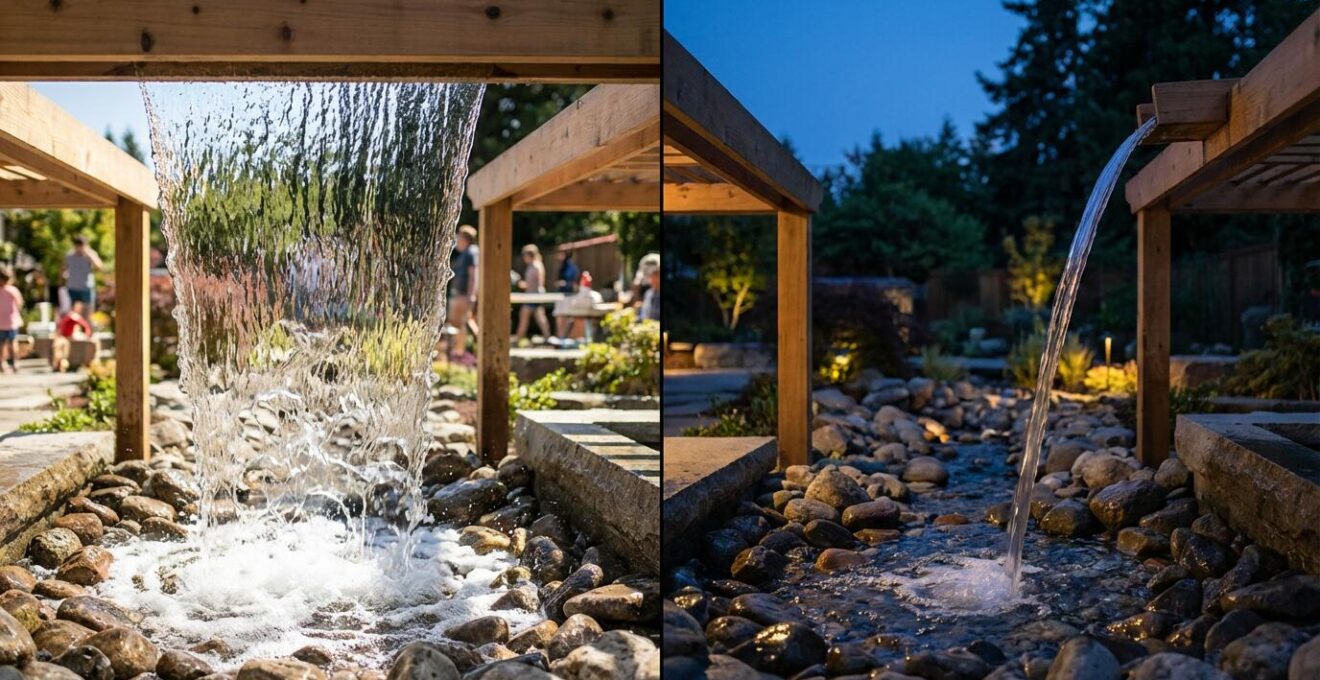
As this image suggests, the character of your outdoor space can be completely transformed by simply adjusting a dial. This dynamic approach to soundscaping allows you to actively manage your acoustic environment. For instance, to create a more complex and effective sound, you can have the water fall not into a flat pool, but onto a bed of 6- to 8-inch river rocks. This creates more turbulence and splashing, diversifying the sound frequencies and enhancing the masking effect. Your water curtain is not static; it is a responsive system for real-time sound sculpting.
Why Spillover Spas Are the Ultimate Focal Point for Flat Yards?
In a flat, featureless backyard, creating a sense of dimension and a captivating focal point can be a significant challenge. A standard, in-ground pool can feel lost in the landscape. This is where the elevated spillover spa excels. By raising a portion of the water, you immediately introduce verticality and movement, instantly drawing the eye. The spa becomes a destination, a defined zone that breaks up the monotony of a level plane. But its power goes beyond the visual; it is also an acoustic anchor.
The sound of water cascading from the elevated spa into the main pool creates a constant, soothing soundscape. However, a simple spillover may not be enough to combat significant traffic noise. As a case study from a Chicago project reveals, the spillover spa alone wasn’t a powerful noisemaker. The trick was to engineer a more robust wall of sound. The designers amplified the effect by adding frothing vertical jets within the elongated spillway. This dramatically increased the volume and complexity of the water sounds, creating an effective acoustic barrier between the pool area and a nearby noisy driveway.
This dual function—visual centerpiece and acoustic device—makes the spillover spa a uniquely efficient design element. It solves the architectural problem of a flat yard while simultaneously contributing to the sensory solution of noise masking. The elevated structure provides a natural housing for lighting and other features, further cementing its role as the undisputed heart of the backyard design, engaging both the eyes and the ears.
Why a Silent Filtration System is Crucial for Courtyard Pools?
The central paradox of using a water feature for noise masking is that the system itself can become a new source of noise pollution. In the confined space of an urban courtyard, the mechanical drone of a standard pool pump can be just as intrusive as the traffic you’re trying to block. Achieving true serenity requires that the sound you add is purely the sound of water, not the hum of machinery. This is why a silent filtration system is not a luxury, but an absolute necessity.
The cornerstone of a silent system is a variable-speed pump with a noise rating below 45 dB at its lower, energy-efficient speeds. These pumps are dramatically quieter than their single-speed counterparts. However, the pump is only part of the solution. The entire equipment pad must be acoustically isolated. This involves installing the pump on rubber isolation pads to prevent vibration from transferring into the concrete slab and building a ventilated acoustic enclosure around the equipment. Using materials like mass-loaded vinyl within the enclosure can significantly dampen mechanical noise.
The impact of this approach is profound. Research in acoustics demonstrates that a reduction of just 10 decibels is perceived by the human ear as making a space 50% quieter. By eliminating the pump’s noise, you allow the water curtain’s sound to work its magic unimpeded. The goal is to create a high signal-to-noise ratio, where the “signal” is the pleasant sound of water and the “noise” of both traffic and equipment is minimized. Without a silent system, you are simply trading one unwanted sound for another.
Checklist: Variable Speed Pump Installation Best Practices
- Select variable speed pumps with noise ratings below 45 dB at low speed.
- Install the pump on rubber isolation pads to prevent vibration transfer.
- Build a ventilated acoustic enclosure using mass-loaded vinyl and foam.
- Position the equipment pad behind natural barriers like dense hedges.
- Program the timer for the lowest speeds during peak relaxation hours.
Key takeaways
- Acoustic Engineering: A water curtain’s effectiveness lies in tuning its flow rate to produce specific frequencies that mask urban noise.
- Material Sonics: The choice between stainless steel and copper is an acoustic decision that defines the sound’s character as much as its visual appeal.
- Systemic Silence: The entire project is compromised if the pump and filtration system are not themselves acoustically isolated and silent.
How to Block the Neighbor’s View of Your Pool Immediately?
In a dense urban environment, privacy is the ultimate luxury. Blocking a neighbor’s line of sight is often the primary driver for backyard renovations, but a truly private oasis engages more than just the visual sense. The most effective solutions create a multi-sensory shield, combining physical barriers with acoustic ones. While a tall fence or dense hedge provides visual screening, a water curtain provides auditory privacy, masking conversations and creating a sonic bubble around your pool area.
Consider the data: landscape design experts confirm that even a solid 8-foot fence reduces noise by only 6-10 decibels. While helpful, this may not be enough to defeat significant traffic noise. The truly sophisticated approach is to layer these solutions. Imagine an 8-foot fence for immediate visual blocking, reinforced by a row of fast-growing arborvitae for a softer, green backdrop. Now, place your water curtain inside this perimeter. You have created two layers of privacy—one for the eyes, and one for the ears.
This concept of a layered, multi-sensory retreat can be refined further by creating a designated “quiet zone.” This might be a pergola, protected by the fence and plantings, that houses the water curtain and comfortable seating. By positioning this zone as far from the primary noise source as possible and shielding it with intervening structures, you create a sanctuary that feels completely removed from the surrounding city. The water curtain becomes the final, immersive layer that completes the illusion of total privacy, transforming your yard from an exposed space into a secluded escape.
Begin designing your own sonic sanctuary by evaluating the structural and acoustic potential of your space. By applying these engineering principles, you can actively sculpt a soundscape that delivers true peace and privacy.