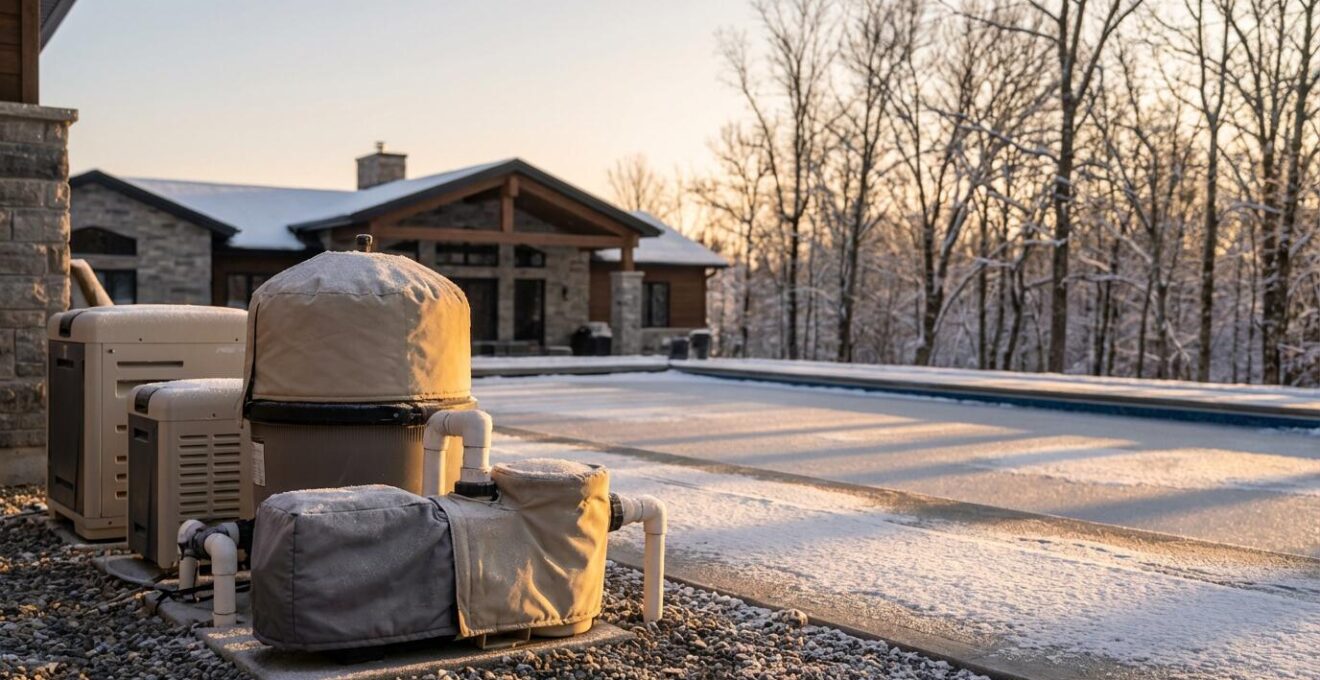
In summary:
- Shift from passive winterizing to active, remote monitoring to truly protect your investment.
- Use smart sensors and data analysis to detect leaks and system failures before they become disasters.
- Implement secure, code-free digital access for service technicians to ensure prompt maintenance.
- Choose redundant connectivity (Wi-Fi + 4G) to guarantee your remote monitoring system never goes offline.
- Prioritize silent, variable-speed pumps for freeze protection that respects guest and neighbor tranquility.
For an absentee owner of a luxury holiday property, the swimming pool represents both a prime asset and a significant liability, especially during the cold season. The standard advice often revolves around a one-time “winterization” process—a complete shutdown that feels final and ill-suited for a property that might see intermittent use. This approach overlooks the modern reality of property management, where readiness and remote oversight are paramount.
The common solutions, like simply running the pump or throwing a cover on, are passive measures against an active threat. They fail to address the core anxieties: “What if a pipe bursts while I’m a thousand miles away? How do I know the system is actually working? How can I grant emergency access without compromising security?” True peace of mind doesn’t come from shutting down; it comes from staying connected and in control.
This guide offers a different perspective. We will move beyond the outdated concept of passive winterizing to embrace a strategy of active, intelligent remote vigilance. The key is not to simply hope for the best but to build a “Digital Sentry” system that provides data-driven oversight, anticipates problems, and allows for swift, decisive action from anywhere in the world. This is how you transform a source of winter anxiety into a well-managed, protected asset.
This article will detail the essential components of a modern remote protection strategy. We will explore how to interpret system data to preempt failures, manage service access securely, choose the right technology for unwavering connectivity, and ensure your pool remains an asset of leisure, not a monument to costly winter damage.
Summary: A Guide to Remote Pool Freeze Protection
- Why a sudden drop in auto-fill activity indicates a leak before you see it?
- How to grant digital gate access to pool boys without sharing codes?
- Wi-Fi or 4G Module: Which Connection is More Reliable for Remote Cabins?
- The sensor calibration error that leads to overdosing chemicals remotely
- When to reduce filtration cycles to “hibernate” mode between guest stays?
- How to Manage Your Pool Chemistry from Your Office Desk?
- Which Isothermal Cover Best Protects Children While Retaining Heat?
- Why a Silent Filtration System is Crucial for Courtyard Pools?
Why a sudden drop in auto-fill activity indicates a leak before you see it?
In the world of remote pool management, your system’s data is your first line of defense. While the title suggests looking for a “drop” in auto-fill activity, an experienced property manager knows the truth is more nuanced and often the opposite. A sudden drop might indicate a clog or a frozen line, which is an issue in itself. However, the true digital siren for a leak is a sudden and sustained increase in auto-fill activity. This is the core of preemptive intelligence: understanding what the data is really telling you. When your system is consistently adding more water than can be explained by normal evaporation, you have a leak—long before you see a soggy patch in the yard or receive a shocking water bill.
The stakes are high, especially in freezing conditions. Experts warn that pool pipes can begin to freeze at 32°F (0°C), a process that can cause catastrophic cracks and bursts in just a few hours. A pre-existing leak exacerbates this risk by introducing more water into the ground around your plumbing, accelerating the freezing process. Your auto-fill sensor, therefore, is not just a convenience; it’s a critical leak detector. Setting up intelligent alerts on your pool automation app to notify you of unusual fill cycles (e.g., filling for more than an hour straight or multiple times a day) is a non-negotiable part of your Digital Sentry system. This is how you catch a small problem from your office desk before it becomes a four-figure repair on-site.
By monitoring these data points, you transform a simple feature into a powerful diagnostic tool, giving you the foresight needed to protect your property remotely.
How to grant digital gate access to pool boys without sharing codes?
One of the greatest logistical challenges for an absentee owner is managing on-site access for service professionals. Sharing gate codes or leaving keys under a pot is a security relic of the past, completely at odds with managing a luxury property. The solution lies in what we call Access-as-a-Service: treating access not as a physical key, but as a temporary, auditable digital credential. This is achieved through smart locks and integrated automation systems that allow you to grant time-sensitive access to your pool technician’s smartphone.
Imagine this scenario: a freeze warning is issued for your property’s location. From your office, you can grant your pool service technician a one-time digital key that works only for a specific 4-hour window. Their entry is automatically logged, creating a clear audit trail. They can service the equipment, and their access automatically expires. This eliminates the risks of shared codes, lost keys, and unauthorized entry. This method not only enhances security but also reinforces the professionalism and trust you place in your service partners.
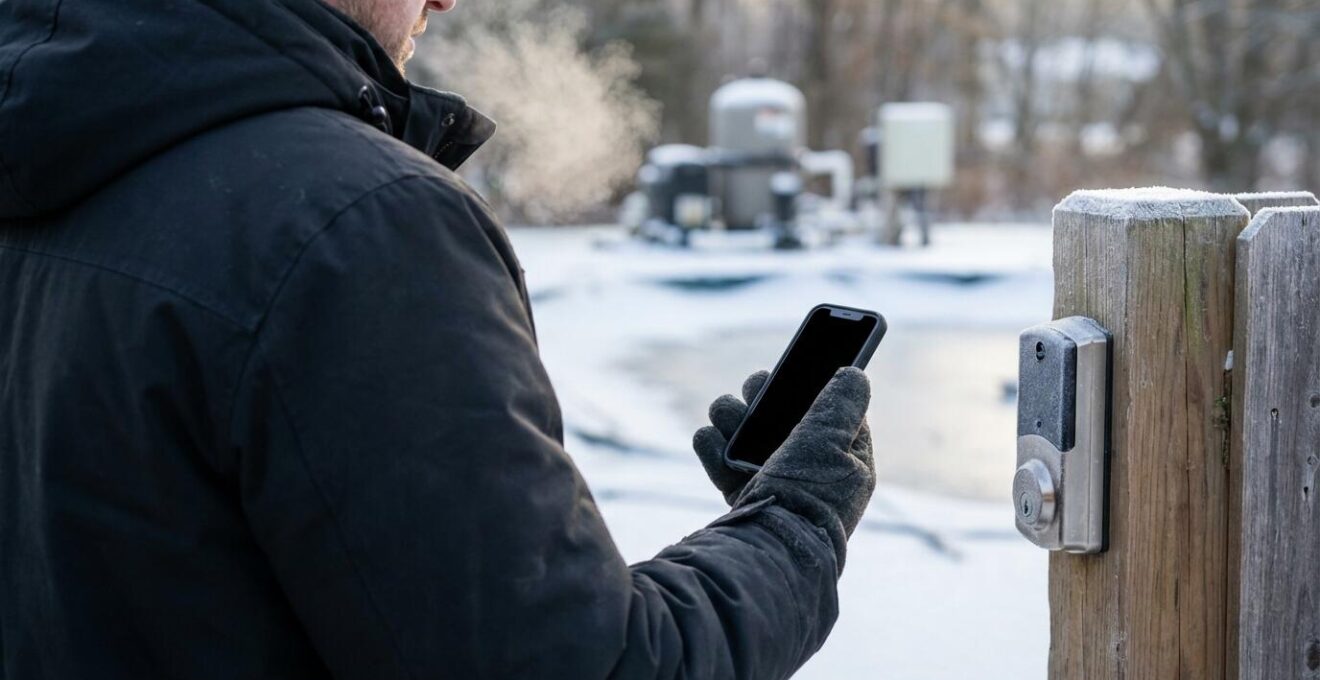
This principle extends beyond just the gate. As detailed in a best-practice case study, providing technicians with their own login credentials for the pool’s computerized automation system is a critical step for remote vigilance.
Case Study: Smart Access Management for Winter Service
Leading pool service companies now recommend that property owners provide them with dedicated login and password information for the pool’s automation system. According to guidelines for freeze events, this allows their technicians to remotely monitor system status, receive alerts, and in some cases, make emergency adjustments without needing to be on-site, providing a crucial layer of proactive protection. This approach creates an invaluable audit trail while maintaining the highest level of security for the vacation property.
By adopting a digital access strategy, you maintain absolute control over who enters your property and when, all while ensuring your pool gets the expert attention it needs, precisely when it’s needed most.
Wi-Fi or 4G Module: Which Connection is More Reliable for Remote Cabins?
Your entire remote monitoring strategy—your Digital Sentry—is completely dependent on one thing: a stable internet connection. If your pool’s automation system goes offline, you are effectively blind. For vacation homes in urban or suburban areas with reliable broadband, a Wi-Fi connection is often sufficient. However, for remote cabins or properties in areas with spotty internet service, relying solely on Wi-Fi is a high-stakes gamble. A power outage that resets the router or a simple service interruption can sever your connection at the most critical moment. This is where a multi-layered approach becomes essential for true peace of mind.
A 4G LTE module, which uses the cellular network, provides a vital layer of redundancy. While it comes with a monthly subscription fee, its value is immeasurable during a winter storm that knocks out local internet services. The most robust and reliable systems employ a dual-connection approach: they use Wi-Fi as the primary connection but can automatically failover to the 4G network if the Wi-Fi signal is lost. This ensures your pool’s brain remains online, sending you data and alerts, no matter the conditions on the ground. Remember, the system needs to be online when the temperature drops; it’s crucial to understand that experts at Pentair state 45°F (7°C) is the critical temperature for activating automated freeze protection. Your connection must be active before and during this threshold.
The following table, based on field data and reliability testing, breaks down the pros and cons of each connection type, making it clear why redundancy is key for critical applications.
| Connection Type | Reliability Score | Cost/Month | Best For |
|---|---|---|---|
| Wi-Fi Only | 6/10 | $0 | Urban vacation homes |
| 4G Only | 8/10 | $30-50 | Remote cabins |
| Dual Wi-Fi + 4G | 9.5/10 | $30-50 | Critical freeze protection |
For a high-value asset in a remote location, the modest monthly cost of a 4G backup is not an expense; it’s an insurance policy against catastrophic, and entirely preventable, failure.
The sensor calibration error that leads to overdosing chemicals remotely
The ability to adjust pool chemistry from your office desk is a marvel of modern technology. With a few taps on an app, you can dose chlorine or adjust pH levels miles away. However, this convenience carries a hidden risk: trusting the data from an uncalibrated sensor. A pH or ORP (Oxidation-Reduction Potential) sensor that has drifted over time can report inaccurate readings, tricking you or your automated system into “correcting” a problem that doesn’t exist. This often leads to a dangerous cycle of overdosing, which can damage pool surfaces, corrode equipment, and create unsafe swimming conditions for future guests. Vigilant management isn’t just about remote access; it’s about ensuring the data you’re acting on is accurate.
Sensor drift is inevitable due to constant exposure to water and chemicals. Without regular calibration, a sensor that reads a pH of 7.2 might be in water that is actually 7.8. If your system automatically doses acid based on this false reading, it will continue to push the actual pH down to dangerously low levels. The same principle applies to chlorine generators. A faulty ORP reading can cause the system to produce far more chlorine than needed. Furthermore, during freeze protection cycles, this problem is compounded. As the Tropix Pools Technical Team notes in their guide:
Most pool systems intentionally lock out the heater during freeze protection
– Tropix Pools Technical Team, Pool Freeze Protection Guide 2025
This means water chemistry can become unbalanced more easily in cold water, making accurate remote dosing even more critical. The solution is a strict, scheduled maintenance protocol and the implementation of smart dosing limits within your automation software.
Your Action Plan: Preventing Remote Chemical Overdosing
- Establish Calibration Schedule: Mandate that your pool service performs two-point calibration on all pH and ORP sensors at least bi-monthly using certified solutions.
- Program Dosing Limits: Configure your automation system to never allow more than a 20% adjustment in any chemical parameter within a 24-hour period.
- Install Redundant Sensors: For critical measurements, install a secondary sensor. If the two readings diverge significantly, it triggers an alert and pauses automated dosing.
- Set ‘Impossible Reading’ Alerts: Program your system to alert you if it detects a reading that is physically improbable, such as a pH shift of more than 1.0 in one hour.
- Verify with Manual Tests: Cross-reference sensor readings with a manual test kit photo sent by your pool technician weekly to track and account for sensor drift over time.
By treating your sensors not as infallible oracles but as sensitive instruments requiring regular maintenance, you can use remote dosing technology safely and effectively, protecting both your pool and your peace of mind.
When to reduce filtration cycles to “hibernate” mode between guest stays?
A vacant property doesn’t mean a dormant pool. The traditional, all-or-nothing approach of either running the pool at full power or shutting it down completely is inefficient and risky. The modern, vigilant strategy is what we call “Active Hibernation.” This involves reducing the pool’s energy consumption and operational intensity between guest stays while keeping it perfectly balanced, protected, and ready for use with minimal lead time. It’s the sweet spot between full operation and a complete, risky shutdown. The key to this strategy is the variable-speed pump (VSP) and a smart automation system.
During guest stays, your filtration may run for 8-10 hours a day at a higher speed to handle the bather load. However, once the property is vacant, this is unnecessary. In Active Hibernation mode, you can program the VSP to run for longer periods—up to 24 hours a day—but at a very low speed. This uses significantly less energy than running at high speed for a shorter period, but it’s enough to keep the water circulating, chemicals dispersed, and, most importantly, provide freeze protection. This continuous low-speed circulation is often the most energy-efficient way to prevent pipes from freezing. As a case study on year-round pools shows, this combination of VSPs and smart controls is the gold standard for providing energy-efficient freeze protection while keeping the system responsive.

Your automation system should allow you to create custom profiles. For instance, a “Guest Mode” with high filtration and heating, and an “Away Mode” (Active Hibernation) that drops the VSP to its lowest effective RPM, deactivates the heater, and maintains just enough circulation to keep the water clear and safe from freezing. You can switch between these modes from anywhere in the world, ensuring the pool is only consuming the energy it absolutely needs at any given time. This dynamic approach saves money, reduces wear on equipment, and ensures your asset is always protected and ready.
By embracing this flexible, data-driven approach, you can optimize your property’s energy usage and ensure the pool is always in a state of protected readiness.
How to Manage Your Pool Chemistry from Your Office Desk?
Remote chemistry management is one of the most powerful tools for an absentee owner, allowing you to maintain a pristine and safe pool without being on-site. Modern automation systems, equipped with chemical controllers and sensors, provide real-time data on pH, ORP (chlorine effectiveness), and temperature. This allows you to make micro-adjustments from your smartphone or computer, ensuring the water remains perfectly balanced. This is particularly crucial during the off-season when the pool is not in regular use. A stagnant, unbalanced pool is a breeding ground for problems that can be costly to fix.
The primary goal of remote chemistry management during colder months is prevention. It’s far easier to maintain balance than to correct a significant issue like an algae bloom. A key piece of preemptive intelligence is understanding the role of water temperature. As pool winterization experts note, water temperatures consistently below 65°F prevent algae growth. When your system reports temperatures below this threshold, you can confidently reduce chlorine production, saving on chemical costs and reducing wear on your salt cell. This is a perfect example of using data to make informed, cost-effective management decisions. Your dashboard is not just for monitoring; it’s for strategic management. You should be checking key parameters like Total Dissolved Solids (TDS) and salt levels (for saltwater pools) remotely to anticipate long-term maintenance needs before your next scheduled service.
By leveraging your pool’s Digital Sentry system, you can proactively manage water quality, prevent problems before they start, and ensure your pool is always sparkling, safe, and ready for the next arrival, all without ever leaving your desk.
Which Isothermal Cover Best Protects Children While Retaining Heat?
A pool cover in a vacation property serves a dual, non-negotiable purpose: it must provide a barrier for safety and be effective at retaining heat to manage energy costs. For an absentee owner, the safety aspect is paramount. Any cover used on a rental property must, at a minimum, meet ASTM F1346 safety standards. This ensures the cover can support the weight of a person, preventing accidental drowning. However, not all safety covers are created equal when it comes to thermal performance.
Isothermal covers, also known as thermal blankets or solar covers, are designed specifically for heat retention. While a standard “bubble” cover is excellent at this, it offers zero safety protection and should never be the primary cover on an unoccupied property. The ideal solution lies in a hybrid that balances both needs. A solid vinyl automatic cover is often the best choice for this application. It is ASTM-compliant, providing a robust safety barrier that can be deployed or retracted with the turn of a key. Its solid surface is highly effective at preventing evaporation—the number one source of heat loss—and can retain up to 85% of the pool’s heat. While a thermal foam cover might offer slightly better insulation (a higher R-value), most are not rated as safety covers and must be manually placed and removed, making them impractical and unsafe for a rental setting.
The following table, using data from pool safety and equipment experts, compares common cover types on the metrics that matter most to a vigilant property manager: safety compliance and thermal efficiency.
This comparative data, drawn from an analysis of pool freeze protection methods, clearly illustrates the trade-offs between different cover types.
| Cover Type | R-Value | ASTM Safety Rating | Heat Retention |
|---|---|---|---|
| Solid Vinyl Auto | 0.8 | F1346 Compliant | 85% |
| Thermal Foam | 1.5 | Not Safety Rated | 92% |
| Mesh Safety | 0.3 | F1346 Compliant | 60% |
Ultimately, the solid automatic cover emerges as the superior choice for most luxury rental properties, offering the best available combination of push-button convenience, certified safety, and significant energy savings.
Key takeaways
- True pool protection is not a one-time task but a continuous process of remote, data-driven vigilance.
- Investing in redundant connectivity (Wi-Fi + 4G) and secure digital access for service providers is non-negotiable.
- The quiet operation of a variable-speed pump is as crucial for guest experience as its ability to prevent freezing.
Why a Silent Filtration System is Crucial for Courtyard Pools?
In a luxury rental property, the guest experience is everything. A pool located in a courtyard, terrace, or close to the house is a premium feature, but it can quickly become a liability if the equipment powering it is a source of constant, disruptive noise. The hum and drone of a traditional, single-speed pump running for freeze protection overnight can ruin the tranquility of a winter retreat and lead to negative reviews and neighbor complaints. This is why a “Silent Sentinel” approach to your filtration system is not a luxury, but a necessity. The goal is to make your pool’s life support system completely unobtrusive.
The hero of this story is the variable-speed pump (VSP). Unlike single-speed pumps that are either off or running at a loud, fixed high speed, VSPs can be programmed to run at very low RPMs. This is the key to both energy efficiency and acoustic stealth. For freeze protection, a VSP can circulate water at a speed so low it’s virtually silent, yet still effective at preventing ice formation. According to pool equipment acoustics data, this low-speed operation can reduce equipment noise by up to 90% compared to its single-speed counterparts. This is the difference between a peaceful night’s sleep and a constant, irritating hum outside the bedroom window.
Achieving true silence, however, may require more than just a VSP. For equipment pads located in acoustically sensitive areas, a multi-layered soundproofing strategy is the hallmark of a truly high-end installation. This can include mounting pumps on anti-vibration pads, enclosing the equipment pad with mass-loaded vinyl barriers, and even installing acoustic fence panels. By scheduling the ultra-low RPM freeze protection cycles for late-night hours (e.g., 10 pm to 6 am), you create a system that protects the pool infrastructure without ever disturbing a sleeping guest. This meticulous attention to detail is what separates a standard rental from a premier vacation experience.
Investing in a silent, efficient filtration system is an investment in your property’s reputation, ensuring your pool is remembered for its serenity, not its sound.
Frequently Asked Questions about Remote Pool Management
Can I safely adjust chemicals remotely during freezing conditions?
Yes, but use micro-dosing strategies with no more than 10% adjustments per day and verify changes through secondary sensors like ORP readings.
Which parameters should I monitor remotely besides pH and chlorine?
Monitor Total Dissolved Solids (TDS), salt levels, and water temperature as these affect long-term equipment health during extended absences.
How often should remote chemistry checks be performed?
Daily automated monitoring with weekly manual verification by pool service, increasing to twice-weekly during temperature fluctuations.