A luxury pool’s contribution to property value is not an amenity bonus, but a direct result of strategic investment in features that enhance marketability and minimize long-term ownership costs.
- Architectural cohesion and timeless design consistently outperform overly personalized or trend-based features in retaining value.
- Operational efficiency through automation and durable construction (concrete) delivers a stronger long-term ROI than lower initial-cost alternatives.
Recommendation: Prioritize features with a proven track record for increasing market appeal and lowering cost-of-ownership to ensure your pool is a performing financial asset, not a depreciating liability.
When evaluating a high-value property, a swimming pool is often viewed through a binary lens: it is either a significant asset or a costly liability. For the discerning investor or homeowner of a property in the $2 million-plus bracket, the question is not simply whether to have a pool, but which specific features will generate a quantifiable return on investment. The common approach is to accumulate a list of trendy additions, from elaborate water slides to exotic lighting. This strategy, however, frequently overlooks the fundamental drivers of value in the luxury real estate market: architectural harmony, long-term durability, and demonstrable market appeal.
The conversation must shift from “what can we add?” to “what will a future buyer value?”. This requires an appraiser’s mindset, scrutinizing each potential feature for its contribution to the property’s overall narrative and its impact on the total cost of ownership. While amenities like hydrotherapy jets or custom tile work can enhance the user experience, their financial impact is far from uniform. Some features offer significant resale premiums, while others can actively detract from a home’s marketability.
This analysis will deconstruct the most common luxury pool features, moving beyond aesthetics to assess their tangible impact on property value. We will explore the financial mechanics behind why an infinity edge can command a premium, how to budget for automation as a value-add investment, and why the foundational choices of structure and materials are the most critical decisions for long-term value retention. The goal is to provide a clear framework for creating a pool that is not just a lifestyle enhancement, but a calculated and performing financial asset.
To navigate this complex investment landscape, this guide breaks down the key financial and design considerations. The following sections provide a detailed analysis of which features add tangible value and which represent potential financial pitfalls.
Summary: Appraising the ROI of High-End Pool Investments
- Why infinity edges command a 20% higher resale price on sloped properties?
- How to budget for automated covers and heating without exceeding 15% of home value?
- Saltwater vs Chlorine: Which System Do Luxury Home Buyers Prefer in 2024?
- The “Theme Park” Mistake That Makes Luxury Pools Impossible to Sell
- How to retrofit a 1990s pool into a modern luxury asset in 4 steps?
- How Hydrotherapy Features Transform a Simple Pool into a 5-Star Resort?
- How to Choose Mosaic Tiles That Won’t Pop Off After Three Winters?
- Why Reinforced Concrete Pools Maintain Value Better Than Vinyl Liners Over 20 Years?
Why Infinity Edges Command a 20% Higher Resale Price on Sloped Properties?
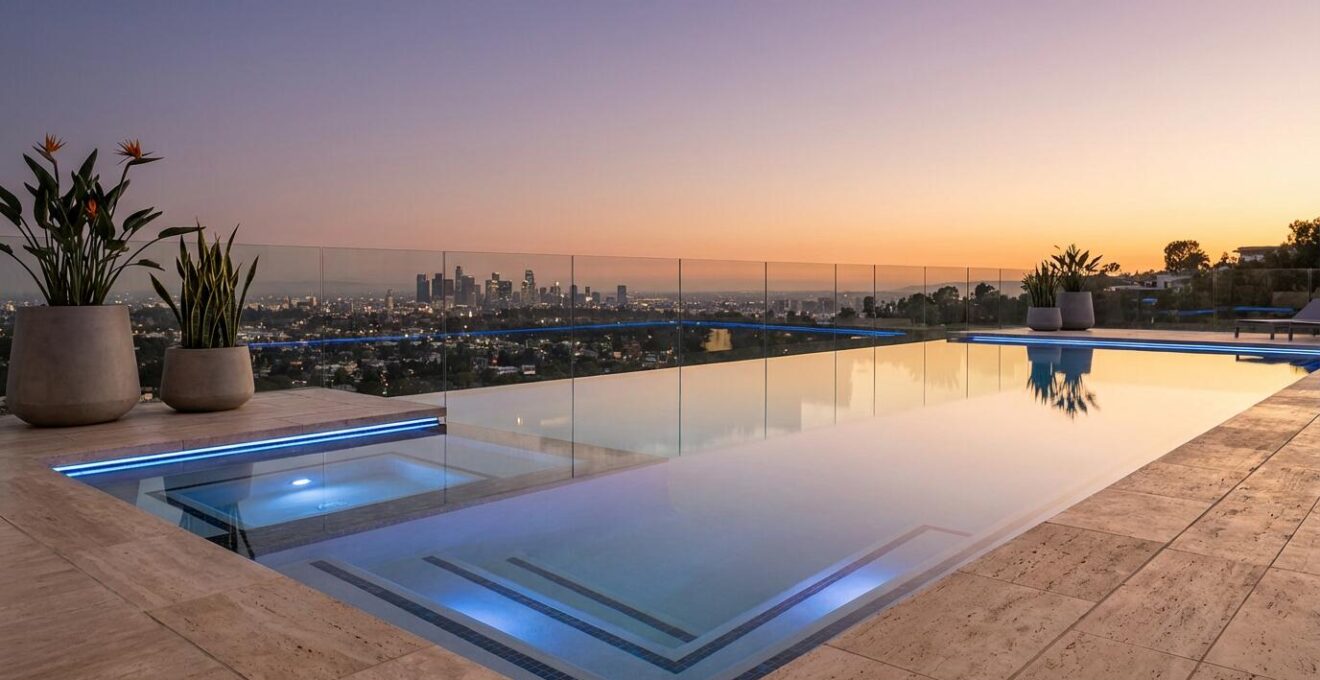
From an appraiser’s perspective, an infinity edge—or vanishing edge—pool is one of the few features that can deliver a direct and substantial premium, but its value is highly conditional. The feature’s power lies in its ability to create a seamless visual transition between the pool water and a stunning background, such as an ocean, a city skyline, or a mountain range. On a flat, enclosed property, an infinity edge is a nonsensical and costly addition. However, on a sloped lot with a view, it becomes the architectural centerpiece that elevates the entire property’s perceived value.
The financial return is driven by buyer psychology. The “aspirational lifestyle” element it creates is a powerful draw in the luxury market. In prime locations like Los Angeles, homes with luxury pools already see significant value addition, but those with infinity edges that capitalize on a view command an undeniable premium. This is because the feature transforms the pool from a recreational space into a piece of living art. While general market data shows that homes with pools sell for 16.9% to 24.4% more, the specific premium for an infinity edge is unlocked by the property’s unique topography and vista.
Case Study: The “Aspirational” Premium in Los Angeles
In the competitive Los Angeles market, luxury homes with pools typically add approximately $95,000 to property values. However, analysis shows that properties featuring infinity edge designs command premium prices, especially when paired with scenic views. The psychological impact of the vanishing edge creates an aspirational lifestyle element that buyers in the $2 million+ market actively seek, viewing it as a status symbol and a key component of a resort-style living experience.
Therefore, the investment decision is straightforward: if the property possesses a “million-dollar view,” an infinity edge is not an expense but a strategic investment to frame and monetize that view. Without it, the capital is better allocated elsewhere.
How to Budget for Automated Covers and Heating Without Exceeding 15% of Home Value?
While less glamorous than visual features, automation systems represent one of the most intelligent investments for a luxury pool, directly impacting both marketability and long-term cost of ownership. High-end buyers are increasingly focused on convenience and efficiency. A pool that requires significant manual effort for maintenance, covering, and heating is perceived as a chore, not a luxury. Automated systems address this directly, transforming the pool into a turnkey asset.
The financial case is compelling. For instance, high-quality automated pool covers can reduce heating costs by up to 70% by minimizing evaporation and heat loss. This delivers a tangible annual saving that contributes to a faster return on the initial investment. Similarly, smart heating systems and variable-speed pumps optimize energy consumption, significantly lowering the pool’s operational budget. When presenting a property for sale, the ability to showcase low, predictable running costs is a powerful selling point that resonates with financially savvy buyers.
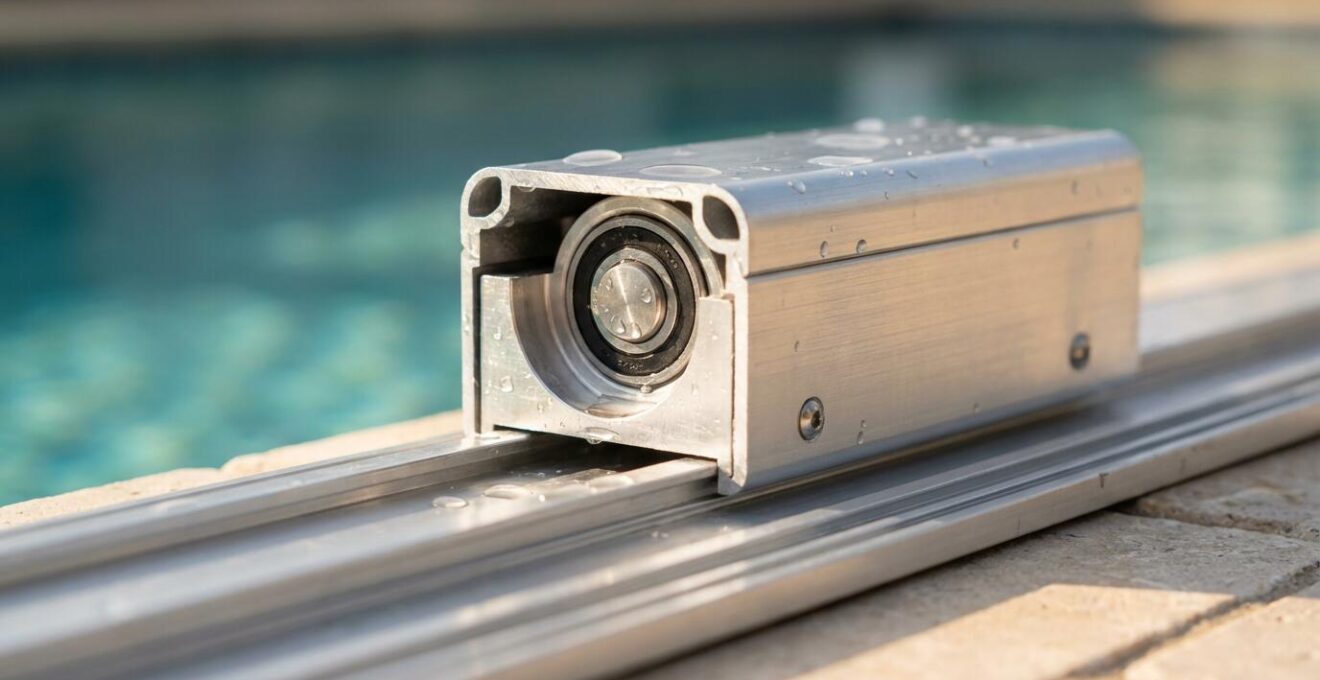
Budgeting for these features should be viewed as a capital investment in the property’s operational efficiency. While a general rule suggests a pool’s total cost shouldn’t exceed 15% of the home’s value, allocating a significant portion of that budget to automation often provides a better ROI than purely aesthetic upgrades. The key is to balance the upfront cost against the long-term savings and enhanced user convenience.
The following data provides a clear framework for evaluating the ROI on key automation features, demonstrating how initial expenditures are recouped through significant annual savings.
| Feature | Initial Cost | Annual Savings | ROI Period |
|---|---|---|---|
| Automated Cover | $8,000-$20,000 | $1,200-$2,500 | 5-8 years |
| Smart Heating System | $3,000-$8,000 | $800-$1,500 | 3-5 years |
| Variable-speed Pump | $1,500-$3,000 | $300-$700 | 3-4 years |
Saltwater vs Chlorine: Which System Do Luxury Home Buyers Prefer in 2024?
The debate between saltwater and traditional chlorine sanitation systems has shifted in the luxury market. For years, saltwater pools were the default “upgrade,” perceived as gentler on the skin and requiring less maintenance. As the LA Homes Real Estate Report notes, this perception holds some truth.
Saltwater pools cost more upfront, but have fewer maintenance requirements than traditional pools
– LA Homes Real Estate Report, Market Analysis on Pool Systems
However, a more sophisticated understanding has emerged among high-end builders and informed buyers. The primary concern with saltwater systems is their corrosive effect on certain materials. This is a critical issue in luxury construction, where expensive natural stone coping, custom metal fixtures, and high-end decking are common. The salt can cause costly and unsightly damage to materials like limestone and some varieties of travertine over time, compromising the pool’s aesthetic integrity and long-term value.
This has led to a growing preference for advanced, low-chlorine alternatives. Systems like Hydroxyl-Based Advanced Oxidation Processes (AOP) are gaining traction as the superior choice for the luxury segment. They provide the water quality and gentle feel of a saltwater pool without the corrosive drawbacks. This protects the significant investment made in premium finishes and materials, aligning with the core principle of long-term asset preservation. For a luxury property, the sanitation system must not only provide clean water but also be compatible with the high-end materials surrounding it, making AOP a more discerning and value-conscious choice.
Material Compatibility Analysis for Luxury Pool Finishes
Recent research highlights a critical consideration for luxury pool owners: saltwater systems can cause significant corrosion damage to certain natural stones, particularly limestone and specific travertine varieties often used in high-end pool coping. This has led to a market shift toward modern Hydroxyl-Based AOP systems. These provide a low-chlorine alternative that preserves the integrity of expensive pool finishes while maintaining crystal-clear water, addressing the luxury market’s dual concerns for health benefits and material preservation.
The “Theme Park” Mistake That Makes Luxury Pools Impossible to Sell
One of the most significant financial errors a homeowner can make is over-personalizing a luxury pool. While features like grottos, faux rock formations, and brightly colored slides might seem appealing, they transform a sophisticated architectural element into a niche, themed amenity. This severely narrows its appeal to potential buyers, who may not share the owner’s specific taste. From an appraiser’s viewpoint, extreme personalization is a liability that often requires a discount to attract a buyer willing to either live with it or pay for its removal.
The core principle of adding value is to create a space that is both beautiful and serves as a blank canvas for the next owner. A timeless, elegant design rooted in high-quality materials and clean architectural lines will always have broader market appeal than a pool designed to look like a pirate’s cove. Data confirms this, showing that pools considered too personalized can reduce home value by approximately $15,000. In the luxury segment, where aesthetic cohesion is paramount, this figure can be significantly higher as it signals a lack of design sophistication.
The investment should be directed towards features that enhance the pool’s architectural quality, not its novelty. A natural stone waterfall, a sleek sun shelf, or imported mosaic tile will hold their value and appeal far longer than a plastic slide. The goal is to create a resort-like feel, not a theme park attraction. To avoid this costly mistake, a disciplined design audit is essential before construction begins.
Your 5-Point Audit for Timeless Pool Design
- Architectural Focus: Choose timeless architectural features (e.g., natural stone waterfalls) over trendy, often plastic, additions (e.g., slides).
- Themed Elements: Limit themed elements to one signature, high-quality feature at most to maintain overall sophistication.
- Color Palette: Select neutral color palettes for tiles and finishes that allow future owners to project their own style and furnishings.
- Quality over Quantity: Focus the budget on superior materials (imported tile, natural stone, premium decking) rather than the sheer number of features.
- Design Cohesion: Ensure the pool’s design, shape, and materials complement the home’s architecture rather than competing with it for attention.
How to Retrofit a 1990s Pool into a Modern Luxury Asset in 4 Steps?
An outdated pool from the 1990s—often characterized by kidney shapes, faded vinyl liners, and bulky concrete decking—can be a significant drag on a luxury property’s value. However, renovating such a pool can offer a substantial return on investment if the upgrades are chosen strategically. The goal is not just to make it look new, but to transform it into a modern, efficient, and desirable asset. This can be achieved through a focused, four-step process.
1. Resurfacing with Modern Finishes: The first step is to replace dated surfaces. Ripping out a vinyl liner or cracked plaster and installing a high-quality pebble or polished aggregate finish instantly modernizes the pool’s look and feel. These materials are more durable and offer a richer, more luxurious aesthetic.
2. Updating Coping and Decking: Replace narrow, rounded concrete or brick coping with large-format, modern materials like travertine or limestone pavers. This creates clean lines and a seamless transition from the deck to the water, visually enlarging the space.
3. Integrating Efficiency Upgrades: This is critical for ROI. Retrofit the old equipment with a modern variable-speed pump, a high-efficiency heater, and energy-saving LED lighting. These upgrades dramatically reduce operating costs, a key selling point for modern buyers.
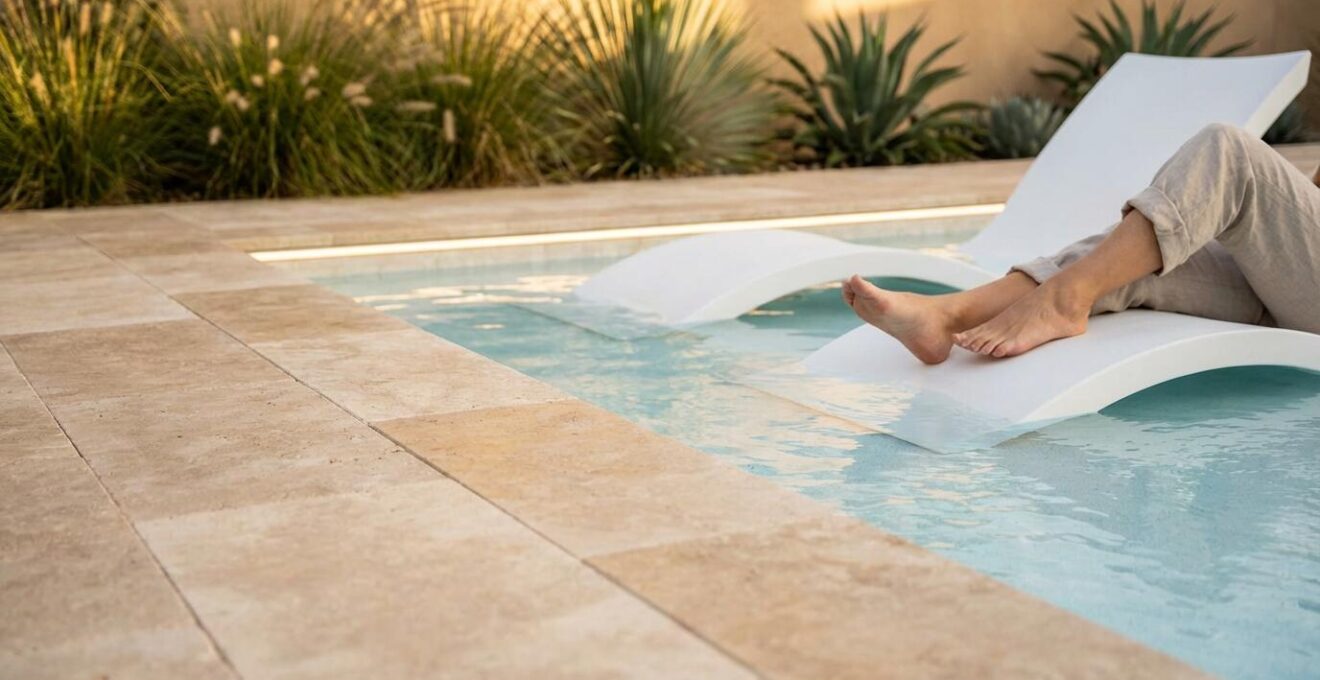
4. Adding a Key Water Feature: Introduce a single, elegant feature like a sun shelf (Baja shelf) for in-water lounging or a simple, sheer-descent waterfall. This adds a “resort” touch without over-personalizing the design. Industry data shows a 56% ROI for pool renovations that focus on these core improvements, proving that a well-executed retrofit is a sound financial move.
How Hydrotherapy Features Transform a Simple Pool into a 5-Star Resort?
Integrating hydrotherapy features, most commonly an attached spa or hot tub, is a strategic move that fundamentally changes a pool’s value proposition. It extends the usability of the aquatic space beyond hot summer days, transforming it into a year-round wellness amenity. This is a powerful selling point in nearly every luxury market, as integrated spas and hot tubs provide year-round usability, effectively doubling the asset’s functional period.
From a design perspective, the most valuable implementation is an integrated spa with a “spillover” feature, where the heated water cascades into the main pool. This creates a visually appealing and acoustically pleasing water feature. Furthermore, the combination of different elements can elevate the experience, as noted by industry experts.
Fire and water features combined in luxury pool designs create a captivating and dramatic ambiance
– KustomScapes & Pools, Luxury Pool Trends Report 2024
Beyond aesthetics, the integration of a spa has a measurable impact on marketability by broadening the property’s appeal. It caters to a multi-generational audience, providing a relaxing space for adults while children use the main pool. This enhanced lifestyle value often translates directly into faster sales and a higher perceived value, going beyond the typical 5-8% property value increase seen with standard pools. The spa repositions the pool from a simple recreational feature to a central component of a home’s health and wellness offering.
How to Choose Mosaic Tiles That Won’t Pop Off After Three Winters?
The choice of tile is a critical detail in luxury pool construction that has significant long-term financial implications. A waterline adorned with beautiful, imported mosaic tiles can be a stunning focal point, but if those tiles begin to delaminate and “pop off” after a few freeze-thaw cycles, the asset quickly becomes a costly maintenance problem. The key to avoiding this lies in understanding the technical specifications of the materials and installation methods.
For properties in climates with freezing winter temperatures, material selection is paramount. The single most important factor is the tile’s water absorption rate. For freeze-thaw resistance, only tiles with a near-zero absorption rate (less than 0.5%) should be considered. This is why high-quality glass tiles are a superior investment for durability in such environments. When properly installed, premium glass tiles can last 20+ years, maintaining the pool’s aesthetic integrity and value.
However, the tile itself is only half the equation. The installation method is equally crucial for long-term value retention. Mandating the use of a flexible, waterproof epoxy grout instead of traditional cementitious grout is non-negotiable in cold climates. Epoxy grout accommodates the micro-movements caused by temperature fluctuations, preventing water from penetrating behind the tiles and freezing, which is the primary cause of tile failure. Choosing tiles from established manufacturers with proven cold-weather performance records, such as Bisazza or Sicis, provides an additional layer of assurance. By focusing on these technical details, you ensure the tile work remains a lasting asset, not a recurring liability.
Key Takeaways
- Structure is Foundational: Reinforced concrete (gunite) pools offer superior design flexibility and long-term value retention compared to vinyl or fiberglass.
- Efficiency is Value: Automation features like smart covers and variable-speed pumps provide a tangible ROI by lowering ownership costs and increasing buyer appeal.
- Timelessness over Trends: Value is maximized by designs that are architecturally cohesive and use high-quality, neutral materials, avoiding overly personal “theme park” elements.
Why Reinforced Concrete Pools Maintain Value Better Than Vinyl Liners Over 20 Years?
The foundational choice of a pool’s structure is the single most important decision impacting its long-term value. While vinyl liner and fiberglass pools offer lower initial costs, a reinforced concrete (gunite or shotcrete) pool is unequivocally the superior long-term financial asset. This is because concrete is considered a permanent, integral part of the property, much like a home’s foundation. Its durability and design flexibility allow it to be fully integrated with the home’s architecture, a key factor in the luxury market.
A 20-year cost analysis reveals the clear financial advantage. While a concrete pool has a higher upfront cost, its maintenance is predictable (typically one resurfacing). A vinyl liner pool, however, will likely require 2-3 expensive liner replacements over the same period, eroding its initial cost advantage. More importantly, the impact on resale value is starkly different. Appraisers and buyers recognize a concrete pool as a durable, premium feature, contributing a measurable percentage to the property’s value. A vinyl liner pool, conversely, is often viewed as a temporary or lower-quality feature with minimal, if any, positive impact on resale value, and can even be a negative if the liner is in poor condition.
This long-term analysis clearly shows how the higher initial investment in a concrete structure pays dividends over the life of the asset.
| Pool Type | Initial Cost | 20-Year Maintenance | Resale Value Impact |
|---|---|---|---|
| Gunite/Concrete | $60,000-$100,000 | $20,000-$30,000 (resurfacing) | +5-7% property value |
| Vinyl Liner | $35,000-$55,000 | $15,000-$24,000 (2-3 replacements) | 0-2% property value |
| Fiberglass | $45,000-$70,000 | $10,000-$15,000 | +3-4% property value |
However, this value is conditional. As experts at HomeGuide note, maintenance is key: “In-ground pools are considered permanent and have the most potential to add value. However, a neglected or poorly maintained inground pool may do the opposite.” A concrete structure provides the best foundation for value, but only if properly maintained.
To ensure your pool project translates into a quantifiable asset rather than a depreciating amenity, a thorough ROI analysis of each proposed feature is the essential next step. Prioritizing architectural cohesion, operational efficiency, and long-term durability will always yield a superior financial outcome.