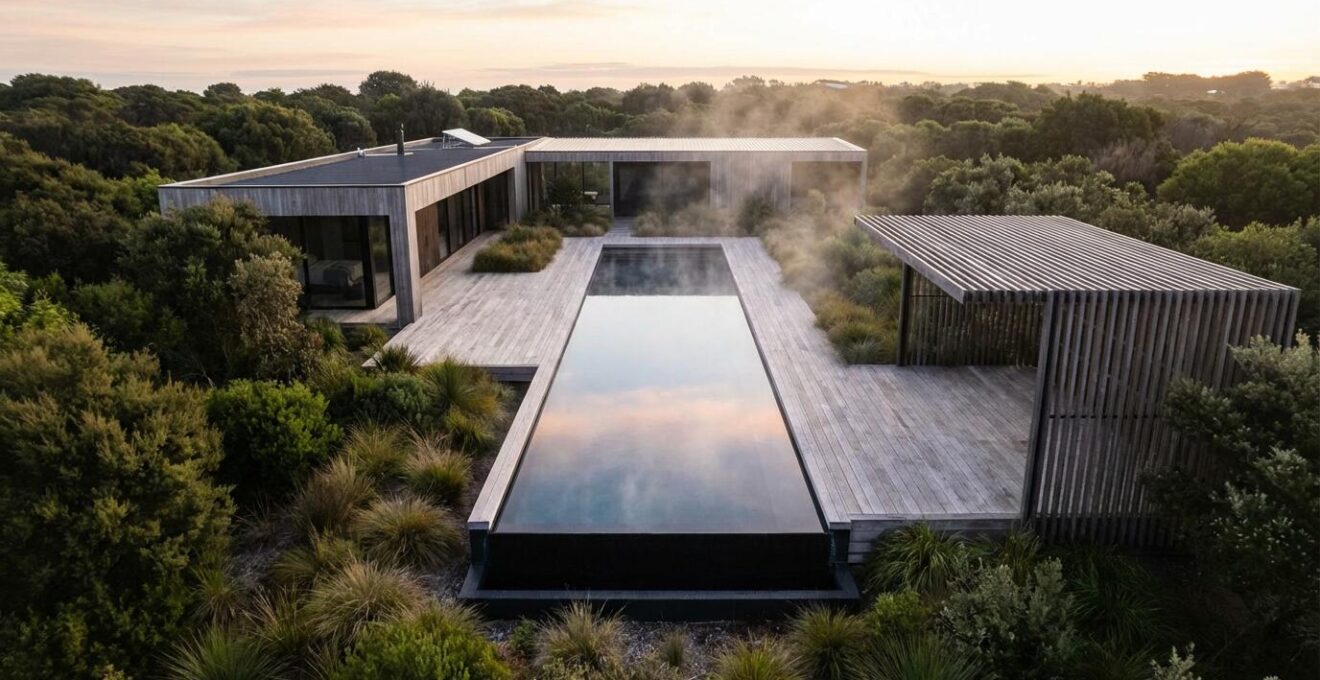
The common belief is that a swimming pool is an energy drain; the reality is that a strategically engineered bioclimatic mirror pool can function as a natural air conditioning unit for your home.
- Properly positioning the pool creates a “breeze corridor” that uses the Venturi effect to actively cool adjacent living spaces.
- The choice of liner color and shade systems allows you to precisely control solar reflection and absorption, turning the pool surface into a dynamic thermal regulator.
Recommendation: Stop viewing your pool as a standalone feature and start integrating it as a core component of your home’s thermal management system to unlock significant energy savings.
For the eco-conscious homeowner, a swimming pool often represents a contradiction: a symbol of leisure that comes with a significant environmental and financial cost. The conventional wisdom focuses on mitigating this impact through covers, efficient pumps, and solar heaters. We are told to minimize the pool’s energy consumption. But this approach is fundamentally limited because it still views the pool as a passive liability—an object to be managed rather than a tool to be wielded.
What if the entire premise was wrong? What if, instead of just being an energy consumer, your pool could be an active part of your home’s cooling system? This is the core principle of a bioclimatic mirror pool. It’s not just about the stunning architectural reflections on a dark, glassy surface. It’s about harnessing the fundamental physics of thermodynamics, fluid dynamics, and solar radiation to create a functional thermal engine. By moving beyond aesthetics and into engineering, the pool transforms from a simple water feature into an instrument for passive cooling, capable of generating refreshing breezes and reflecting unwanted solar heat away from your home.
This article will deconstruct the engineering principles that allow a mirror pool to reduce your air conditioning costs. We will explore how its positioning, surface material, and integrated systems work in concert to create a more comfortable and energy-efficient environment, proving that thoughtful design can turn a perceived luxury into a high-performance functional element of your home.
To fully understand how to transform a standard pool into a high-performance bioclimatic tool, this guide breaks down the critical engineering and design decisions you will face. The following sections provide a data-driven roadmap for each key aspect, from initial site planning to advanced system integration.
Summary: How to Turn Your Pool Into a Natural AC Unit
- How to position your pool to create a refreshing breeze corridor for the terrace?
- Dark vs Light Liners: Which One Creates the Best Mirror Effect for Architectural Reflection?
- The 3 biological imbalances that turn mirror pools green within weeks
- Shade Sails or Pergolas: What to Choose for Temperature Control Over the Water?
- When to adjust water levels to maximize thermal inertia in autumn?
- How to Maintain 28°C Water Temperature in October Without Bankrupting Yourself?
- How to Sync Your Pool Pump with Solar Panels to Run for Free?
- Why Switch to Eco-Friendly Water Treatment if Your Chlorine Pool Seems Fine?
How to Position Your Pool to Create a Refreshing Breeze Corridor for the Terrace?
The single most impactful decision in bioclimatic pool design occurs before any excavation begins: positioning. A strategically placed pool does more than just occupy space; it actively manipulates airflow. The goal is to create a “breeze corridor” that leverages evaporative cooling to lower the ambient temperature on your terrace and near your home’s windows. By channeling prevailing winds across the water’s surface, the air cools as it picks up moisture, creating a natural and free air conditioning effect. The key is to use the house, walls, or dense plantings as a funnel, creating a Venturi effect that accelerates the air as it passes over the water, maximizing the cooling potential.
Failing to control airflow can be incredibly costly. While wind enhances cooling, uncontrolled exposure dramatically increases evaporation. In fact, compelling research on pool energy efficiency shows that a mere 7mph wind can increase a pool’s energy consumption by up to 300% due to heat loss from evaporation. Therefore, the design must be precise: channel the breeze where you want it (the terrace) and shield the rest of the pool to conserve heat and water.
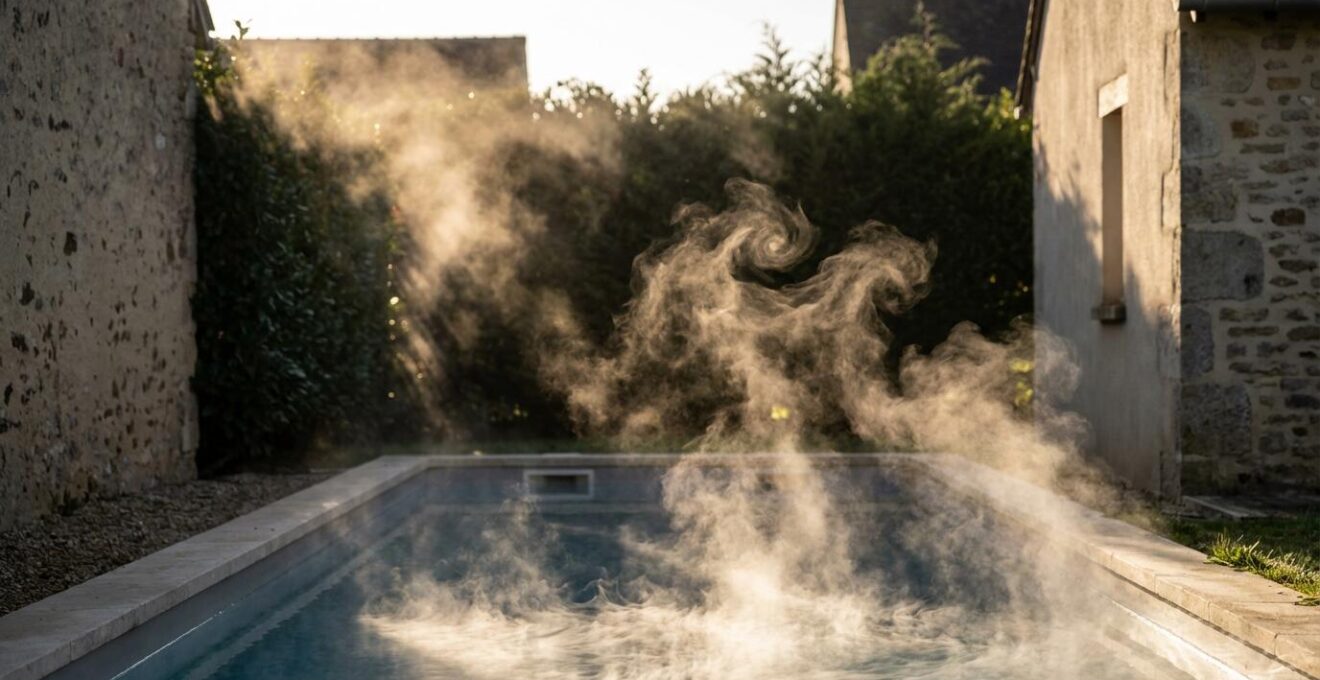
As this diagram illustrates, the careful placement of architectural elements and landscaping creates a microclimate. The pool becomes the heart of a convection system, where cool, dense air from the water surface flows towards the warmer land and building, displacing hot air upwards. This thermal drafting is the mechanism that turns a static body of water into an active cooling engine for your outdoor living spaces.
Your Action Plan: Site Analysis for Optimal Pool Positioning
- Map Prevailing Winds: Use local meteorological data to identify the dominant wind directions during the hottest summer months.
- Identify Natural Corridors: Inventory existing structures, walls, and dense vegetation on your property to find or create a natural wind funnel.
- Calculate Sun Path: Analyze the sun’s trajectory to understand how shadows will fall and where reflective light will be directed throughout the day and seasons.
- Maximize the Venturi Effect: Position the pool between two parallel structures (e.g., the house and a garden wall) to accelerate the breeze across the water.
- Design for Thermal Drafting: Plan deck plantings and low walls to help guide the cool air generated by the pool towards your primary outdoor seating and indoor areas.
Dark vs Light Liners: Which One Creates the Best Mirror Effect for Architectural Reflection?
The “mirror” in a mirror pool is not just an aesthetic choice; it’s a critical component of the thermal engine. The color of your pool’s liner directly dictates its Solar Reflectance Index (SRI), determining how much solar energy is absorbed as heat versus how much is reflected. A dark liner is essential for creating a deep, seamless reflection, but it comes at a thermal cost. While a white surface reflects most light, it creates a flat, chalky appearance that fails to produce the desired mirror effect. A black or dark grey liner provides the best mirror quality by absorbing light, which makes the water’s surface appear darker and more reflective.
However, this absorption has a significant impact on water temperature. Data from Solar Reflectance Index measurements shows that dark surfaces are powerful heat collectors; black can absorb over 90% of solar energy, whereas white may absorb as little as 30%. This means a dark-lined pool will naturally be several degrees warmer than a light-colored one, a benefit in shoulder seasons but a potential heat-sink in peak summer if not managed with shading. The key is to balance the superior reflective aesthetic of a dark liner with its thermal properties.
This comparative analysis breaks down the trade-offs between different liner colors, providing a clear framework for selecting the material that best aligns with your aesthetic goals and climatic reality.
| Liner Color | Solar Absorption | Mirror Quality | Temperature Impact |
|---|---|---|---|
| Black | 90%+ | Excellent | +5-8°C |
| Dark Grey | 70-80% | Very Good | +3-5°C |
| Light Grey | 40-50% | Good | +1-3°C |
| White | 30-40% | Poor | Minimal |
| Metallic/Pearl | 45-55% | Very Good | +2-4°C |
For a true bioclimatic design, the choice is often a dark grey or metallic liner. These options provide an excellent mirror effect while offering a more moderate level of solar absorption compared to pure black, giving you greater control over the pool’s thermal behavior.
The 3 Biological Imbalances That Turn Mirror Pools Green Within Weeks
A dark, still mirror pool is an ideal environment not just for reflecting architecture, but also for cultivating algae. The very design choices that create the perfect aesthetic—still water for a glassy surface and a dark liner for heat absorption—also create a perfect storm for biological imbalances. Without proactive management, these pools can quickly turn green and cloudy. The three primary culprits are thermal stratification, nutrient overload, and biofilm growth.
1. Thermal Stratification: In a still pool, the sun-warmed water from the dark liner stays at the surface, creating layers of different temperatures. The warmer, oxygen-depleted bottom layers become ideal breeding grounds for specific types of algae that thrive in low-oxygen conditions. 2. Nutrient Overload: A bioclimatic pool is often surrounded by lush vegetation. Leaves, pollen, and soil runoff introduce phosphates and nitrates into the water. These nutrients are a feast for algae, leading to explosive blooms. 3. Accelerated Biofilm Growth: The higher surface temperatures of a dark liner significantly speed up the growth of biofilm—a slimy layer of microorganisms—on the pool walls and floor. This not only feels unpleasant but also provides a foothold for algae. A 2024 study on natural pools found that dark-lined pools showed 35% faster biofilm growth due to these elevated temperatures.
To counteract these inherent risks, a proactive biological management strategy is not optional, but essential. Success depends on maintaining a balanced ecosystem where beneficial bacteria outcompete algae for nutrients and circulation systems prevent stratification. Key prevention strategies include:
- Installing small, energy-efficient circulation pumps to constantly mix water layers and prevent thermal stratification.
- Monitoring phosphate and nitrate levels weekly, especially after rain or during high pollen seasons.
- Regularly adding beneficial bacteria to the water to consume excess nutrients.
- For natural pools, designing a regeneration zone with specific aquatic plants that act as a living filter, occupying at least 30% of the total water area.
- Using a UV clarifier to control biofilm and free-floating algae, a critical tool for maintaining clarity on dark surfaces.
Shade Sails or Pergolas: What to Choose for Temperature Control Over the Water?
While a dark liner absorbs solar energy to heat the water, uncontrolled sun exposure can lead to overheating in peak summer, negating the passive cooling benefits. Therefore, a dynamic shading strategy is essential. The choice between shade sails and pergolas is not just aesthetic; it’s a decision between a static and a dynamic system of thermal control. Shade sails are a cost-effective solution for creating fixed areas of shadow, but they lack adaptability. A retractable bioclimatic pergola offers far superior control, allowing you to modulate sun exposure with precision.
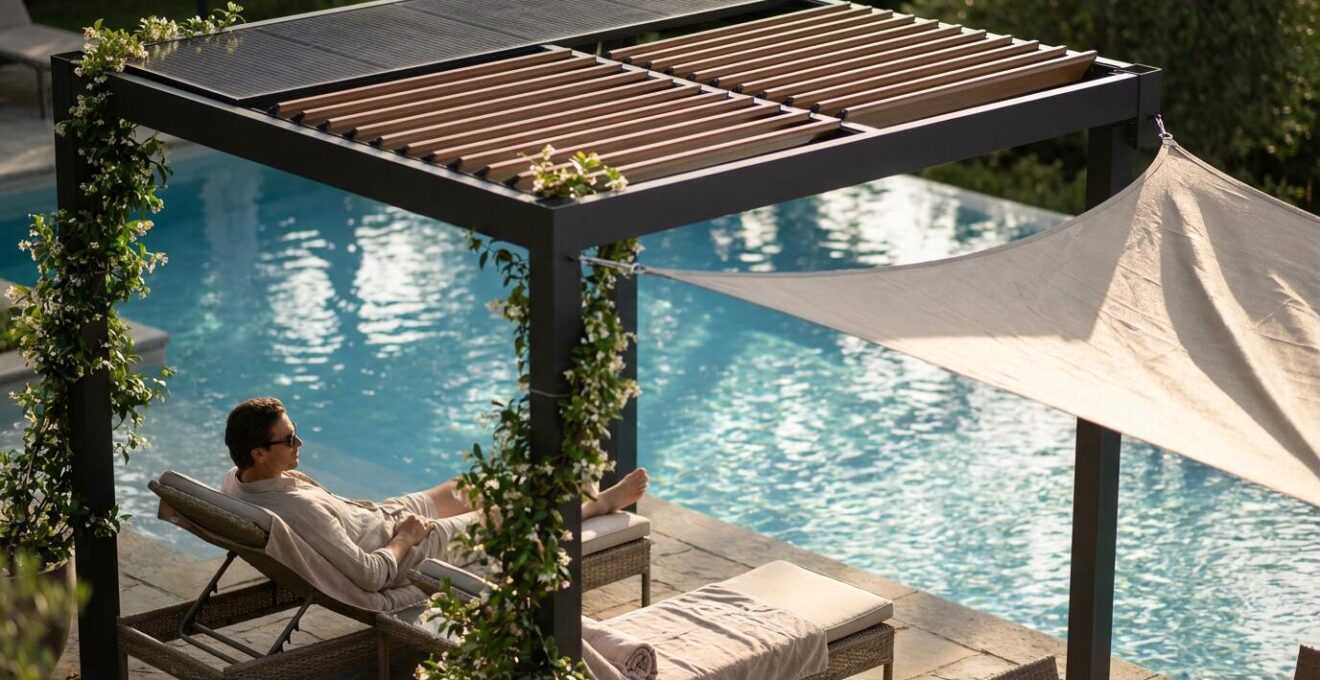
A pergola with adjustable louvers lets you block the harsh midday sun to keep the water and surrounding deck cool, then open them in the late afternoon to allow for gentle warming. This adaptability is key to using the pool as a thermal regulator. Furthermore, modern pergolas can integrate photovoltaic panels, turning the shade structure itself into a power source for the pool’s systems.
Retractable pergolas with integrated solar panels represent the ultimate bioclimatic solution, allowing precise control of solar gain while generating electricity for pool systems.
– Dr. Michael Chen, Sustainable Pool Design Conference 2024
This table compares the key features of different shading systems, highlighting why a dynamic pergola is the superior choice for a high-performance bioclimatic design.
| Feature | Retractable Pergola | Fixed Pergola | Shade Sails |
|---|---|---|---|
| Seasonal Adaptability | Excellent | Poor | Good (if adjustable) |
| Solar Panel Integration | Yes | Yes | No |
| SRI Performance | Variable | Fixed | Depends on fabric |
| Installation Cost | High | Medium | Low |
| Maintenance | High | Low | Medium |
When to Adjust Water Levels to Maximize Thermal Inertia in Autumn?
As summer fades, the goal shifts from cooling to heat retention. A bioclimatic pool’s greatest asset during the shoulder seasons is its thermal inertia—the ability of a large body of water to store heat and resist temperature changes. You can strategically manage this property by adjusting the water level. A deeper pool has more thermal mass, meaning it can absorb more heat during a sunny autumn day and release it slowly overnight, keeping the water warmer for longer. The key is knowing exactly when to make this adjustment.
The trigger for this strategy is not a date on the calendar, but a specific environmental cue: when nighttime temperatures consistently begin to drop below 15°C (60°F). At this point, you should start raising the water level to its maximum safe height. This simple action has a quantifiable impact; thermal dynamics research indicates that raising the water level by just 15cm can increase the pool’s thermal mass by approximately 20% and reduce overnight heat loss by around 12%. This extends the comfortable swimming season without relying on active heating.
This strategy should follow a clear timeline for maximum effect:
- Begin raising levels as soon as nighttime temperatures consistently fall below the 15°C (60°F) threshold.
- Fill to maximum height in the late afternoon to capture the day’s solar gain in the largest possible water volume.
- Deploy a solar cover at dusk to trap the stored heat and dramatically reduce evaporative heat loss overnight.
- Maintain elevated levels throughout the autumn shoulder season, as long as daytime sun provides sufficient solar gain.
- Reduce levels back to normal only when you are closing the pool for winter or when daytime temperatures are consistently warm enough again in the spring.
Key Takeaways
- A pool’s position is its most powerful bioclimatic feature; engineer it to create cooling breeze corridors.
- Dark liners create the best mirror effect but act as heat absorbers; this must be managed with dynamic shading.
- Energy independence is achievable by syncing a variable-speed pump with a properly sized solar array and a smart controller.
How to Maintain 28°C Water Temperature in October Without Bankrupting Yourself?
Maintaining a comfortable swimming temperature in the cooler months is the ultimate test of a bioclimatic pool’s efficiency. Brute-force heating with gas or standard electric heaters is financially and environmentally unsustainable. The solution lies in a layered strategy of heat retention and waste heat recovery. The primary source of heat loss in a pool is evaporation, which acts like a constant cooling mechanism. The first and most critical step is to minimize it.
While physical solar covers are effective, they can be cumbersome. A highly efficient and simple alternative is a liquid solar cover. This is a biodegradable, ultra-thin liquid layer that spreads across the water’s surface, reducing evaporation by up to 50%. More advanced formulations can be even more effective, and energy efficiency studies demonstrate that some liquid solar covers can reduce evaporation heat loss by up to 85%. For an average pool, this can translate into thousands of dollars in annual savings.
The next level of efficiency involves heat recovery. Instead of generating new heat, you can capture “waste” heat from other systems in your home. A water-to-water heat exchanger can be connected to your home’s air conditioning system. In summer and early autumn, when the AC is running, it extracts heat from your house and typically vents it outside. The heat exchanger intercepts this waste heat and transfers it directly into your pool water. This is not just efficient; it’s practically free heat.
Case Study: Zero-Cost Autumn Heating with AC Waste Heat
A Florida pool owner implemented this exact strategy by installing a water-to-water heat exchanger to capture waste heat from their central AC unit. The system successfully maintained a consistent 28°C (82°F) pool temperature throughout October with zero additional heating costs. The investment in the heat exchanger paid for itself in just 18 months through eliminated heating bills, perfectly demonstrating the power of integrated system design.
How to Sync Your Pool Pump with Solar Panels to Run for Free?
The heart of any pool system is its pump, which is also typically its largest energy consumer. The goal of a truly bioclimatic system is to run this essential equipment with zero net energy cost. This is achieved by combining two key technologies: a variable-speed pump (VSP) and a dedicated photovoltaic (PV) solar array, all governed by a smart controller. A VSP is fundamentally more efficient than a traditional single-speed pump because it can be run at a much lower speed for longer periods, consuming drastically less power to circulate the same amount of water.
The energy savings are substantial. According to ENERGY STAR certified equipment analysis shows that homeowners can save over $300 annually just by switching to a VSP, which can reduce energy consumption by up to 90%. When you pair this efficiency with free energy from the sun, you create a self-sufficient system. The smart controller is the brain of the operation, monitoring the output from the solar panels and adjusting the pump’s speed in real-time. On a bright, sunny day, the pump runs at a higher speed for maximum filtration; on an overcast day, it dials back to a lower, energy-sipping speed, ensuring it never draws more power than the panels are producing.
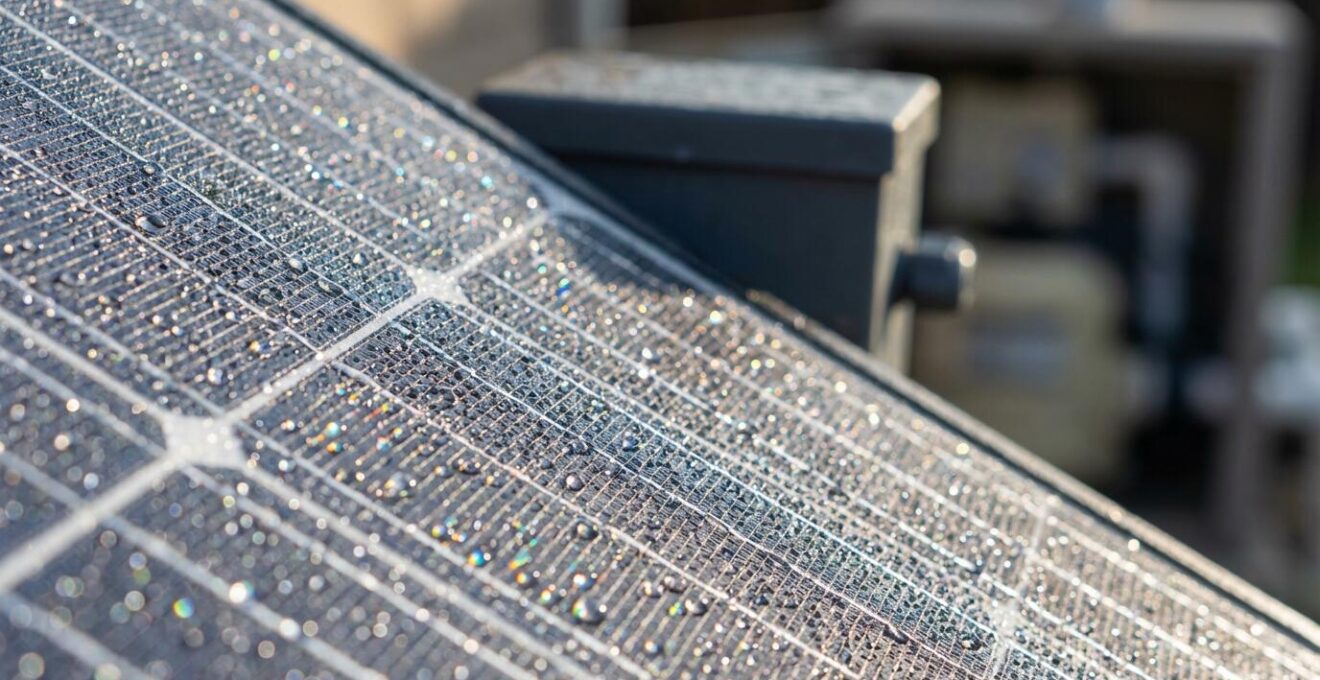
To implement this, you must establish a “solar-first” energy hierarchy. The smart controller should be programmed to prioritize power allocation. The first priority is always the VSP, as filtration is non-negotiable. Any surplus solar power can then be allocated to secondary systems, like a robotic pool cleaner or a salt chlorinator. For maximum efficiency, consider oversizing your solar array by about 20% to provide enough power to run the pump even on less-than-perfect days and to extend its daily runtime.
Why Switch to Eco-Friendly Water Treatment if Your Chlorine Pool Seems Fine?
Using traditional chlorine in a bioclimatic mirror pool is a critical design flaw. It undermines the entire philosophy of creating a healthy, sustainable ecosystem. A bioclimatic pool, especially one designed with a dark liner and for evaporative cooling, has a much higher rate of water evaporation. This process concentrates chemicals left behind, requiring you to add even more chlorine to maintain proper sanitation levels. This creates a vicious cycle of chemical dependency.
The scale of this issue is significant. As noted in an official report, a bioclimatic design can inadvertently increase chemical usage. In a statement on pool sustainability, an expert from the Environmental Protection Agency highlighted this risk. The increased evaporation can have a counterintuitive effect, as the pool may require significantly more treatment chemicals. A bioclimatic pool with high evaporation rates can consume 40% more chlorine than a standard pool, negating the environmental benefits of the passive cooling design.
Furthermore, high chlorine levels are harsh on the very components of the pool. They can degrade expensive dark liners, causing them to fade and lose their mirror finish years ahead of schedule. They are also harmful to surrounding plants, contradicting the goal of integrating the pool into a natural landscape. The solution is to switch to an eco-friendly treatment system that works in harmony with the bioclimatic design. Advanced Oxidation Process (AOP) systems are a prime example. They use a combination of UV light and ozone to create powerful hydroxyl radicals that are far more effective at destroying contaminants than chlorine, with the only byproduct being clean water.
Case Study: AOP Implementation in an Arizona Bioclimatic Pool
A bioclimatic pool in Arizona made the switch from a traditional chlorine system to an Advanced Oxidation Process (AOP) for its water treatment. The results were transformative. The owner reduced their chemical costs by 75% while achieving superior water clarity. Within six months, the surrounding native plants, previously stressed by chlorine splash-out, showed marked improvements in health. Most impressively, the dark, mirror-finish liner remained pristine after three years, a stark contrast to the typical 18-month degradation seen with high chlorine levels.
By shifting your perspective and viewing your pool as an integrated component of your home’s ecosystem, you can move beyond simple energy conservation and into active energy contribution. To put these data-driven principles into practice, the next logical step is a detailed site analysis and system design tailored to your specific climate and property.