
That impressive COP number on the brochure is a carefully constructed illusion; it doesn’t reflect what you’ll actually pay in electricity bills.
- Lab-tested COP is measured under ideal, unrealistic conditions (high air temperature and humidity) that rarely exist in your backyard.
- A heat pump’s real-world efficiency can be cut in half just by raising the water temperature a few degrees or on a cool evening.
Recommendation: Ignore the single “Max COP” value. Instead, demand performance data across multiple temperatures and look for NF certification to understand a unit’s true seasonal efficiency.
As a discerning pool owner, you’ve been trained to look for one number when buying a heat pump: the Coefficient of Performance (COP). The marketing is simple: a higher number means more efficiency and lower running costs. You see a unit boasting a staggering COP of 16 and assume you’ve found the holy grail of pool heating. But what if that number is less of a scientific measurement and more of a marketing sleight of hand? What if the real-world performance you get is a fraction of what was promised on that glossy tag?
The common wisdom is to compare these numbers directly. However, this approach completely ignores the fundamental physics of how a heat pump works. Its efficiency is not a static value; it’s a dynamic variable that plummets under real-world conditions. Manufacturers know this. They exploit standardized testing procedures, cherry-picking the most favorable conditions—warm, humid air and lukewarm water—to produce an impressive, but ultimately misleading, maximum COP. This number is a snapshot of the pump’s best possible moment, not its everyday reality.
The truth is that the key to genuine efficiency lies not in a single, inflated number, but in understanding the performance curve of a unit across an entire season. This article will act as your consumer protection guide. We will deconstruct the performance illusion piece by piece, revealing the testing condition tricks used to inflate efficiency numbers. We will show you why a seemingly small change in water temperature can decimate your COP and what certifications actually guarantee real-world performance.
By the end, you won’t be fooled by a high COP. You’ll be armed with the critical knowledge to analyze a system’s true total cost of ownership, understanding how technologies like inverters and variable-speed pumps deliver tangible savings that a meaningless brochure number can only promise. You’ll learn to look beyond the marketing and choose a system based on proven, seasonal efficiency.
To navigate this complex topic, we will break down exactly how performance metrics are manipulated and what you should look for instead. This guide provides a clear roadmap to understanding true heat pump efficiency.
Summary: Decoding Real Heat Pump Efficiency
- How to spot the difference between “Max COP” and “Average COP”?
- Why does your COP drop by half when heating water to 30°C vs 26°C?
- NF vs TÜV: Which Certification Guarantee Real-World Performance?
- The testing condition trick manufacturers use to inflate efficiency numbers
- When to adjust bypass valves to hit the “sweet spot” of thermal transfer?
- Why Inverter Heat Pumps Are Worth the Extra Upfront Cost for Large Pools?
- How Inverter Technology Reduces Your Pool’s Carbon Footprint by 40%?
- How Variable-Speed Pumps Pay for Themselves in Less Than 24 Months?
How to spot the difference between “Max COP” and “Average COP”?
The most common deception in heat pump marketing is the conflation of “Maximum COP” with “Average COP.” The giant number on the sticker is almost always the maximum, achievable only in a perfect, lab-controlled environment. This is the performance illusion in action. True efficiency, the one that impacts your wallet, is the Seasonal COP (SCOP)—an average of the unit’s performance across the varied temperatures of an entire swimming season.
Manufacturers often test their units under the most favorable conditions possible. For instance, according to the Department of Energy’s federal test procedure, a standard condition is an 80°F ambient temperature with 63% relative humidity, heating water that is already 80°F. In this ideal scenario, the heat pump has to do very little work, allowing it to post an impressive but unrealistic efficiency number. The “Max COP” is a best-case scenario, while the “Average COP” you experience will be significantly lower, reflecting chilly mornings, cooler nights, and less-than-tropical humidity levels.
The difference isn’t trivial; a real-world seasonal COP can easily be 30-50% lower than the advertised maximum. To protect yourself, you must learn to read between the lines of a spec sheet and identify the red flags that signal a manufacturer is hiding poor performance behind an inflated “Max COP” number.
Actionable checklist: Red Flags in Marketing COP Claims
- Is the COP stated without air and water temperature conditions? If so, assume it was tested under perfect 80°F/80°F/80% humidity conditions.
- Is there a complete absence of performance data below 50°F (10°C)? This indicates selective reporting to hide poor cold-weather efficiency.
- Are humidity levels for the test specified? A high humidity level (over 70%) can artificially boost COP readings by making heat transfer easier.
- Does the data show only one test point? Legitimate certifications like NF demand tests at multiple temperatures (e.g., 7°C, 15°C, 26°C), not just one “sweet spot”.
- Is a Seasonal COP (SCOP) or performance curve provided? A refusal to provide this data is a major red flag that the unit performs poorly outside its ideal test bubble.
Why does your COP drop by half when heating water to 30°C vs 26°C?
The dramatic drop in efficiency when you demand warmer water is not a sign of a faulty unit; it’s a demonstration of fundamental physics. This concept is known as “thermal lift.” A heat pump doesn’t create heat; it moves it from the ambient air into your pool water. The “lift” is the work the compressor must do to bridge the temperature difference between the air and your desired water temperature. The larger this gap, the harder the compressor works, and the more electricity it consumes for every unit of heat delivered. Consequently, the COP plummets.
Heating water to a comfortable 26°C (79°F) on a 20°C (68°F) day requires a relatively small thermal lift. But asking the same unit to heat the water to a balmy 30°C (86°F) dramatically increases the workload. The compressor runs longer and at a higher intensity, consuming significantly more power. This is why industry analysis shows that the COP can drop from 6 to below 3 just by increasing the setpoint from 26°C to 30°C. You are effectively halving the unit’s efficiency and doubling your heating cost for those extra few degrees of comfort.
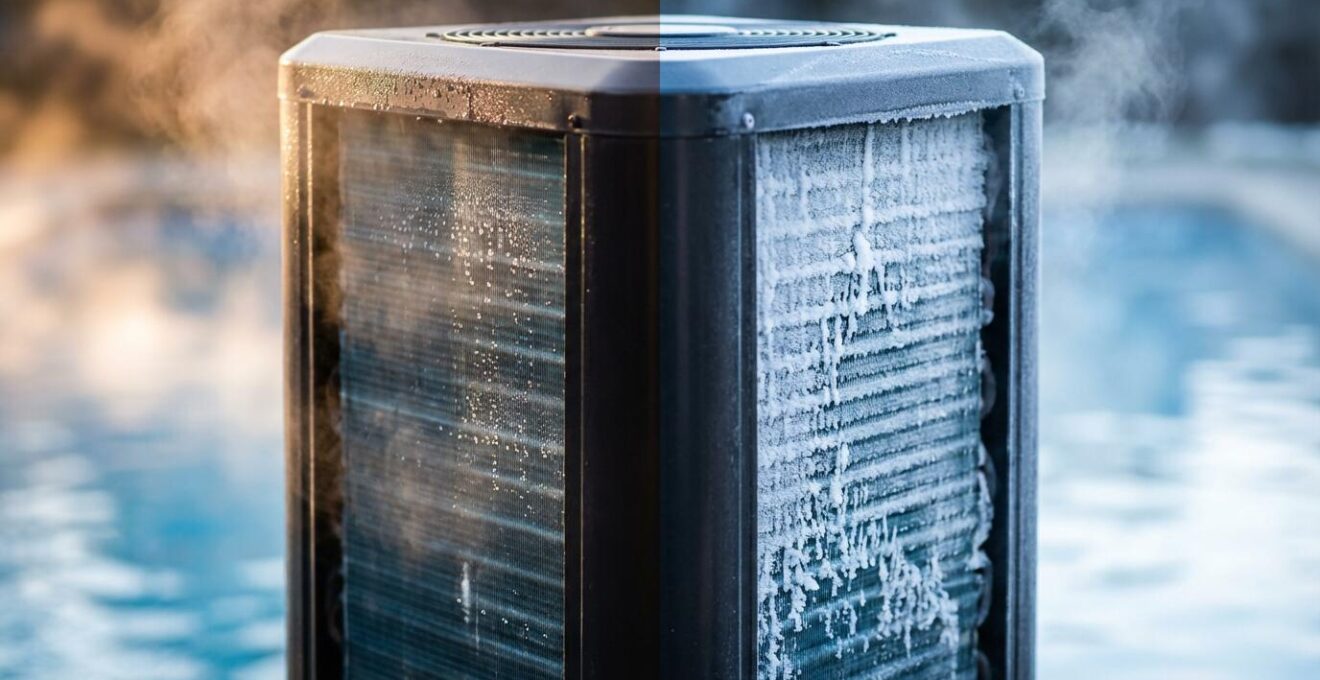
This visual perfectly illustrates the strain. On the left, operating efficiently, the unit shows minimal stress. On the right, pushing for that higher temperature, the system is covered in frost, a clear sign of a system working at its absolute limit. This continuous high-stress operation has consequences beyond your electricity bill.
The Hidden Cost of High Temperatures: Reduced Equipment Lifespan
Field studies demonstrate that maintaining pool water at 30°C instead of 26°C not only increases daily running costs by 15-20% per degree but also forces the heat pump to operate constantly at its operational limit. This continuous high-stress operation can reduce equipment lifespan by 30-40% due to increased compressor wear and more frequent, energy-intensive defrost cycles in cooler weather conditions. The pursuit of a few extra degrees can literally wear out your expensive equipment years ahead of schedule.
NF vs TÜV: Which Certification Guarantee Real-World Performance?
In a market flooded with misleading performance claims, third-party certifications are supposed to be a beacon of trust for consumers. However, not all certifications are created equal. Many, like a standard TÜV certification, often only verify the manufacturer’s own claims at a single, ideal operating point. This does little to expose the performance illusion. In contrast, the NF certification stands out as a far more rigorous and reliable guarantor of real-world performance.
The critical difference lies in the testing methodology. The NF mark, managed by organizations like Eurovent, mandates multi-point testing. Instead of just certifying performance at a balmy 15°C or 26°C, it forces manufacturers to prove their unit’s efficiency across a range of realistic seasonal conditions, including colder temperatures like 7°C and 15°C. This approach exposes units that perform well in perfect weather but fail miserably on a cool spring morning or autumn evening. It provides a much more honest picture of the Seasonal COP (SCOP) you can expect.
As the European Heat Pump Association Technical Committee states in its regulations, this methodology is designed specifically to protect consumers:
Multi-point testing of the NF mark provides a much more reliable indicator of Seasonal COP because it forces manufacturers to prove efficiency across a range of realistic conditions, not just a single sweet spot.
– European Heat Pump Association Technical Committee, EHPA Testing Regulations for Heat Pumps 2024
The following table, based on data from an analysis by Eurovent Certification, clearly breaks down the difference in rigor between common certifications.
| Certification | Test Points | Temperature Range | Real-World Coverage |
|---|---|---|---|
| NF Certification | Multiple (3+) | 7°C, 15°C, 26°C | Full seasonal range |
| Standard TÜV | Single point | 15°C typical | Ideal conditions only |
| AHRI Standard | 2-3 points | 10°C, 26°C | Moderate coverage |
The testing condition trick manufacturers use to inflate efficiency numbers
Beyond testing at ideal temperatures, manufacturers employ another subtle trick to skew results: manipulating humidity. A heat pump’s efficiency is directly tied to its ability to extract latent heat from moisture in the air. Therefore, testing a unit in a high-humidity environment (typically 70-80%) makes the heat transfer process significantly easier, artificially boosting the measured COP.
This “Test Condition Skew” creates a major discrepancy between lab results and real-world performance, especially in drier climates. A heat pump that boasts a COP of 15 in the humid air of a Florida-based test lab will never achieve that performance in the arid climates of Arizona or inland California. In fact, field measurements reveal a potential 20-30% COP reduction in dry climates compared to the numbers achieved under humid test conditions. The advertised efficiency simply evaporates in dry air.
Other manipulated factors include assuming perfect airflow, which is rarely achievable in a real installation next to a wall or under a deck, and omitting the energy consumed during defrost cycles. Below 10°C (50°F), a heat pump must periodically reverse its cycle to melt ice off its evaporator, a process that consumes energy and produces no heat for your pool. If this is not factored into the COP calculation, the number is fundamentally dishonest. To accurately interpret a manufacturer’s data sheet, you must become a forensic accountant, looking for what is—and isn’t—disclosed. Always check the test humidity level; if it’s high, mentally deduct 15-20% from the COP for average conditions. Likewise, if the data omits performance curves at low temperatures, assume the efficiency is too poor to print.
When to adjust bypass valves to hit the “sweet spot” of thermal transfer?
While many efficiency factors are outside your control, one powerful tool you have is the bypass valve. This simple plumbing component allows you to regulate the water flow rate through the heat pump, and dialing it in correctly is essential to hitting the “sweet spot” of thermal transfer. Many owners assume that more flow is always better, but this is a critical mistake. Both too much and too little flow can sabotage your heat pump’s efficiency.
Every heat pump is designed with an optimal flow rate range. If the flow is too fast, water rushes through the heat exchanger too quickly, not allowing enough “contact time” for efficient heat transfer to occur. You’re wasting energy to pump water that isn’t getting properly heated. Conversely, if the flow is too slow, the water may overheat locally within the unit, but the overall volume of water being heated is too low to be effective for the whole pool, and the unit may shut off on a high-pressure fault. The goal is to find the “Goldilocks zone.” A great way to check this is to measure the temperature difference (Delta T) between the water entering and leaving the heat pump. An ideal Delta T is typically 8-10°F (4-5°C). If it’s higher, your flow is too slow; if it’s lower, your flow is too fast.
Properly setting this flow rate isn’t a one-time task. It should be checked at the start of the season and any time you change your main pump’s speed or clean your filter, as both actions alter system pressure and flow. The effort is well worth it. Field testing has shown that proper bypass valve adjustment to achieve manufacturer-specified flow rates can increase achieved COP by 5-10% versus non-adjusted systems. This is because you are allowing the heat pump to operate under the exact hydraulic conditions it was designed and tested for, maximizing its performance.
Why Inverter Heat Pumps Are Worth the Extra Upfront Cost for Large Pools?
After deconstructing the myth of the static COP, the real solution to efficiency emerges: technology that adapts. This is the core value of an inverter heat pump. Unlike traditional on/off models that run at 100% capacity and then shut down, an inverter pump uses a variable-speed compressor and fan. It can intelligently modulate its power output from as low as 20% up to 100% based on the real-time heating demand.
This adaptive capability is a game-changer for efficiency. To reach the desired temperature, an inverter will initially run at high power. But once the temperature is reached, instead of shutting off, it throttles down to a very low, quiet, and ultra-efficient speed to simply maintain the temperature. It spends most of its time “sipping” energy rather than “gulping” it in on/off cycles. This is why it’s not uncommon for an inverter heat pump to achieve a real-world seasonal COP that is 50-100% higher than a standard model. The technology is so effective that market research indicates that the inverter pool heat pump market is projected to grow exponentially, reaching $3.4 billion by 2033.
For owners of large pools, the initial higher purchase price can be intimidating. However, analyzing the Total Cost of Ownership (TCO) over a five-year period reveals the true value. The massive energy savings quickly offset the higher upfront cost, and the reduced wear-and-tear from gentle, continuous operation also leads to lower maintenance bills.
| Factor | On/Off Heat Pump | Inverter Heat Pump | 5-Year Difference |
|---|---|---|---|
| Initial Cost (140k BTU) | $4,500 | $6,500 | -$2,000 |
| Annual Energy Cost | $2,400 | $1,200 | +$6,000 savings |
| Maintenance (5 years) | $1,500 | $800 | +$700 savings |
| Total 5-Year TCO | $18,000 | $13,300 | +$4,700 net savings |
How Inverter Technology Reduces Your Pool’s Carbon Footprint by 40%?
The benefits of inverter technology extend far beyond your electricity bill; they represent a significant step forward in reducing the environmental impact of pool ownership. The core of this benefit lies in its radical efficiency improvement. As technological evolution has pushed performance, we’ve seen COP improvements from an average of 4 to potential highs of 16 through advanced inverter technology. By consuming drastically less electricity to produce the same amount of heat, inverter pumps directly reduce the demand on the power grid, which in many regions still relies on fossil fuels.
This reduction in energy consumption translates directly to a smaller carbon footprint. Compared to an old, inefficient on/off heat pump or, even more so, a natural gas heater, an inverter heat pump can reduce the energy required for pool heating by up to 50-70%. For the average residential pool, this can equate to saving several tons of CO2 emissions over the course of a swimming season. The International Energy Agency highlights the massive potential of this technology.
Even with today’s refrigerants, heat pumps can reduce greenhouse gas emissions by potentially up to 80% compared to gas-fired boilers in countries with cleaner electricity.
– International Energy Agency, The Future of Heat Pumps Report
Furthermore, inverter technology offers a more subtle but equally important environmental benefit through its “soft-start” capability, which helps stabilize the electrical grid itself.
Grid-Friendly Operation: The Soft-Start Advantage
Analysis of inverter heat pump installations shows a significant reduction in peak grid demand. The soft-start capability eliminates the massive 5-7x inrush current spike that is typical when an on/off model’s compressor kicks in. This grid-friendly operation prevents voltage sags and contributes to overall power system stability, especially during peak summer demand periods when many pools and air conditioners are operating simultaneously. By smoothing out demand, inverter technology helps utility providers manage the grid more efficiently, reducing the need for high-polluting “peaker” power plants.
Key takeaways
- The COP on a brochure is a “Max COP” achieved in unrealistic lab conditions, not the “Seasonal COP” you’ll actually experience.
- True efficiency depends on a system-wide approach, combining adaptive technology (inverters) with optimized components (variable-speed pumps) and proper setup (bypass valves).
- Demanding multi-point certifications like NF is the only way to verify a unit’s performance across a realistic range of temperatures, cutting through the marketing hype.
How Variable-Speed Pumps Pay for Themselves in Less Than 24 Months?
To complete the picture of a truly efficient system, the heat pump must be paired with an equally intelligent circulation pump. A variable-speed pump (VSP) is the perfect complement to an inverter heat pump, and it delivers such dramatic energy savings that it often pays for its higher upfront cost in under two years.
The secret lies in a principle of physics known as the “Pump Affinity Law.” This law states that if you reduce a pump’s motor speed by half, you reduce its power consumption by a factor of eight. A traditional single-speed pump runs at full blast (e.g., 3450 RPM) for a set number of hours, consuming a massive amount of energy. A VSP, however, can be programmed to run at a very low speed (e.g., 1000 RPM) for 24 hours a day. This slow, continuous circulation uses a fraction of the energy while providing superior filtration and chemical distribution. The savings are staggering; field measurements demonstrate annual savings of 3,796 kWh when operating at a low flow rate versus running a single-speed pump at full power.
The synergy with a heat pump creates even more savings. By running the VSP at the precise flow rate that is optimal for the heat pump’s exchanger, you can boost the heat pump’s own achieved COP by an additional 5-10%. This symbiotic relationship is the foundation of a modern, energy-efficient pool pad. With electricity prices continuing to rise, the return on investment for a VSP has become faster than ever. Analysis of recent installations shows that rising energy costs have reduced the typical payback period by up to 50%, with many owners recouping their investment in under 18 months. A VSP is no longer a luxury item; it is an essential component for any cost-conscious and environmentally-aware pool owner.
Now that you are equipped with the knowledge to see past deceptive marketing, the next step is to apply this critical thinking to selecting the components for your own pool system, ensuring every piece works in harmony to deliver true efficiency.
Frequently Asked Questions on Pool Heat Pump Efficiency
How do I know if my flow rate is in the ‘Goldilocks zone’?
Measure the temperature difference between water entering and leaving the heat pump. Ideal delta T is typically 8-10°F (4-5°C). A higher difference means the flow is too slow, while a lower difference means it’s too fast. Adjust your bypass valve accordingly to hit this sweet spot.
Can more flow ever be harmful to efficiency?
Yes, absolutely. Excessive flow reduces the “contact time” of water inside the heat exchanger, preventing efficient heat transfer from the refrigerant to the water. This wastes both the energy used by your circulation pump and the energy used by the heat pump itself.
How often should bypass valves be checked?
You should check your bypass valve settings at the beginning of each pool season. It’s also critical to re-check them anytime you change your variable-speed pump’s settings or after cleaning your filter, as these actions change the system’s overall pressure and can knock the flow rate out of its optimal zone.