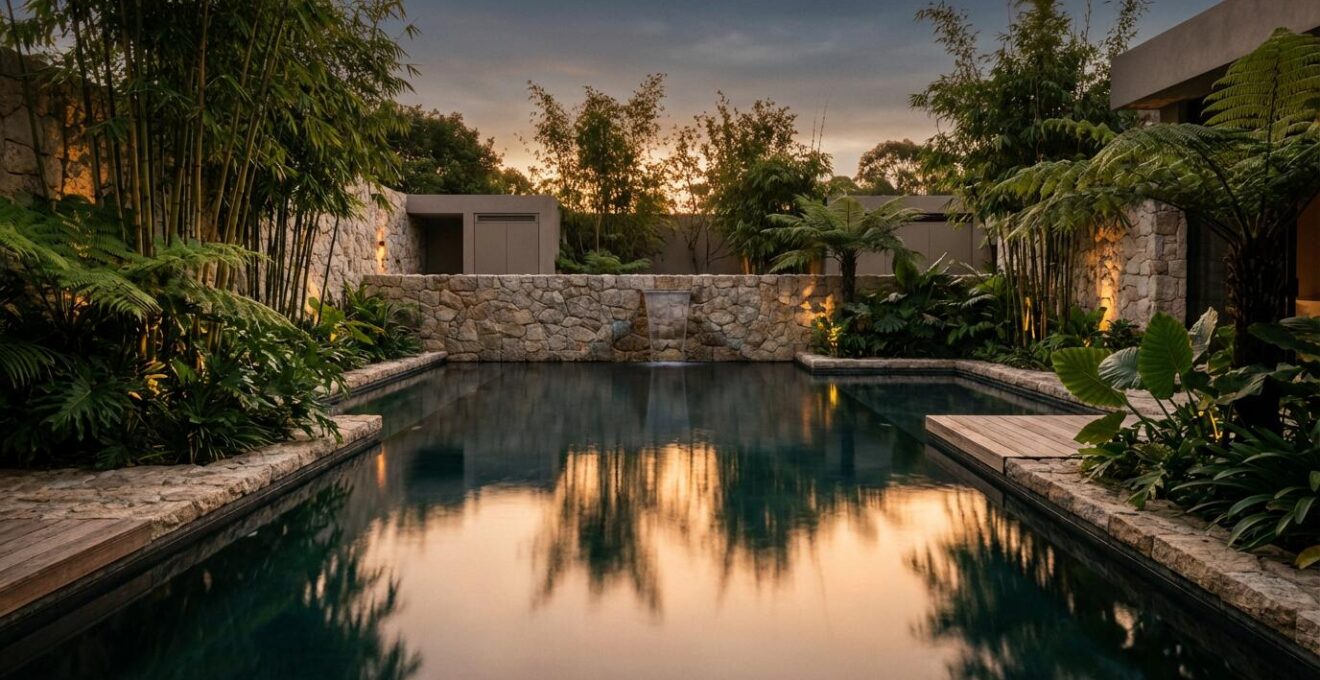
The constant drone of a pool pump in a compact courtyard is not merely an inconvenience; it is a fundamental design failure that shatters the very purpose of a backyard sanctuary.
- Achieving true silence requires moving beyond a single “quiet” pump to meticulously engineering an entire acoustic ecosystem.
- Controlling structure-borne vibration and eliminating plumbing-induced cavitation are often more critical than managing airborne noise alone.
Recommendation: Treat your pool’s filtration not as a loud utility to be hidden, but as an integral, silent component of your landscape’s sensory design.
For the urban homeowner, a courtyard pool is a private oasis, a compact refuge from the city’s clamor. Yet, this sanctuary is often compromised from within by an insidious source of stress: the relentless hum of the pool’s filtration system. In a small, enclosed space where sound waves reflect and amplify, a standard pump’s drone becomes an unavoidable presence, turning a tranquil retreat into a source of persistent, low-level irritation. The common advice—to simply buy a “quiet” model or build a basic box around it—frequently fails because it ignores the fundamental physics of sound in such environments.
The issue is rarely just about the volume of the pump itself. It’s about how that sound energy travels. It becomes airborne noise that bounces off walls, and more critically, it becomes structure-borne vibration that can turn your entire patio or deck into a low-frequency speaker. Addressing this requires a more sophisticated approach, one that looks at the entire filtration loop as a single, integrated acoustic system. This involves not only selecting the right equipment but also mastering its installation, plumbing, and operational schedule.
But what if the solution wasn’t just about subtracting noise, but also about adding the right kind of sound? This guide moves beyond simplistic fixes to present an engineer’s methodology for achieving true poolside tranquility. We will deconstruct the nature of pump noise, explore advanced soundproofing and vibration-damping techniques, and reveal how intelligent system design can create a soundscape that actively reduces stress. The goal is not just a quieter pool, but a profoundly more peaceful and restorative outdoor experience.
This article provides a systematic approach to transforming your pool’s acoustic signature. Below is a summary of the key areas we will explore to engineer a truly silent and serene courtyard environment.
Summary: A Systematic Guide to Poolside Acoustic Control
- How to read pump noise specs: What is the difference between 45dB and 60dB?
- How to build an acoustic enclosure that doesn’t overheat the pump?
- Submerged or Dry Mount: Which Installation Method Eliminates Vibration Hum?
- The plumbing mistake that makes even silent pumps scream
- When to run filtration cycles to ensure total silence during dinner parties?
- How Variable-Speed Pumps Pay for Themselves in Less Than 24 Months?
- How Water Curtains Block Traffic Noise in Urban Backyards?
- How to Design a Pool Area That Reduces Cortisol Levels?
How to read pump noise specs: What is the difference between 45dB and 60dB?
Understanding a pump’s noise rating is the first step in acoustic design, yet the decibel (dB) scale is deeply deceptive. It is logarithmic, not linear, meaning our perception of loudness does not scale directly with the number. A small numerical difference on a spec sheet can represent a massive real-world difference in auditory experience. For instance, a pump rated at 60dB is not just slightly louder than one at 45dB; 60dB is perceived as roughly 3 times louder than 45dB. This is the difference between a quiet library (45dB) and a normal conversation you cannot ignore (60dB).
When evaluating specifications, it’s crucial to verify the context. Manufacturers may list dB ratings measured at 3 meters or even 10 meters, which makes the pump appear significantly quieter than it will be at the typical 1-meter distance in a compact equipment area. A truly quiet pump will have a rating in the low-to-mid 40s at a 1-meter distance. Anything advertised at 60dB or higher will be a dominant, intrusive noise source in a courtyard setting. Remember that every 10dB increase represents a tenfold increase in sound intensity, a critical factor when the goal is tranquility.
Therefore, scrutinizing the fine print on noise ratings is non-negotiable. Look for the measurement distance and aim for the lowest possible number, understanding that each decibel you save has an exponential impact on the peacefulness of your backyard. This initial data analysis forms the bedrock of your entire noise-reduction strategy.
How to build an acoustic enclosure that doesn’t overheat the pump?
Once you have the quietest possible pump, the next layer of defense is a properly designed acoustic enclosure. A common mistake is to build a simple, airtight box, which effectively soundproofs the pump but also starves it of cooling air, leading to overheating and premature failure. The engineering solution is an enclosure that both blocks sound and manages airflow, a principle best achieved through a “Mass-Air-Mass” construction with baffled ventilation.
The enclosure’s walls should be constructed from a dense, heavy material to block airborne sound waves. As detailed by soundproofing experts, using dense materials like 1/2″ plywood or cement board is highly effective. The “Mass-Air-Mass” principle involves creating a sandwich: an outer dense layer (Mass), an air gap, and an inner layer of sound-absorbing material like acoustic foam (the second Mass). Any gaps or seams in the outer box must be meticulously sealed with acoustic caulk to prevent sound leaks.
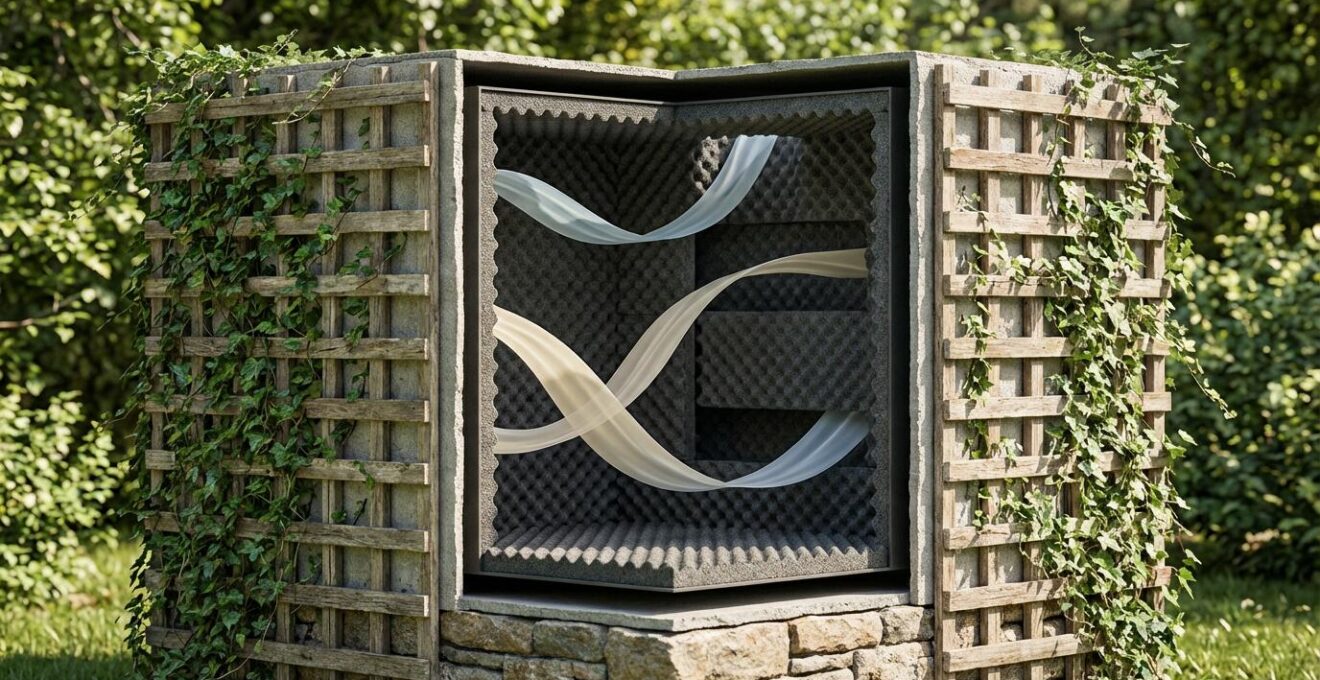
As the illustration demonstrates, ventilation is the most critical and complex part of the design. Air must be able to enter and exit freely without providing a direct path for sound. This is achieved with baffled or L-shaped vents. These vents force the air to turn corners, which dissipates sound energy, while still allowing for sufficient heat exchange. The inlet vent should be positioned low on one side, and the outlet vent high on the opposite side, to promote natural convection. This strategic design ensures your pump remains both silent and cool.
Submerged or Dry Mount: Which Installation Method Eliminates Vibration Hum?
Even the quietest pump in the most sophisticated enclosure will fail to deliver silence if it’s installed incorrectly. The primary culprit is structure-borne vibration, a low-frequency hum that travels from the pump, through its mounting base, and into your deck or patio, turning large surfaces into speakers. A typical swimming pool pump runs in the 65-90 decibels range, and a significant portion of this energy is vibrational. The choice of installation method is paramount in severing this connection.
Bolting a pump directly to a concrete slab is the worst-case scenario, as it ensures maximum vibration transfer. A submerged installation, while eliminating ground vibration, can transmit noise through the water and plumbing system. The most effective method for a dry-mounted pump is to create a multi-stage isolation system. This starts with placing the pump on a heavy, dense base (like a thick concrete paver) to add mass, which inherently dampens vibration. This paver should then be isolated from the ground or deck using a high-quality, dedicated anti-vibration rubber pad.
The following table compares the acoustic implications of different installation choices, highlighting why mechanical isolation is so critical for a tranquil courtyard setting.
| Installation Type | Vibration Level | Maintenance Access | Noise Transmission |
|---|---|---|---|
| Dry Mount with Anti-vibration Pads | Low (isolated from ground) | Easy | Minimal structure-borne noise |
| Direct Concrete Mount | High (turns patio into speaker) | Easy | Maximum vibration transfer |
| Submerged Installation | No ground vibration | Difficult | Transmits through water/plumbing |
By using anti-vibration pads to decouple the pump from the surrounding structure, you contain the mechanical energy at its source, preventing it from radiating throughout your outdoor space. This small detail is often the difference between a tolerable hum and genuine silence.
The plumbing mistake that makes even silent pumps scream
You can have the best pump, enclosure, and mounting, but one common plumbing error can make the entire system shriek: cavitation. This phenomenon occurs when there isn’t enough water pressure at the pump’s inlet, causing microscopic vacuum bubbles to form in the water. As these bubbles travel through the pump and collapse, they create a loud, damaging noise often described as gravel or marbles rattling inside the pump. This not only generates high-frequency noise but also severely damages the pump’s impeller over time.
Cavitation is almost always caused by restrictions in the intake plumbing. According to pump engineering best practices, there should be no unnecessary restrictions in the inlet line, such as undersized pipes, clogged filters, or too many sharp 90-degree elbows. A critical and often-overlooked rule is to provide a straight, unobstructed run of pipe directly before the pump’s intake. The professional standard is the “10x Pipe Diameter” rule: a straight pipe measuring at least 10 times the pipe’s diameter (e.g., 20 inches of straight pipe for a 2-inch pipe) allows the water flow to become smooth and non-turbulent (laminar) before it enters the pump.

As this close-up view shows, the formation and violent collapse of these bubbles is a physical process that generates significant acoustic energy. By ensuring your plumbing is designed for unrestricted, laminar flow, you prevent the conditions that lead to cavitation. This means using large-radius, “sweep” elbows instead of sharp 90-degree fittings and keeping the suction line as short and straight as possible. This is the final step in silencing the machine itself, ensuring it operates under its designed hydraulic conditions.
When to run filtration cycles to ensure total silence during dinner parties?
With a physically quieted system, the final layer of control is operational intelligence. The goal is to ensure the pool is clean without the filtration system ever being audible when you are using the backyard. This is where variable-speed pumps (VSPs) and modern automation become indispensable tools for the acoustically-sensitive homeowner. Rather than running a single-speed pump at full power for a fixed 8-hour block, a VSP can be programmed for strategic, silent operation.
The core principle is to trade intensity for duration. A VSP can circulate the same total volume of water by running for 16-24 hours at a very low, nearly inaudible speed (producing noise levels around 45-55 dB) instead of for 8 hours at a loud, high speed. This continuous, low-speed filtration is not only quieter but also more energy-efficient and better for water quality. For ultimate control, smart controllers allow for the creation of custom “modes.” You can program a “Dinner Party Mode” that automatically throttles the pump down to its minimum speed for a few hours in the evening, ensuring absolute silence during social gatherings.
Variable speed pumps are consistently quieter than single-speed models when run at low or medium speeds.
– Larry’s Pool Equipment Testing, Quietest Above Ground Pool Pumps Review 2025
Furthermore, it’s wise to check local noise ordinances, which often dictate maximum permissible noise levels during nighttime hours, typically in the 45-50 dB range. Programming your pump to respect these limits prevents neighborhood disputes. By combining low-speed continuous filtration with event-specific scheduling, you achieve full command over your backyard’s soundscape.
How Variable-Speed Pumps Pay for Themselves in Less Than 24 Months?
The initial investment in a variable-speed pump (VSP) is higher than that of a traditional single-speed model, a fact that can cause hesitation. However, from an engineering and financial perspective, the VSP is not a cost but a high-return investment, particularly in terms of energy consumption. The physics of pump operation dictates that energy use is not linear with speed. A fundamental pump law states that if you halve the pump’s speed, you reduce its energy consumption by a factor of eight. This is the key to their dramatic efficiency.
Instead of running at a fixed, high speed (e.g., 3,450 RPM) all the time, a VSP can be programmed to run at a much lower speed (e.g., 1,500 RPM) for longer periods to achieve the same water turnover. This operational shift can lead to staggering energy reductions. According to industry data, homeowners can achieve up to 80% energy savings over a traditional single-speed pump. In many regions with high electricity costs, these savings can be substantial enough to cover the initial price difference of the VSP in as little as 18 to 24 months. After this payback period, the pump generates net savings for the remainder of its operational life.
Case Study: Aquagem InverPro Silent Pump Performance
Advanced inverter pumps like the Aquagem InverPro demonstrate the dual benefits of this technology. When running at just 40% of its capacity, the pump’s noise level can drop to an astonishingly low 36.6 dB(A) at 1 meter—a level that is 20 times quieter than the typical 60-70 dB(A) of a regular pump. This is combined with performance that offers up to 15 times the energy savings. This case highlights how modern VSPs deliver on both acoustic and economic fronts, making them the cornerstone of any modern, efficient, and quiet pool system.
Therefore, the decision to invest in a VSP is not just about acoustic comfort; it’s a financially sound choice that offers a clear and relatively rapid return on investment, all while providing the quiet operation essential for a courtyard sanctuary.
How Water Curtains Block Traffic Noise in Urban Backyards?
After meticulously silencing the pool equipment, the final acoustic challenge in an urban courtyard is often external: traffic, neighbors, and the general hum of the city. While a solid wall is an effective sound barrier, a more elegant and aesthetically pleasing solution is to use the principles of sound masking. This involves introducing a pleasant, natural sound to cover or mask the undesirable noise. The gentle, broad-spectrum sound of moving water is exceptionally effective at this.
A water feature, such as a water curtain, small waterfall, or sheer descent, can be strategically positioned between your primary seating area and the source of the external noise. The sound it produces doesn’t “cancel” the traffic noise, but it makes your brain perceive it as less intrusive. The key is to design the feature to produce the right kind of sound. A free-falling drop of water creates high-frequency splashing, which can be irritating. In contrast, water flowing over a textured surface like slate tile creates a lower-frequency, more soothing “gurgle” or “whoosh” sound. This broad-spectrum sound is more effective at masking the variable frequencies of urban noise.
Combining this water feature with other acoustic elements can further enhance the effect. Dense plantings, such as a hedge of bamboo, act as sound diffusers, scattering sound waves. The gentle rustling of their leaves also contributes to the pleasant soundscape. This layered approach—using a water feature for masking and plants for diffusion—allows you to shape a serene acoustic environment, effectively building a “wall of sound” that is beautiful, natural, and calming.
Key takeaways
- True silence is an engineered system, not a single product; it requires addressing noise and vibration at every point.
- Variable-speed pumps are the cornerstone of a quiet pool, offering dramatic noise reduction and paying for themselves through energy savings.
- Beyond silencing equipment, actively shaping the soundscape with elements like water features is key to masking external noise and creating a tranquil oasis.
How to Design a Pool Area That Reduces Cortisol Levels?
The ultimate goal of creating a silent courtyard pool extends beyond mere noise abatement; it is about designing a space that actively promotes relaxation and reduces physiological stress. The constant presence of mechanical noise, even at a low level, can keep our nervous system in a state of heightened alert, contributing to elevated levels of the stress hormone cortisol. A truly successful design considers the entire sensory experience to create a restorative sanctuary.
The backyard environment should be a place of relaxation and equipment pad noise not only affects the pool owners but the surrounding neighbors as well.
– CUBIC Research Team, Silent Inverter Pool Heat Pump Study 2022
With a foundation of silence from the filtration system, you can begin to layer in positive sensory inputs. This involves thinking about sound, sight, touch, and even smell. For sight, using warm, indirect lighting (around 2700K) in the evening creates a calming ambiance, avoiding the harsh glare of bright, blue-toned security lights. For touch, materials like natural wood decking or smooth, thermally treated stone feel comfortable and grounding under bare feet. The sound and sight of fragrant plants like jasmine, or the gentle rustling of ornamental grasses, add another layer of natural tranquility.
By thoughtfully orchestrating these elements, the pool area transforms from a mere recreational feature into a holistic sensory environment. This integrated design approach, founded upon the crucial first step of eliminating mechanical noise, is what truly lowers stress and makes a courtyard pool the peaceful oasis it was always meant to be.
Your Action Plan: The Sensory Sanctuary Design Checklist
- Sound Foundation: Confirm that a silent filtration system is installed and operational, establishing the acoustic baseline for your natural soundscape.
- Visual Calm: Audit all outdoor lighting. Replace harsh, bright lights with warm, indirect fixtures to create a soft, welcoming glow.
- Tactile Comfort: Assess walking surfaces. Prioritize natural, comfortable materials like wood or smooth stone in high-traffic, barefoot zones.
- Scent & Movement: Inventory your plantings. Introduce fragrant species (like lavender or jasmine) and plants that create gentle, natural sound (like bamboo or grasses).
- Zone of Silence: Designate a “Quiet Zone” seating area, positioning it furthest from any potential residual noise and closest to positive sound elements like a water feature or rustling plants.
By systematically applying these engineering and design principles, you can transform a noisy utility into a silent, integrated component of a truly peaceful backyard retreat. The first step is to assess your current system and identify the primary sources of noise, then begin implementing these solutions layer by layer.