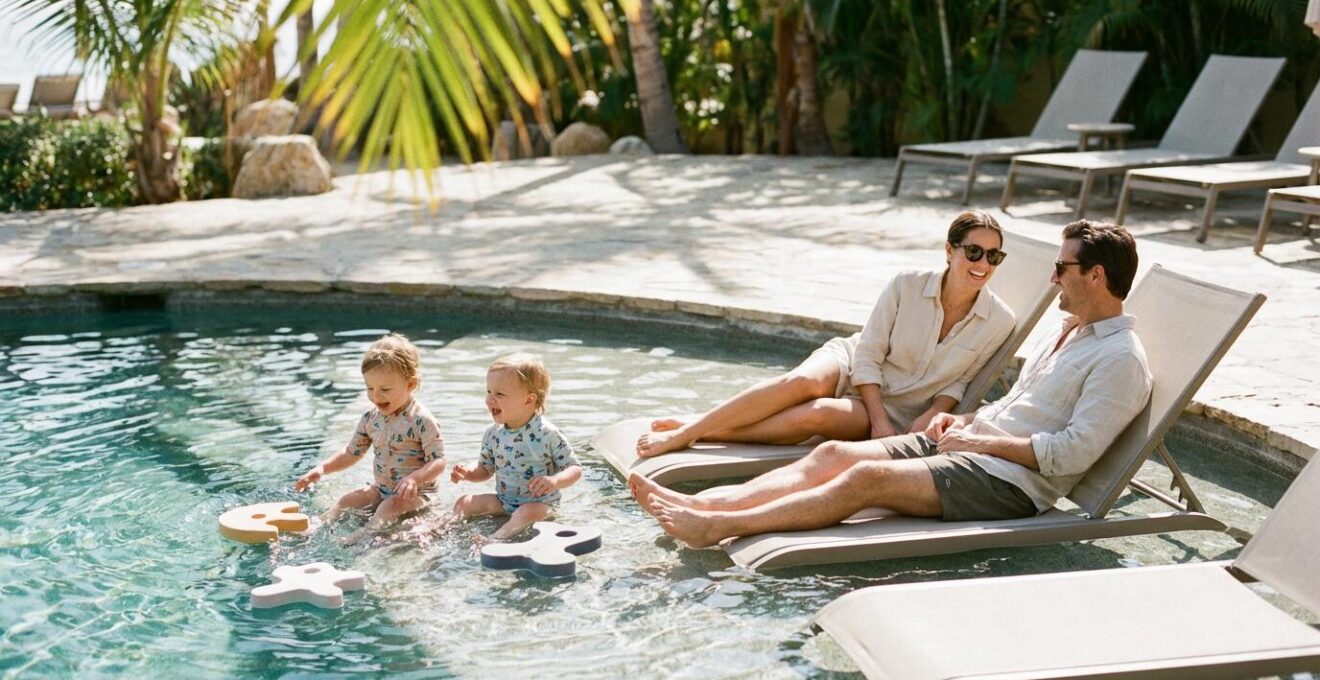
A well-designed Baja shelf is more than a pool feature; it’s a dedicated ‘aquatic living room’ engineered for family safety and social connection.
- Safety is built-in through specific water depths, non-slip surfaces with a DCOF rating of 0.42 or higher, and seamless construction methods.
- Functionality comes from zoned areas for toddlers and adults, ergonomic seating, and engaging features like bubblers.
Recommendation: Prioritize a monolithic shotcrete construction and consult a professional designer to integrate all safety and style elements seamlessly.
If you’ve been browsing modern pool designs, you’ve undoubtedly seen it: a wide, shallow expanse of water that looks like an elegant, submerged patio. This feature, known as a Baja shelf, sun shelf, or tanning ledge, has moved from a luxury resort novelty to the number one request for family-focused pool projects. But its popularity isn’t just a fleeting trend. It’s a direct response to a fundamental desire of parents: creating a space where toddlers can splash safely while adults relax and socialize nearby. This shift is driven by a deep understanding of family dynamics and pool safety.
Many homeowners initially think of a Baja shelf as just a big first step into the pool. However, a truly effective design is far more sophisticated. It’s an engineered ecosystem where every detail, from water depth and surface texture to circulation, is meticulously planned. The goal is to create a versatile, multi-generational hub—an aquatic living room that serves as a secure playground for the little ones and a chic lounge for adults. While design is critical, it must be paired with active supervision and safety measures. For example, research published by the Children’s Safety Network shows an 88% reduction in drowning risk for 1-4 year olds who have had formal swimming lessons, a crucial layer of protection in any aquatic environment.
The secret to the Baja shelf’s success lies in transforming a simple architectural element into a dynamic family experience. It’s not about adding a feature; it’s about designing a lifestyle. This guide will deconstruct the key design decisions that make a Baja shelf not just beautiful, but a perfectly functional and safe centerpiece for your family’s backyard.
To help you navigate the essential elements of a successful Baja shelf design, this article breaks down the most critical considerations, from foundational dimensions to finishing touches that ensure both safety and style.
Summary: Why Baja Shelves Are the Ultimate Family Pool Upgrade
- How deep should a sun shelf be to keep loungers comfortable but dry?
- Plastic or Resin: Which Loungers Won’t Float Away in 30cm of Water?
- How to install bubblers on a shelf without creating splash hazards?
- The tile mistake that turns sun shelves into dangerous slide zones
- When to direct return jets toward the shelf to prevent stagnant warm water?
- How to Design In-Pool Seating That Doesn’t Hurt Your Back?
- Why Shotcrete is the Only Viable Option for Complex Free-Form Pool Designs?
- How to Eliminate Trip Hazards Between the Coping and Decking?
How deep should a sun shelf be to keep loungers comfortable but dry?
The single most important design choice for a Baja shelf is its depth. This isn’t a one-size-fits-all measurement; it’s about creating distinct “hydro-zones” tailored to different users and activities. For toddlers, a shallow zone of 4-6 inches provides a safe splash-and-play area where they can sit and play without being fully submerged, a critical safety consideration given that 75% of child drowning deaths occur in children 5 years old and younger, according to the U.S. Consumer Product Safety Commission’s 2024 report. This shallow area should be closest to the pool entry for easy access and constant supervision.
For adults, the goal is different. A depth of 9-12 inches is the sweet spot for in-pool chaise loungers. This allows your body to be partially submerged for a cooling effect while keeping your torso, book, and drink comfortably dry. Some designs even incorporate a deeper “social shelf” of 15-18 inches, which is perfect for built-in benches where adults can sit and converse with their feet in the water. The key is to plan these zones based on your intended use and the specific furniture you plan to have.
This table illustrates how different depths accommodate various activities and user types, helping you tailor your Baja shelf design to your family’s specific needs.
| Lounger Type | Recommended Water Depth | User Experience | Best For |
|---|---|---|---|
| Standard Chaise Lounger | 9-12 inches | Full body partially submerged | Adults seeking full relaxation |
| Low-Profile Lounger | 6-9 inches | Lower body in water, torso dry | Sunbathing with minimal water |
| Kids’ Mini Lounger | 4-6 inches | Shallow splash zone | Toddlers and small children |
| Deep Lounger | 15-18 inches | Transforms to ‘social shelf’ | Sitting and socializing |
Plastic or Resin: Which Loungers Won’t Float Away in 30cm of Water?
Choosing furniture for your Baja shelf isn’t like buying patio furniture. Standard plastic or lightweight loungers will immediately float and become a nuisance, not to mention a potential hazard. The key is to select pieces specifically designed for in-pool use. These are typically made from dense, marine-grade resin, rotomolded polyethylene, or fiberglass. These materials are heavy enough to resist buoyancy and are built to withstand constant exposure to chlorine and UV rays.
As noted by pool construction experts, quality tanning ledge chairs are engineered with UV16-rated materials to prevent fading and deterioration from sun and chemicals. The most critical feature, however, is the mechanism for weighting them. These loungers have a port that allows you to fill them with water. This internal ballast is what keeps them firmly planted on the shelf. It’s crucial to follow the manufacturer’s instructions for filling to ensure no air pockets remain, which could cause the lounger to become unstable or float.
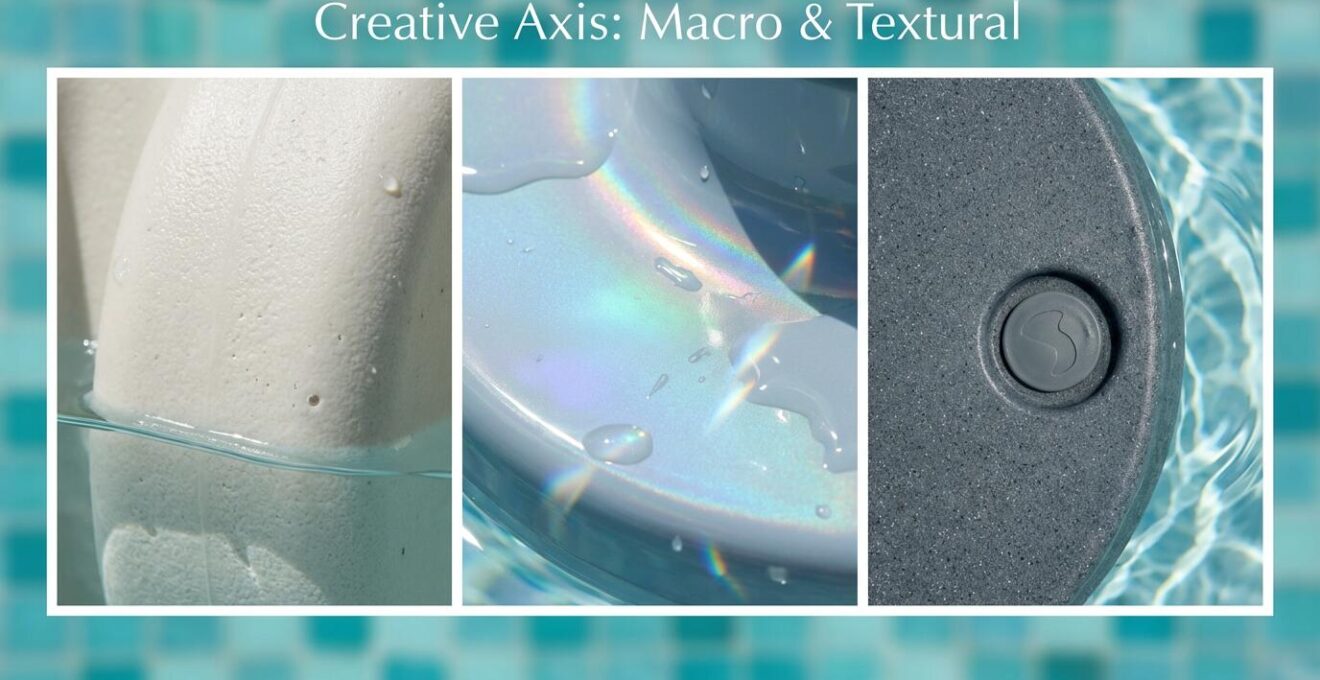
The texture and build quality of these materials are designed for underwater longevity. The water-filled base is the secret to their stability, preventing the floating issues that plague standard outdoor furniture when placed in a pool environment.
Action Plan: Best Practices for Weighting Pool Loungers
- Fill loungers slowly using a garden hose to prevent air pocket formation.
- Ensure water fills to the manufacturer’s recommended level, typically between 75-90% of capacity.
- Tilt the lounger slightly while filling to help release any trapped air bubbles.
- For winter removal, drain the lounger completely and store it indoors to prevent material degradation from freezing.
- Check and refill water levels monthly, as some evaporation can occur through the ports during hot weather.
How to install bubblers on a shelf without creating splash hazards?
Bubblers are a fantastic way to add ambiance and a playful element to a Baja shelf. They create a gentle, gurgling effect that’s both visually appealing and fun for kids. However, improper placement can turn this relaxing feature into a splashy annoyance, soaking loungers, chilling sunbathers, and creating slip hazards on the surrounding deck. The key to successful bubbler installation lies in strategic placement and controlled flow.
First, location is paramount. To prevent water from splashing onto nearby loungers or the deck, pool design experts recommend a 24-inch minimum distance from the shelf’s edge and any furniture. This buffer zone ensures the gentle fountain effect remains contained within the shelf area. It’s also wise to place them in the shallower toddler zone, where they add a fun sensory element, rather than the adult lounging area where tranquility is preferred.
Second, modern technology offers unprecedented control. As Dhruv Gangwal, Marketing Director at Shasta Pools, highlights, advanced systems are a game-changer for customizing the experience:
Variable-speed pumps and smart control systems allow for programmable ‘scenes’ – a gentle, low-flow setting for adult relaxation and a more vigorous, playful setting for kids, all controlled via a phone app.
– Dhruv Gangwal, Shasta Pools Marketing Director
This level of control allows you to tailor the bubbler’s intensity to the moment, ensuring it’s always an enhancement, never a hazard. You can create a serene, spa-like ripple for quiet afternoons and a more energetic bubbling fountain when the kids are playing.
The tile mistake that turns sun shelves into dangerous slide zones
The aesthetic appeal of a beautiful tile or stone finish on a Baja shelf can be tempting, but choosing a surface based on looks alone is one of the most dangerous mistakes a homeowner can make. A shallow, submerged surface that is constantly walked on requires a material with a high coefficient of friction to prevent slips and falls, especially with active toddlers. The industry standard for measuring this is the Dynamic Coefficient of Friction (DCOF). For safety on wet, level floors like a Baja shelf, the industry standard for slip resistance on wet, level floors requires a DCOF rating of ≥ 0.42. Any material with a rating below this, such as glossy ceramic or polished stone, is a significant hazard.
Instead of glossy finishes, opt for materials specifically designed for wet-area safety. These include textured porcelain tiles, sand-blasted natural stone, or an exposed aggregate finish like pebble. These surfaces have a tactile texture that provides grip underfoot, even when covered in water. While a rougher texture offers more grip, it’s a trade-off with comfort on the skin, so it’s important to find a balance that suits your family.
This comparative table breaks down the common surface options, highlighting their safety ratings and other important considerations to help you make an informed, safety-first decision.
| Surface Material | DCOF Rating | Comfort Level | Maintenance Required |
|---|---|---|---|
| Textured Porcelain | 0.45-0.55 | Smooth on skin | Weekly brushing |
| Sand-blasted Stone | 0.50-0.60 | Moderate texture | Bi-weekly brushing |
| Exposed Aggregate/Pebble | 0.60+ | Rough texture | Monthly deep clean |
| Glossy Tile (Dangerous) | <0.30 | Very smooth | Not recommended |
When to direct return jets toward the shelf to prevent stagnant warm water?
A common but overlooked problem with Baja shelves is water stagnation. Because the water is shallow, it heats up much faster than the main body of the pool, especially in sunny climates. Without proper circulation, this warm, still water becomes a perfect breeding ground for algae and bacteria. This not only looks unsightly but can also make the surface slippery and unhygienic. The solution is strategic water circulation, driven by the pool’s return jets.
Case Study: Southern California Circulation Solutions
In regions like Southern California with over 266 days of sunshine annually, pool experts at Majestic Pools have observed that Baja shelves without dedicated circulation can become 10-15°F warmer than the main pool. This temperature difference accelerates algae growth. Their standard solution is to install dual adjustable eyeball fittings aimed at the shelf. By setting these jets to a lower flow, they create a gentle, wide circulation pattern that pushes the warm surface water off the shelf and back into the main pool’s filtration system. This prevents stagnation without creating an uncomfortable current or surface chop that would disturb loungers.
The key is to direct one or two return jets towards the shelf, not away from it. The goal is not to create a strong current but a gentle, consistent flow that skims the surface. Using adjustable “eyeball” fittings allows you to fine-tune the direction and intensity of the flow. You want to create a slow, circular pattern across the shelf that encourages water exchange with the deeper, cooler parts of the pool. This constant movement ensures that filtered, chemically treated water is always circulating through the shelf area, inhibiting algae growth and maintaining a clean, comfortable, and safe environment for your family.
How to Design In-Pool Seating That Doesn’t Hurt Your Back?
While loungers offer flexibility, built-in benches are a fantastic way to add permanent, ergonomic seating to your Baja shelf or an adjacent area. They create a natural social hub where adults can sit comfortably while supervising children. However, a poorly designed bench can be incredibly uncomfortable, causing back pain and discouraging use. The secret to comfortable in-pool seating lies in following proven ergonomic dimensions.
For optimal comfort, a bench should feel like a good chair, just underwater. This means paying close attention to height, depth, and back support. A seat height of 16-18 inches from the pool floor is ideal, allowing most adults to sit with their feet resting comfortably. The seat depth should be 18-20 inches to provide adequate thigh support. Most importantly, the backrest should not be a straight vertical wall. Incorporating a slight 10-15 degree recline angle provides crucial lumbar support and prevents slouching, allowing for hours of comfortable conversation.
Integrating these benches directly onto a deeper section of the Baja shelf (around an 18-inch water depth) is a brilliant design strategy. This places seated adults at eye level with toddlers playing in the shallower 6-inch zone, fostering easy interaction and effortless supervision. A well-placed footrest, positioned 16-18 inches below the seat level, completes the ergonomic design by allowing for proper leg support and preventing the feeling of dangling feet.
Why Shotcrete is the Only Viable Option for Complex Free-Form Pool Designs?
When designing a pool with integrated features like a Baja shelf, steps, and benches, the construction method becomes a critical safety decision. For free-form, custom shapes, shotcrete construction is not just the best option—it’s the only one that guarantees a seamless, monolithic structure. Unlike fiberglass or vinyl liner pools where a shelf might be a separate, bolted-on piece, shotcrete allows the entire pool shell to be created as one continuous, steel-reinforced body. This is a massive advantage for families with toddlers.
Case Study: Blue Haven Pools’ Monolithic Safety
Pool builder Blue Haven Pools champions shotcrete for retrofit and new builds precisely for this reason. Their process demonstrates how the Baja shelf, steps, and pool floor are formed into a single, unified piece reinforced with a rebar cage. This monolithic design completely eliminates the seams and joints found in other construction types. These joints are notorious weak points, posing risks for leaks and, more importantly, creating subtle edges that can become dangerous trip hazards for unsteady toddlers. This seamless integration is a core principle of “engineered safety” in modern pool design.
This structural integrity is paramount in a residential setting, where safety is the top priority. Data consistently shows the home is the most common location for tragic accidents, with Pool Safely’s 2024 drowning prevention data indicating that 81% of fatal child drownings happen in residential settings. By eliminating joints and creating smooth, continuous transitions between the shelf, steps, and pool floor, a shotcrete design removes a significant category of risk. It creates a predictable and stable underwater environment where little feet are less likely to stumble.
Key Takeaways
- Zone Your Depths: Design distinct zones with 4-6 inches for toddlers and 9-12 inches for adult loungers to maximize safety and functionality.
- Prioritize Grip and Weight: Choose non-slip surfaces with a DCOF rating of 0.42+ and select purpose-built, water-fillable loungers that won’t float.
- Engineer Your Water Flow: Use strategically placed return jets and bubblers with variable controls to ensure water circulation and prevent stagnation without creating hazards.
How to Eliminate Trip Hazards Between the Coping and Decking?
The “zero-entry” feel of a Baja shelf is a huge part of its appeal, but the transition from the dry pool deck to the submerged shelf is a critical safety point. An uneven joint, a change in material, or a poorly sealed gap between the pool’s coping (the edge stone) and the surrounding deck can create a serious trip hazard. For a family with a running, excited toddler, eliminating these hazards is non-negotiable.
The best approach is to design for a seamless transition. This can be achieved by using the same material for both the decking and the coping stones, creating a visually and physically continuous surface. Using oversized coping stones, such as 24×24 inch pavers, at the primary entry point to the shelf also helps to minimize the number of joints. If a different material is used, ensure they are installed perfectly flush. The expansion joint between the pool shell and the deck must be filled with a high-quality, self-leveling polyurethane sealant that cures firm and flush, rather than a soft, gummy filler that can trap debris or become a tripping edge itself.
Another elegant and highly effective solution is a cantilevered deck design. In this construction, the concrete deck is poured so that it extends slightly over the pool’s edge, completely hiding the top of the pool shell and creating a perfectly smooth, single-surface transition from deck to water. Even with a seamless physical transition, adding a visual cue, such as a band of contrasting but equally slip-resistant tile at the water’s edge, can help signal the change from a dry to a wet surface.
By thoughtfully designing each of these elements—from the foundational depth to the final transition—a Baja shelf is elevated from a simple feature into the heart of the backyard. It becomes the safe, stylish, and social hub you envisioned, proving its worth as the most requested and valuable addition to a modern family pool. To bring this vision to life, the next logical step is to consult with a professional pool designer who can integrate these principles into a cohesive plan for your specific space.