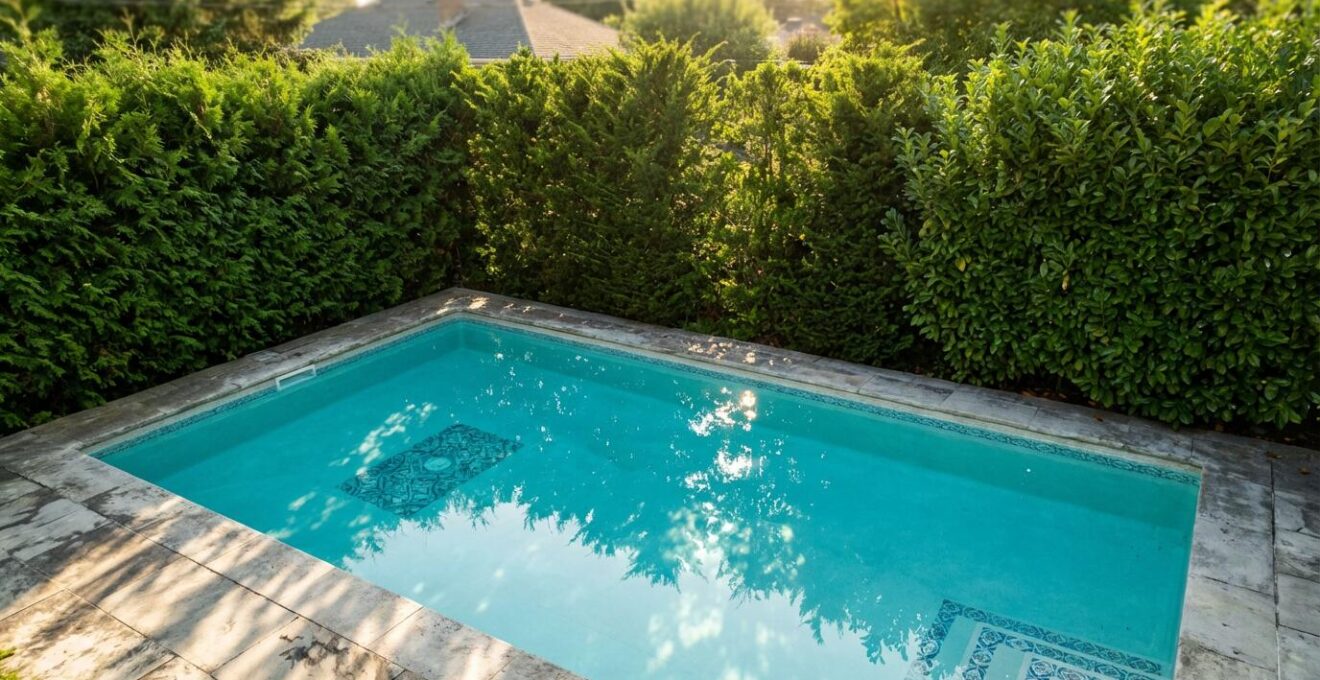
The secret to a pristine pool isn’t better cleaning tools; it’s a smarter garden design that prevents debris from ever reaching the water.
- Success lies in choosing evergreens with a minimal “debris footprint”—plants that naturally drop fewer needles, leaves, or berries.
- Strategic pruning and correct spacing are more critical than plant choice alone, creating a dense, healthy barrier that requires less cleanup.
Recommendation: Shift your focus from reactive skimming to proactive landscape design. By creating an integrated ecosystem, you minimize maintenance and maximize year-round enjoyment.
The dream is a sparkling blue pool, a private oasis for relaxation. The reality, for many, is a constant battle against an invasion of leaves, needles, and berries. You invested in a pool for leisure, not to become a full-time skimmer operator. This endless cycle of cleanup is a common frustration, turning a luxury feature into a recurring chore. According to a 2024 survey, nearly 24.4% of pool owners identify water quality maintenance as their top pain point, much of which is caused by surrounding landscape debris.
The standard advice is often simplistic: “plant evergreens.” While well-intentioned, this advice barely scratches the surface. Choosing the wrong evergreen can lead to a hedge that’s thin at the base, prone to disease, or still drops a surprising amount of mess. The truth is, a genuinely low-maintenance poolside screen isn’t about finding one “magic” plant. It’s about implementing a smarter, more integrated system.
But what if the key wasn’t just *what* you plant, but *how* you plan, prune, and space it? This guide moves beyond generic recommendations to offer a pragmatic system for the “lazy gardener.” We will explore how to design a poolside hedge ecosystem focused on one thing: preemptively eliminating the cleanup you despise. It’s about mastering the plant’s growth architecture and understanding its debris footprint to build a beautiful, dense screen that works for you, not against you.
This article provides a complete framework, from selecting the cleanest species to mastering pruning techniques for ultimate density. Follow along to learn the strategic secrets to reclaiming your poolside time.
Summary: Why Evergreen Hedges Are the Ultimate Choice for Poolside Screening
- Which evergreen species drop the least amount of needles or berries?
- How to prune evergreens to encourage thick growth from the base up?
- Thuja or Laurel: Which Hedge Reaches 3 Meters Fastest?
- The spacing mistake that encourages fungal infections in hedges
- When to feed evergreens to prevent winter browning?
- How to Block the Neighbor’s View of Your Pool Immediately?
- How Water Curtains Block Traffic Noise in Urban Backyards?
- How to Cultivate a Lush Garden That Survives Pool Splash and Humidity?
Which evergreen species drop the least amount of needles or berries?
The foundation of a low-maintenance poolside hedge is minimizing its “debris footprint.” This isn’t about finding a plant that drops nothing—an impossible task—but choosing one whose natural shedding is manageable and clean. Forget fine needles that clog filters or squishy berries that stain decking. The goal is to select species with larger, glossy leaves that are easy to collect or that produce minimal to no fruit.
Excellent choices include broadleaf evergreens like Waterhousia floribunda (Weeping Lilly Pilly), which has glossy leaves and minimal berry production. For plants that do produce berries, such as Holly or Yew, the solution is strategic selection. Opting for male or sterile cultivars eliminates the possibility of berry mess entirely. Another strong contender is the Magnolia ‘Teddy Bear’, a compact evergreen with large, leathery leaves that are simple to handle if they fall.
Even with the right species, proactive management is key. For any potentially messy plant, you can practice “preventive maintenance.” This involves clipping or shearing the hedge just before it flowers. This simple action suppresses fruit formation, stopping the problem before it starts. This shift from reactive cleanup to proactive care is the cornerstone of a truly lazy-friendly garden design.
How to prune evergreens to encourage thick growth from the base up?
A common failure in privacy hedges is a “leggy” appearance—thin and gappy at the bottom, with all the density at the top. This defeats the purpose of a screen. The solution lies in understanding the hedge’s “growth architecture” and using pruning not just to control height, but to actively build density from the ground up. The goal is to encourage lateral branching on the lower two-thirds of the plant.
The key is to start early and be consistent. When the hedge is young, you should prune it to be slightly narrower at the top than at the bottom. This A-shape allows sunlight to reach the lower branches, preventing them from dying off and leaving gaps. For conifers, this foundational pruning should be done in early spring as new growth emerges. For flowering evergreen shrubs, it’s best to wait until just after they finish blooming to avoid sacrificing that season’s display.
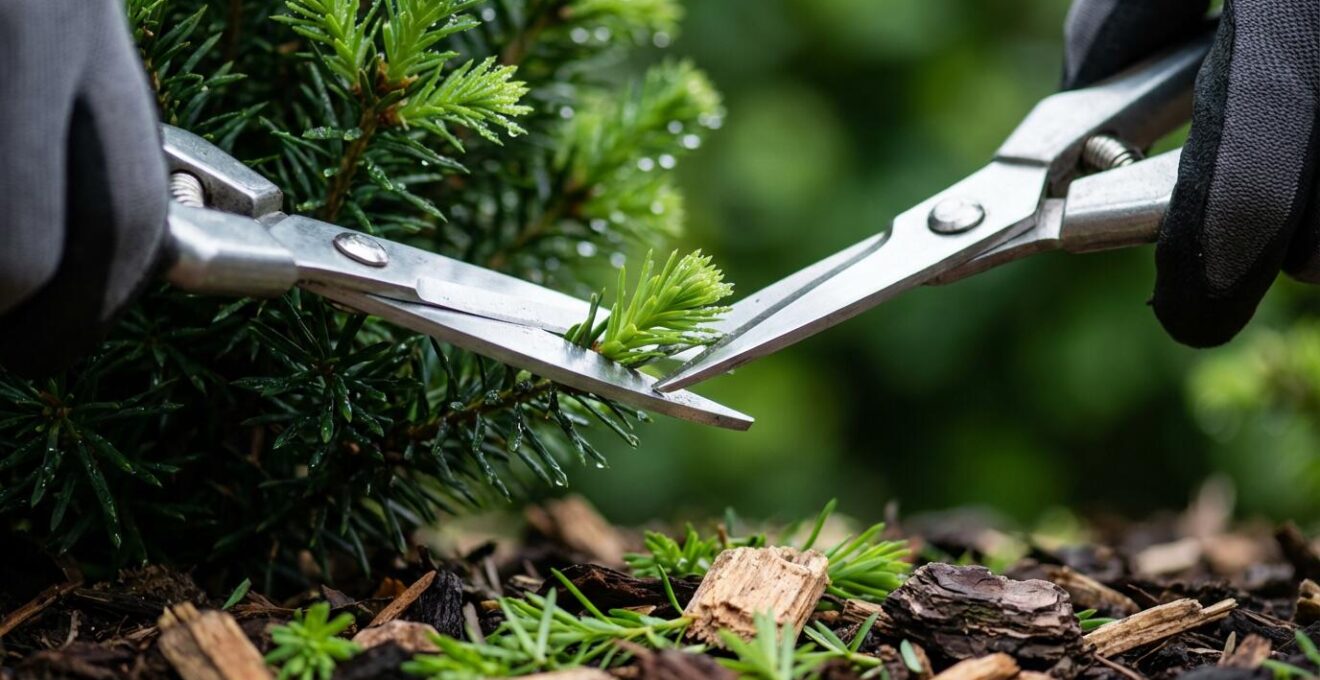
As the illustration shows, precise cuts on young shoots stimulate the plant to send out multiple new branches from below the cut. This is how you build a solid wall of green. Don’t wait for the hedge to reach your desired height before you start shaping it. Regular, light pruning from the first year is far more effective than a single, drastic cut on a mature, overgrown hedge. This methodical approach ensures a thick, impenetrable screen that provides privacy from top to bottom.
Thuja or Laurel: Which Hedge Reaches 3 Meters Fastest?
When privacy is the goal, speed matters. However, it’s crucial to look beyond simple height growth and consider “density velocity”—how quickly a hedge becomes a functional, solid screen. Thuja (like Western Red Cedar or ‘Emerald Green’ Arborvitae) and Laurel (Cherry or Portugal) are two of the most popular choices, but they perform differently. Thuja is often the champion for pure vertical speed, but Laurel typically wins on creating dense, ground-level coverage more reliably.
Under ideal conditions, some varieties of English Laurel can achieve impressive growth rates. In fact, it is documented that English laurel can grow up to 3 feet per year, making it a strong contender for rapid screening. Thuja is no slouch, but its growth pattern can sometimes lead to thinning at the base if not pruned correctly from a young age.
The following table breaks down the key performance differences to help you make a pragmatic choice based not just on speed, but on the type of privacy you want to achieve.
| Characteristic | Thuja (Western Red Cedar) | Laurel (Cherry/Portugal) |
|---|---|---|
| Annual Growth Rate | 60-75cm (2-2.5ft) | 45-60cm (1.5-2ft) |
| Time to 3 meters | 4-5 years | 5-7 years |
| Density at maturity | Good but may thin at base | Excellent, thick to ground |
| Root system | More aggressive, fibrous | Less invasive |
| Wind resistance | Moderate | High |
While Thuja may reach the 3-meter mark a year or two sooner, a Laurel hedge often provides a thicker, more robust screen with a less invasive root system, which is a significant advantage near pool structures. The choice depends on your priority: pure speed or superior long-term density and structure.
The spacing mistake that encourages fungal infections in hedges
The single biggest mistake in planting poolside hedges is cramming them too close together. The intention is understandable—to create a dense screen faster. The reality, however, is that you create a perfect breeding ground for fungal diseases. A poolside environment is already a zone of high humidity due to water splash and evaporation. Planting a hedge too densely traps that moisture, eliminates air circulation, and invites problems like powdery mildew and root rot.
As the experts at STIHL note, this is a critical factor in hedge health. In their garden maintenance guide, they state:
Humidity and dampness promote the spread of fungi and pests. Always follow the recommended spacing when planting. This helps the hedge form a dense, but well-ventilated wall.
– STIHL Garden Maintenance Guide, Detecting and treating hedge diseases
The standard spacing recommendations are a starting point, but for a humid poolside location, you need to be even more generous. Poor airflow is your enemy. A well-ventilated hedge is a healthy hedge that requires far less intervention. Instead of fighting disease with fungicides, you can prevent it with intelligent design from day one.
Your Action Plan for Perfect Poolside Hedge Spacing
- Add a Buffer: Increase the standard recommended spacing for your chosen plant by 20-30% for poolside locations to guarantee airflow.
- Go Staggered: Plant in a double-row, staggered (triangular) pattern instead of a single straight line. This creates a much denser visual block while maintaining space between individual plants.
- Know Your Numbers: For common choices like Thuja varieties, maintain a spacing of at least 60-100cm (2-3ft) between plants.
- Promote Interior Airflow: Commit to an annual light pruning of the hedge’s interior to remove a few crossing branches and open up the core of the plant to air.
- Water Smart: Use drip irrigation or soaker hoses at the base of the plants. Avoid overhead sprinklers that wet the foliage and dramatically increase local humidity.
When to feed evergreens to prevent winter browning?
Winter browning, or desiccation, is a common issue where evergreen foliage turns brown and dies off due to dry winter winds and frozen ground. The plant loses moisture through its needles but can’t draw any up from the frozen soil to replace it. While proper watering in the fall is the first line of defense, a strategic feeding schedule provides the internal fortitude your hedge needs to withstand these harsh conditions.
The key is to feed for resilience, not for growth. Applying a high-nitrogen fertilizer late in the season is a mistake; it encourages tender new growth that will be immediately damaged by the first frost. Instead, the focus should be on strengthening the existing structure of the plant. A two-part feeding strategy is most effective.
First, apply a balanced, organic, slow-release fertilizer in the spring. This supports healthy, steady growth throughout the main season. The second, more critical feeding happens in late summer or early fall. This application should be low in nitrogen but rich in potassium. Potassium is a vital nutrient that helps regulate water use within the plant cells and improves its overall hardiness and stress tolerance. This “hardening off” feed prepares the hedge for the rigors of winter, significantly reducing the risk of browning and ensuring it emerges lush and green in the spring.
How to Block the Neighbor’s View of Your Pool Immediately?
While a mature evergreen hedge is the ultimate long-term solution for privacy, it doesn’t solve the immediate problem of a new pool and an exposed backyard. Waiting 4-5 years for a hedge to grow in isn’t a practical option. The solution is a two-phase strategy: an instant, temporary fix combined with the planting of your permanent screen.
For immediate coverage, think modular and mobile. Large potted evergreens, such as tall Arborvitae or clumping bamboo, can be positioned strategically to block the most critical sightlines. This creates an instant green wall that is both effective and aesthetically pleasing. These can be supplemented with other fast solutions like temporary bamboo roll fencing, decorative modular screens, or even fabric sail shades. The goal of this first phase is to give you privacy from day one.
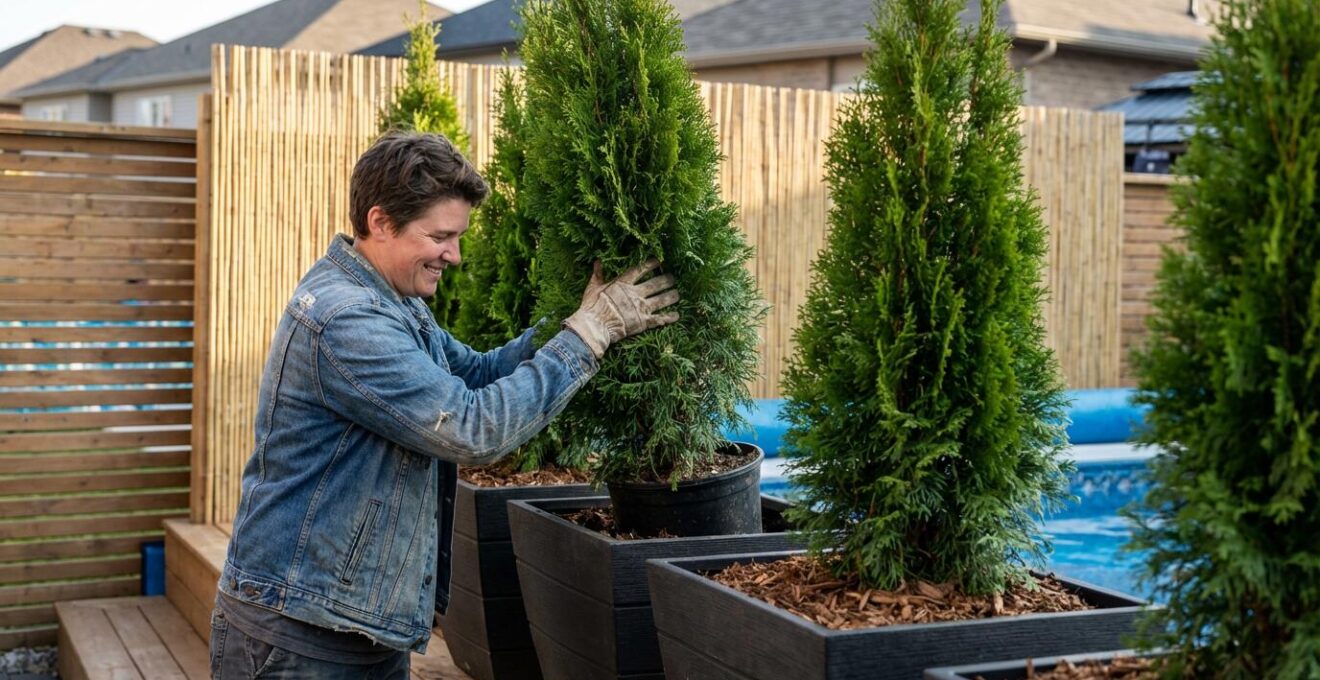
Phase two happens in parallel. Behind your temporary screen, you plant your permanent hedge. This gives the young plants a protected environment to establish themselves without the pressure of being your only source of privacy. As the permanent hedge grows taller and thicker each year, you can gradually remove the temporary elements. This layered approach bridges the gap between immediate need and long-term goals, providing a seamless transition to a lush, permanent, and private oasis.
How Water Curtains Block Traffic Noise in Urban Backyards?
In an urban or suburban setting, visual privacy is only half the battle. The constant drone of traffic or neighborhood noise can shatter the tranquility of a poolside retreat. While a dense evergreen hedge provides a significant visual block, its ability to absorb sound is good but limited. This is where the principle of “sensory layering” comes into play, combining a physical barrier with a sound-masking element like a water curtain or fountain.
The hedge works by diffracting and absorbing some of the high-frequency sound waves. A dense, tall hedge like ‘Spartan’ Juniper or ‘Emerald’ Arborvitae is particularly effective, especially in narrow urban yards where a wide footprint isn’t possible. As experts from the N.C. Cooperative Extension point out:
Upright evergreens work well as screens in narrow spaces because they take up little horizontal space. Two of the narrowest evergreens available are ‘Spartan’ Juniper and ‘Emerald’ Arborvitae, both of which grow 15′ tall and only 3′-4′ wide.
– N.C. Cooperative Extension, Great Evergreens for Screens and Hedges
The water feature doesn’t “block” the remaining noise in the traditional sense. Instead, it masks it. The sound of moving water produces “white noise,” a broad spectrum of sound frequencies. This pleasant, natural sound effectively covers up the jarring, intermittent sounds of traffic, voices, or barking dogs. Your brain focuses on the consistent, close-by sound of the water, and the distant, annoying noises fade into the background. The synergy is powerful: the hedge provides the visual enclosure and initial sound buffer, while the water feature provides the auditory “privacy” that completes the oasis.
Key Takeaways
- A low-maintenance hedge is a system, not a single plant. Success depends on integrating selection, pruning, and spacing.
- Proactive care, like pruning before flowering to prevent berries, is more effective than reactive cleanup.
- Generous spacing is non-negotiable in a humid poolside environment to prevent fungal diseases by promoting airflow.
How to Cultivate a Lush Garden That Survives Pool Splash and Humidity?
The area immediately surrounding a pool is a microclimate with unique challenges: high humidity, reflected heat from decking, and exposure to chlorinated or saltwater splash. Cultivating a lush, thriving hedge in this environment requires selecting plants that are not only evergreen but also tolerant of these specific stressors. Planting too close is a common error, as roots can interfere with pool structures and foliage is constantly exposed to chemical splash.
As a rule of thumb, it’s best to plant any hedge at least 3-5 meters (10-15 feet) away from the pool’s edge. This distance minimizes both root intrusion and the impact of constant water splash. For this zone, you need robust species. Salt-tolerant evergreens like certain Junipers, Yew, and Portugal Laurel are excellent choices as they are less likely to suffer from leaf burn due to splash. It’s also wise to choose plants that can handle the increased humidity without being susceptible to mildew.
In smaller pool areas where space is at a premium, compact cultivars are the answer. Varieties like Olea europea ‘Tolley’s Upright’ (an upright olive) or the previously mentioned Magnolia ‘Teddy Bear’ offer a dense screening effect without a massive footprint. Regardless of the species, maintaining the hedge’s health through a consistent pruning schedule—typically once or twice a year—is crucial. This removes any potentially damaged foliage and encourages the dense, healthy growth that can withstand the unique challenges of the poolside environment.
By applying this system-based thinking—focusing on debris footprint, growth architecture, and environmental synergy—you can design a poolside screen that delivers maximum privacy with minimum effort. The next logical step is to map out your own space and select the species and strategies that best fit your specific needs.
Frequently Asked Questions About Poolside Hedges
How close can I plant evergreen hedges to my pool?
To avoid root interference with the pool shell and minimize debris falling into the water, it is strongly recommended to plant trees and large shrubs at least 3-5 meters (10-15 feet) away from the pool’s edge.
Which evergreens are best for small pool areas?
For tight spaces, choose compact, upright cultivars. Excellent options include Magnolia ‘Teddy Bear’, Olea Europaea ‘Tolley’s Upright’, and narrow conifers like ‘Emerald’ Arborvitae or ‘Spartan’ Juniper, which provide vertical height without a wide spread.
How often should I prune poolside hedges?
Most evergreen hedges benefit from pruning once or twice a year to maintain their shape, encourage density, and remove any dead or damaged branches. A light prune in early spring and another shaping session in mid-summer is a common and effective schedule.