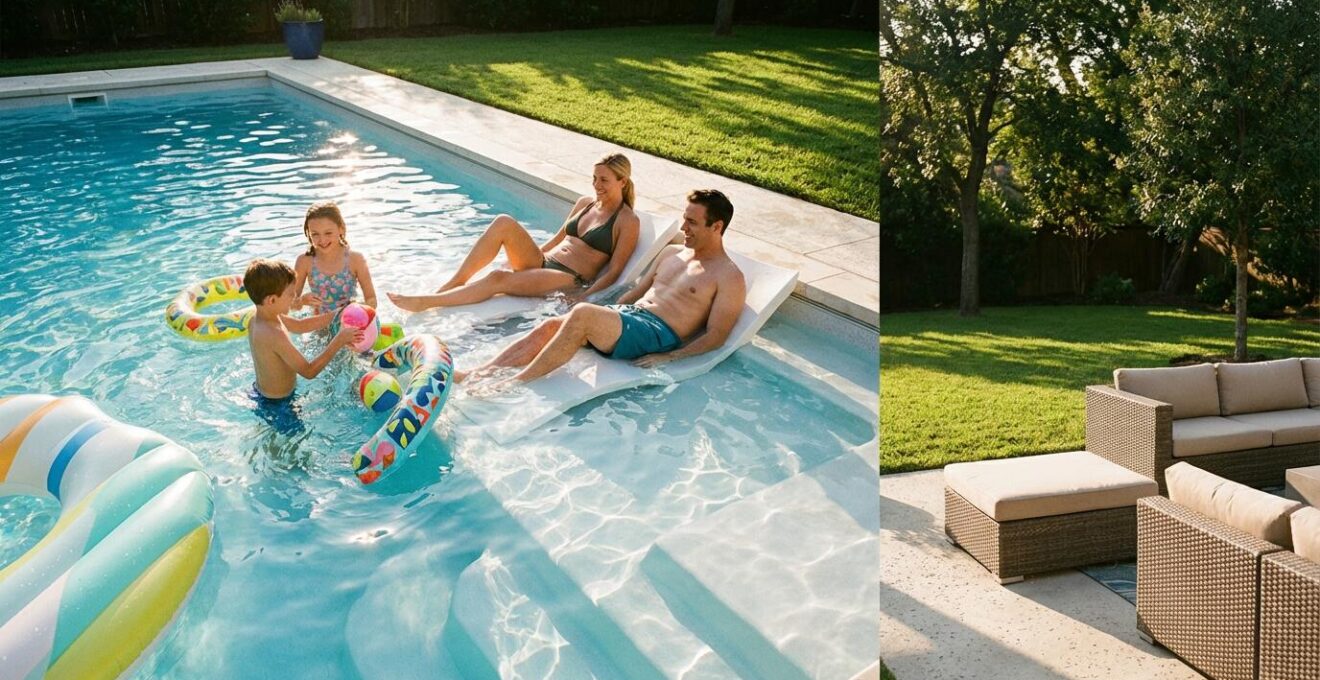
A fiberglass pool is the fastest and safest way to get your active family swimming, thanks to its pre-engineered shell and kid-friendly surface.
- The non-porous gel coat finish prevents scrapes and dramatically reduces chemical usage and algae growth.
- The one-piece shell allows for an incredibly fast installation, often going from a hole in the ground to a swim-ready pool in under a week.
Recommendation: Prioritize a thorough site access audit before purchase to ensure the pre-fabricated shell can be delivered without issue, guaranteeing a smooth and stress-free installation.
As a parent, you dream of a backyard oasis where your kids can splash, play, and burn off that endless energy. But the thought of a long, messy construction project, constant chemical adjustments, and the rough surface of a traditional pool can be daunting. You want the joy, not the job. Many families consider vinyl or concrete pools, thinking they are the standard, but often overlook the underlying realities of long-term maintenance and comfort.
What if the secret to a perfect family pool wasn’t just about the water, but about the shell that holds it? The choice of material is the single most important decision you’ll make, impacting everything from installation speed to daily safety and weekend chores. This is where the pre-engineered system of a fiberglass pool changes the game. It’s a solution designed from the factory floor to your backyard for maximum family enjoyment and minimum parental stress.
This guide will walk you through the core engineering and logistical advantages of fiberglass. We will explore how its manufacturing process leads to a faster, safer, and more economical pool experience. From the science of the gel coat to the crucial details of installation, you’ll understand why this choice offers unparalleled peace of mind for families with active kids.
To help you navigate this decision, we’ve broken down the key aspects of choosing, installing, and owning a fiberglass pool. This structured overview will provide the clarity needed to invest confidently in your family’s summer fun.
Summary: Your Family’s Fast-Track to a Safer, Low-Maintenance Pool
- How to go from excavation to swimming in just 5 days with fiberglass?
- The manufacturing quality check that avoids bubbles in the gel coat
- Fiberglass vs Vinyl: Which Surface Requires 50% Less Chemical Usage?
- The access mistake that leaves a fiberglass shell stuck in the street
- When to use gravel vs sand to prevent fiberglass walls from bulging?
- Why Reinforced Concrete Pools Maintain Value Better Than Vinyl Liners Over 20 Years?
- How Variable-Speed Pumps Pay for Themselves in Less Than 24 Months?
- How to Manage Your Pool Chemistry from Your Office Desk?
How to go from excavation to swimming in just 5 days with fiberglass?
The biggest advantage of a fiberglass pool is speed. Because the pool shell is manufactured off-site in a controlled factory environment, the on-site work is dramatically reduced. Instead of weeks of framing, pouring, and curing concrete, the process is one of logistical precision. Once the excavation is complete, the pre-fabricated shell is delivered and carefully craned into place. This single step replaces what can be a multi-week ordeal with other pool types.
This rapid timeline minimizes the disruption to your backyard and family life. A typical fast-track installation follows a clear, predictable schedule: excavation and base prep, shell delivery and leveling, plumbing and backfilling, and finally, decking and water. While the complete project with landscaping and fencing takes longer, the core transformation from a dirt hole to a functional swimming pool can happen in less than a business week. One homeowner’s successful DIY project, which involved installing a 16×40 pool for his young children, highlights this efficiency, even when facing unexpected challenges like a flooded excavation site.
While the shell itself can be set in a few days, it’s wise to plan for a more comprehensive timeline. A full installation, including patio work, fencing, and landscaping, typically takes 3 to 5 weeks from start to finish. This manageable timeframe means you can plan for a new pool in the spring and be swimming by the first heatwave of summer, a feat nearly impossible with other in-ground options.
The manufacturing quality check that avoids bubbles in the gel coat
The magic of a fiberglass pool—and the source of its “tactile safety”—is the gel coat finish. This is the smooth, non-porous interior surface that your family will interact with every day. Unlike the abrasive plaster of a concrete pool that can easily scrape knees and snag swimsuits, the gel coat is smooth to the touch. This quality is not an accident; it’s the result of a meticulous manufacturing process in a controlled factory setting, which prevents imperfections like bubbles or blisters from forming.
For parents, this smooth surface provides immense peace of mind. As one expert from Splash Fiberglass Pool Co. notes, the design itself minimizes risk:
Fiberglass pools are renowned for their smooth surfaces, which are not only aesthetically pleasing but also pose fewer risks to children compared to other pool materials. Unlike concrete pools, which can have rough surfaces that may cause abrasions, fiberglass pools are non-porous and have a smooth gelcoat finish, reducing the chances of injuries caused by sharp edges.
– Splash Fiberglass Pool Co., Are Fiberglass Pools Good for Kids?
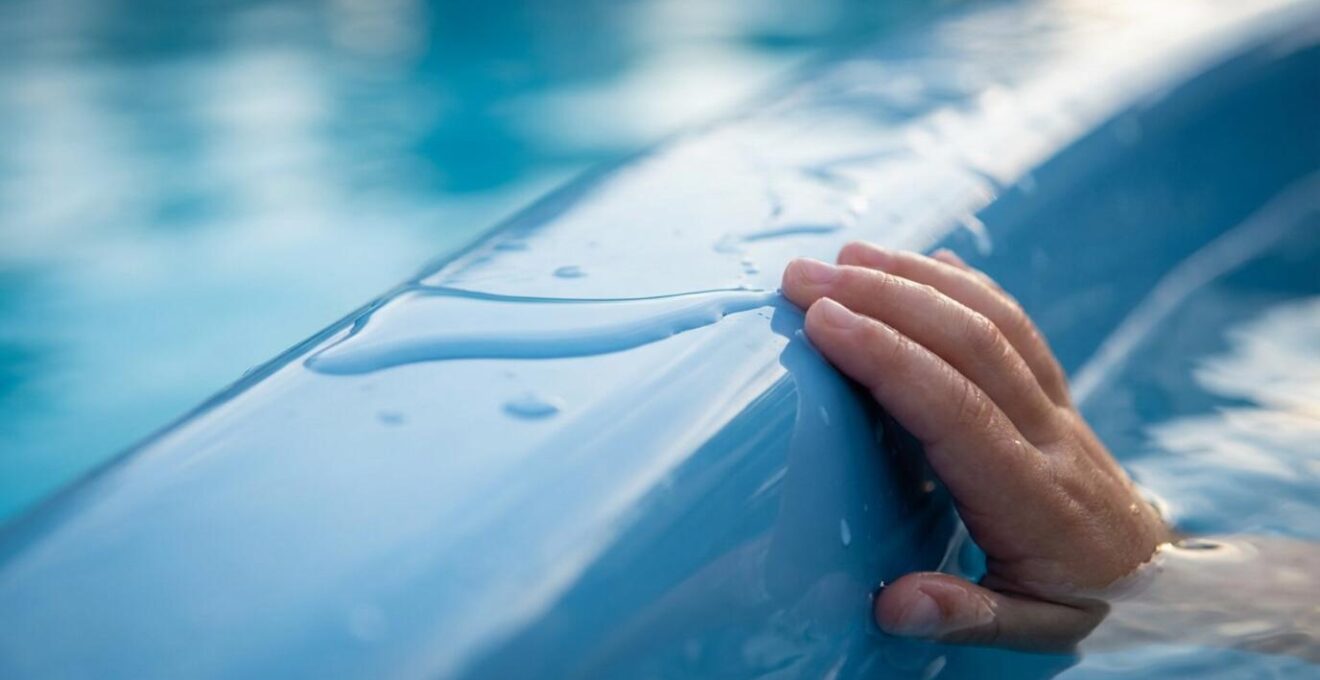
This durability is built to last. A quality gel coat is designed to last the lifetime of the pool, much like the finish on a bathtub. This longevity is often backed by strong manufacturer warranties, with leading companies like San Juan offering a 25-year non-prorated warranty on the pool’s structure, guaranteeing it won’t rip, crack, or leak under normal use. This factory-guaranteed quality is a core component of the fiberglass pool’s value proposition for families.
Fiberglass vs Vinyl: Which Surface Requires 50% Less Chemical Usage?
One of the least enjoyable parts of pool ownership is managing the water chemistry. This is where the “chemical inertness” of a fiberglass pool surface becomes a massive benefit for busy parents. The gel coat is non-porous and chemically inert, meaning it doesn’t react with the water or absorb chemicals. This creates a stable aquatic environment that is far easier and cheaper to maintain.
In contrast, the porous surface of a concrete pool is alkaline and leaches into the water, constantly raising the pH. This requires the regular addition of acid to keep the water balanced. Furthermore, its rough texture is a breeding ground for algae, demanding higher chlorine levels and more frequent scrubbing. Studies show that because of these factors, porous concrete surfaces often require 25-50% more chemicals annually to combat algae and maintain balance compared to a non-porous fiberglass surface.
This fundamental difference in material science has a direct impact on your time and budget. Less chemical usage means fewer trips to the pool store and more money in your pocket. The stable pH and algae resistance of fiberglass also mean you’ll spend less time testing and correcting the water and more time enjoying it with your kids. The table below clearly illustrates these differences.
| Pool Type | Chemical Usage | pH Stability | Algae Resistance |
|---|---|---|---|
| Fiberglass | Lowest – non-porous surface | Stable – inert material | Excellent – smooth gel coat |
| Vinyl | Moderate – non-porous liner | Good – neutral surface | Good – smooth surface |
| Concrete | Highest – porous surface | Unstable – alkaline material | Poor – rough texture harbors algae |
The access mistake that leaves a fiberglass shell stuck in the street
The single greatest hurdle in a fiberglass pool installation is not technical; it’s logistical. A beautiful, pre-fabricated pool shell is useless if it can’t get from the delivery truck to the excavated hole in your backyard. Forgetting to conduct a thorough site access audit is the most common and costly mistake a homeowner can make. This involves measuring every gate, checking overhead clearance for power lines and tree branches, and confirming the driveway can support the weight of a crane.
When access is tight, installers have to get creative, but it underscores the need for meticulous planning. Without it, you risk having your dream pool stuck on the street, causing delays, added costs, and immense stress.
Case Study: A Game of Inches
One installation team faced a nightmare scenario: a web of utility lines blocked aerial crane access, and the path to the backyard was a narrow channel between the house and garage. Standard installation was impossible. Their solution required incredible “logistical precision”—they had to manually push the massive pool shell down the street, up the driveway, and slide it between the two buildings with less than an inch of clearance on either side. While successful, it was a high-risk maneuver that proper initial planning could have addressed with a different crane strategy.
To prevent such a scenario, you or your installer must act like a detective before ever breaking ground. Documenting every potential obstacle ensures the delivery and placement are a smooth, drama-free event. This upfront diligence is the key to unlocking the speed advantage of a fiberglass pool.
Your Pre-Installation Access Audit Checklist
- Measure all gate openings and pathways (a minimum of 10 feet width is often required).
- Check for and document all overhead obstructions like power lines, cable wires, and low-hanging tree branches.
- Verify the width, turning radius, and structural integrity of the driveway for crane and delivery truck access.
- Assess the soil conditions and any significant slopes along the access path that could affect heavy equipment movement.
- Contact utility companies to identify and clearly mark all underground lines (gas, water, electric) to define safe zones for crane setup.
When to use gravel vs sand to prevent fiberglass walls from bulging?
The long-term structural integrity of your fiberglass pool depends entirely on what you can’t see: the backfill material packed around its walls. For years, sand was the common choice, but modern best practices have completely shifted away from it. Sand’s major flaw is that it can become saturated with water and liquefy, a process that removes all support from the pool walls and can even exert inward pressure, causing bulges. Furthermore, it requires tedious water-packing to compact properly, a process that is often done inconsistently.
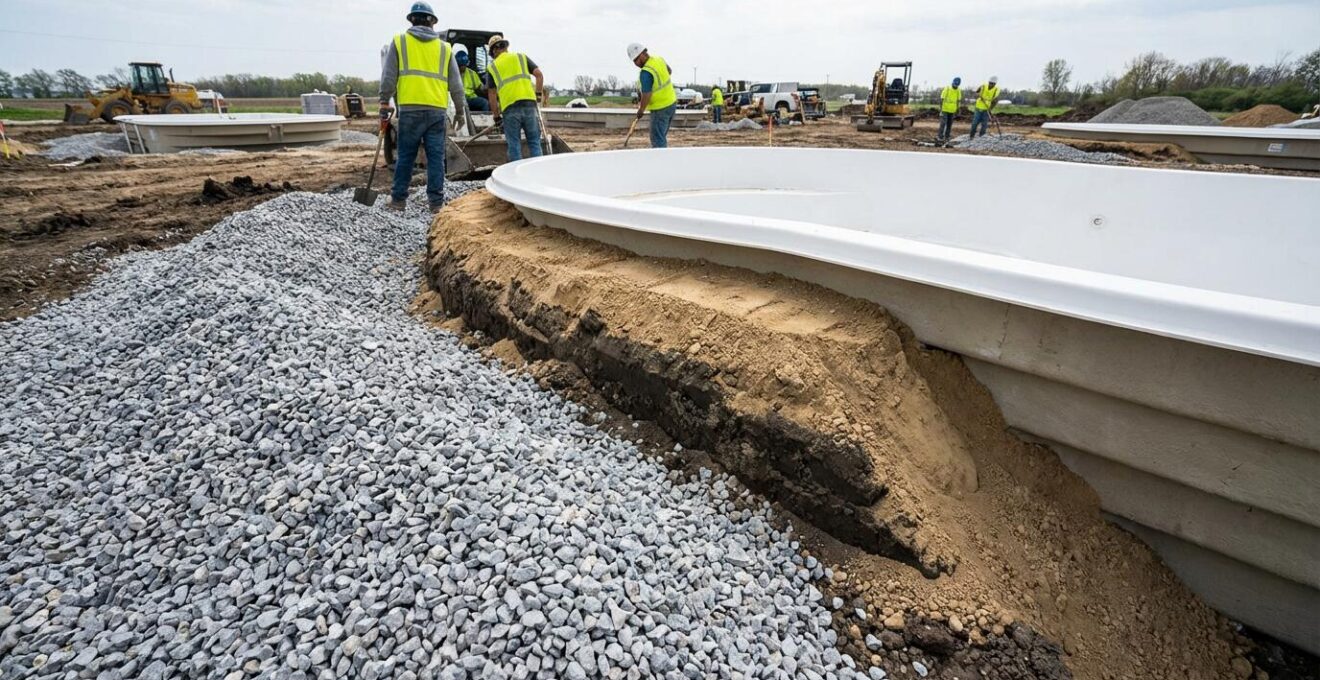
Today’s top installers exclusively use clean, crushed stone for backfill. As the experts at River Pools explain, the choice is based on simple physics:
The type of gravel used for backfilling around a fiberglass pool is critical. Installers prefer to use clean crushed blue stone roughly 3/4″ – 1″ in size. …Gravel with stone dust would not compact when we dump it in the hole and therefore would require manual compaction… Clean crushed stone compacts when placed. It drains very well. The point-on-point friction between the pieces of stone locks them together, allowing it to hold well on the side walls of the pool.
– River Pools Installation Team, How are Fiberglass Pools Installed?
This self-compacting, interlocking nature provides a rock-solid foundation that moves water away from the shell and maintains its shape for decades. While sand might seem like a cheaper option upfront, using the proper clean, crushed stone of about 3/4″ to 1″ in size is non-negotiable for ensuring the “system integrity” of your investment. It’s the unseen guardian of your pool’s structure.
Why Reinforced Concrete Pools Maintain Value Better Than Vinyl Liners Over 20 Years?
While the title of this section compares concrete and vinyl, a smart homeowner looks at the full picture, including fiberglass. When you evaluate a pool as a long-term investment, the initial price tag is only part of the story. The total cost of ownership over 10 to 20 years reveals the true financial picture, and this is where fiberglass demonstrates its superior value, especially for a family on a budget.
Concrete pools have the highest upkeep. They require frequent, expensive resurfacing every 10-15 years, a job that can cost tens of thousands of dollars. Vinyl liner pools have a lower initial cost, but the liner itself is fragile and needs replacement every 5-9 years. These recurring major expenses can quickly erase any upfront savings. Fiberglass, with its durable, inert shell, has the lowest long-term maintenance costs of all three types. There is no liner to replace and no surface to refinish.
This becomes clear when looking at the total cost of ownership over two decades, as highlighted in a recent long-term cost analysis. The data shows that while fiberglass may have a slightly higher initial cost than vinyl, its minimal maintenance needs make it the most economical choice over the life of the pool.
| Pool Type | Initial Cost | 10-Year Maintenance | Major Repairs | 20-Year Total |
|---|---|---|---|---|
| Fiberglass | $55,000-$100,000 | <$5,000 | Rare gel coat touch-up | $60,000-$105,000 |
| Concrete | $65,000+ | $10,000+ | Resurfacing every 10-15 years | $85,000-$150,000+ |
| Vinyl | $45,000-$80,000 | Liner replacements every 5-9 years | Multiple liner replacements | $65,000-$120,000 |
How Variable-Speed Pumps Pay for Themselves in Less Than 24 Months?
Your pool pump is the heart of its circulation system, but it can also be one of the biggest energy consumers in your home. Traditional single-speed pumps run at full blast all the time, like flooring the gas pedal every time you drive. A Variable-Speed Pump (VSP) is the modern, intelligent alternative. It allows you to run the pump at much lower speeds for longer periods, providing better filtration while using a fraction of the electricity.
The savings are staggering. In fact, manufacturers report that a modern VSP can lead to an up to 90% reduction in energy costs compared to a conventional pump. This efficiency means the higher initial investment in a VSP typically pays for itself in energy savings in less than two years. For one family, the results were even faster: a verified switch to a VSP saved them an average of $98 per month, allowing the pump to pay for itself in just over a year.
For a family, optimizing a VSP is simple and delivers immediate benefits beyond just cost savings. Running the pump at low speeds overnight keeps the water pristine and is whisper-quiet, so it won’t disturb sleeping kids (or neighbors). You can program it to run at high speed for a short period to power a cleaner, then drop back to an energy-sipping circulation speed. To maximize your return on investment, you can follow a few simple programming guidelines:
- Run the pump at high speed (e.g., 3450 RPM) for only 1-2 hours daily during cleaning cycles.
- Use a medium speed (e.g., 1500 RPM) for 3-4 hours when the pool is in heavy use for active filtration.
- Operate at a very low speed (e.g., 600-800 RPM) for the remaining filtration time to maintain circulation at minimal cost.
- If your utility offers them, program longer run times during off-peak electricity hours.
Key Takeaways
- The speed of fiberglass installation is due to the shell being made in a factory, not your backyard.
- A smooth, non-porous gel coat is the key to both child safety (no scrapes) and low maintenance (less algae and chemicals).
- Proper backfill with crushed stone, not sand, is non-negotiable for the pool’s long-term structural health.
How to Manage Your Pool Chemistry from Your Office Desk?
The ultimate dream for any busy parent is a pool that practically takes care of itself. With modern automation, this is now a reality. A smart pool system integrates key equipment—like your pump, heater, and chlorinator—with WiFi-enabled controllers. This allows you to monitor and adjust your pool’s vitals from a smartphone app, whether you’re at your desk, in a meeting, or on your commute.
This technology is particularly effective with fiberglass pools. Because the fiberglass surface is inert and doesn’t alter the water chemistry, automated systems can maintain perfect balance with minimal intervention. An automated salt chlorine generator can produce chlorine steadily, and sensors can monitor and dose pH-adjusting chemicals as needed. This creates a hands-off system that ensures the water is always perfectly sanitized and comfortable.
Imagine checking the pool’s temperature from your phone before you leave work to make sure it’s perfect for an after-school swim. Imagine receiving an alert at lunch that the pH was automatically adjusted, with no action required from you. This is the peace of mind that automation provides, transforming pool ownership from a chore into a pure convenience. It’s the final piece of the puzzle that makes a fiberglass pool the truly stress-free choice for a modern family.
To truly build a backyard oasis that serves your family without adding to your workload, the next logical step is to explore automation options that fit your specific pool setup and lifestyle.
Frequently Asked Questions about Fiberglass Pools and Automation
What equipment enables remote pool management?
The core components are smart controllers with WiFi connectivity, which link to your other equipment. When combined with automated salt chlorine generators and pH/ORP sensors, they create a hands-off system that can be monitored and adjusted via smartphone apps from anywhere.
How does fiberglass enhance automation effectiveness?
Fiberglass pools are chemically inert and do not affect the water chemistry in any way. This stability means automated systems don’t have to fight against a constantly changing baseline, as they do with concrete pools, making them far more efficient and reliable. This leads to less time and money spent on maintenance.
What does a typical day with automated pool management look like?
It’s about proactive convenience. You might check your pool’s temperature during your morning commute, receive an automatic alert at lunchtime that the pH was adjusted, and come home to perfectly balanced, heated water ready for after-school swimming—all without ever manually testing the water or adding chemicals.