The high upfront cost of an inverter heat pump is not a liability, but a strategic investment that pays for itself in under two years for large pool owners.
- Full Inverter technology actively matches energy use to real-time heating demand, cutting waste and operational expenses.
- Smart operational tactics, like temperature adjustments and solar syncing, can further reduce energy costs by over 60%.
Recommendation: Stop viewing your heater as a volatile cost center and start treating it as a manageable asset whose performance guarantees a fast and significant return on investment.
For owners of large swimming pools, the joy of an extended swimming season often comes with a shocking side effect: exorbitant energy bills. A standard, single-speed heat pump operates on a crude “all or nothing” principle, firing at full power to chase a target temperature, then shutting off. This constant cycling is grossly inefficient for maintaining the thermal inertia of a large body of water, leading to volatile and unpredictable operational expenses (OpEx). You’ve likely seen the generic advice: “get a more efficient heater” or “use a pool cover.” While valid, these tips barely scratch the surface of the problem.
The standard approach treats the heat pump as a simple appliance. But what if the solution isn’t just a more efficient appliance, but a fundamentally smarter system? This is where the initial sticker price of a “Full Inverter” heat pump becomes misleading. The real value isn’t just in saving a few percentage points on energy; it’s about shifting from a reactive heating model to a proactive energy management strategy. An inverter heat pump is an intelligent system that constantly adapts, turning the high upfront cost into a predictable investment with a clear payback horizon.
This article moves beyond the marketing claims to reveal the underlying mechanics that make this ROI possible. We will dissect how inverter technology provides dynamic load matching in response to weather, how proper placement and design choices eliminate hidden inefficiencies, and why a high COP number on the box is meaningless without understanding its context. We’ll provide the framework to transform your pool heating from a money pit into a smartly managed asset that pays for itself.
To fully grasp the financial and operational benefits, this guide breaks down the critical components that contribute to the rapid ROI of an inverter system. Follow along to understand the technology, the strategy, and the implementation steps.
Summary: Why Inverter Heat Pumps Are a Smart Investment for Large Pools
- How does “Full Inverter” technology adjust to weather changes in real-time?
- How to position the heat pump to avoid “cold air recirculation” issues?
- Vertical or Horizontal Fan: Which Heat Pump Design is Silent Enough for Night Use?
- The low-ambient error that freezes your heat pump when you need it most
- When to lower the target temperature to double your Coefficient of Performance?
- How Variable-Speed Pumps Pay for Themselves in Less Than 24 Months?
- Why a High COP of 16 is Meaningless Without Contextual Air Temperature?
- How to Sync Your Pool Pump with Solar Panels to Run for Free?
How Does “Full Inverter” Technology Adjust to Weather Changes in Real-Time?
The core difference between a standard heat pump and a Full Inverter model lies in its ability to perform Dynamic Load Matching. A traditional pump is binary: 100% on or 100% off. An inverter pump, by contrast, is a master of modulation. It uses a DC inverter compressor and fan motors that can continuously vary their speed from 0% to 100%. This isn’t just about running slower; it’s about precisely matching the energy output to the exact heating demand of your pool at any given moment. This granular control is what drives massive OpEx optimization.
This real-time adjustment is managed by a sophisticated network of sensors. The system constantly monitors variables like the ambient air temperature, the water inlet/outlet temperatures, and the internal refrigerant pressure. When a cold front moves in or the sun suddenly emerges, the inverter doesn’t cycle on or off abruptly. Instead, it smoothly ramps its output up or down to maintain the target temperature with surgical precision. This process eliminates the energy spikes and wasteful overshooting common with on/off systems. It’s the difference between a driver who slams the gas and brake pedals versus one who maintains a steady, efficient speed.
The result is a system that works smarter, not harder. Instead of running at full, power-guzzling capacity to heat the pool and then shutting down, the inverter will reach the target temperature and then throttle down to a very low, quiet, and energy-sipping speed to simply maintain it. This is crucial for large pools with significant thermal inertia. The ability to just “tick over” at 20% or 30% capacity is what unlocks such significant cost reductions, with research showing that inverter technology can save 30% to 50% in annual energy consumption. The operational modes reflect this intelligence:
- Full Inverter Operation: The system continuously varies compressor speed from 0-100% using efficient DC power.
- Sensor Network: Multiple sensors monitor air temp, water temp, and refrigerant pressure to inform adjustments.
- Optimized Performance: The system intelligently matches fan speeds with compressor speed for the best possible performance-to-cost ratio.
- Smooth Adjustments: During sudden weather changes, the inverter smoothly adjusts output rather than cycling on/off.
- Manual Overrides: Modes like “Turbo” for quick heating and “Silent” for overnight operation allow for specific user needs.
How to Position the Heat Pump to Avoid “Cold Air Recirculation” Issues?
Investing in a high-efficiency inverter heat pump is pointless if its installation sabotages its performance. The most common and costly installation mistake is failing to provide adequate clearance, which leads to “cold air recirculation.” A heat pump works by pulling heat from the ambient air and transferring it to your pool water. In the process, it expels a large volume of cold air. If the unit is placed too close to a wall, fence, or dense foliage, this cold air has nowhere to go. It gets sucked back into the unit’s intake, forcing the heat pump to work much harder to extract heat from already-chilled air. This drastically lowers its efficiency and drives up your energy bill.
Proper positioning is not a suggestion; it is a critical requirement for achieving the advertised COP and ROI. The key is to ensure unimpeded airflow both into and away from the unit. The expelled cold air needs a clear path to dissipate away from the heat pump, allowing it to draw in fresh, warmer ambient air. The illustration below highlights the essential clearance zones you must maintain for optimal performance.
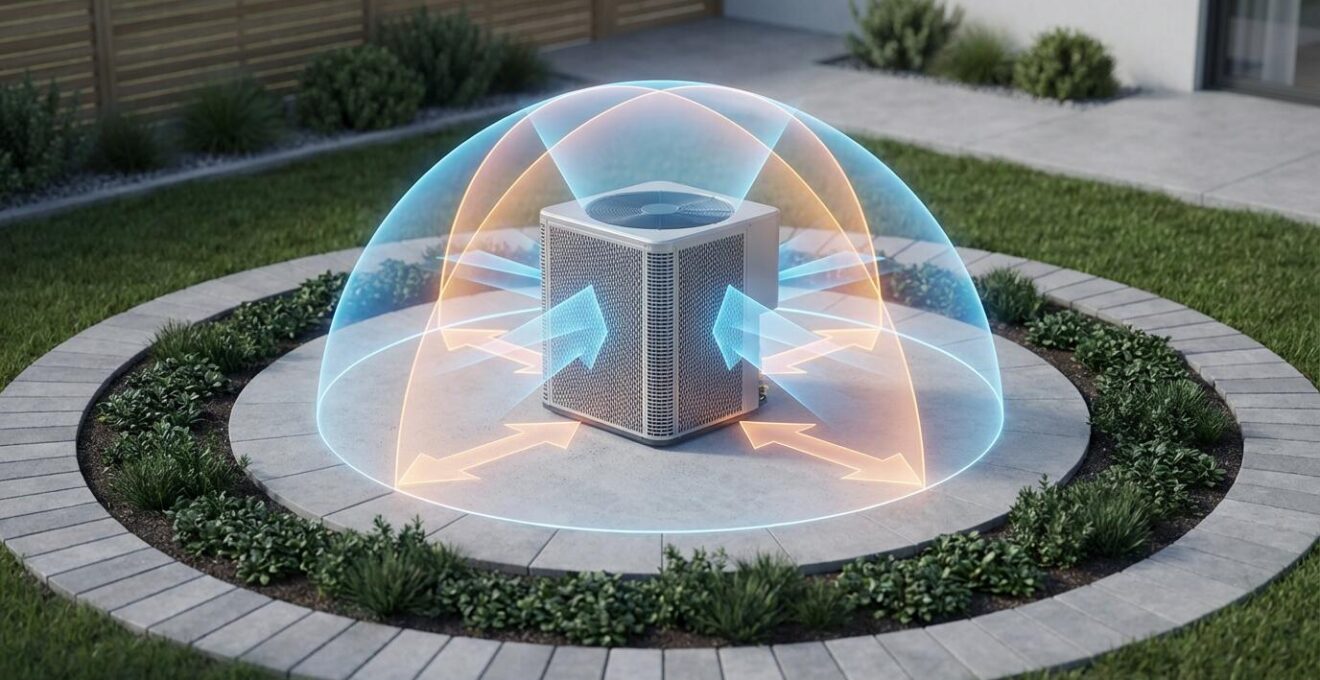
As the diagram shows, these zones are non-negotiable. Placing the unit under a low deck, inside a tight enclosure for aesthetic reasons, or allowing bushes to grow around it will directly undermine your investment. Aligning the fan outlet with the prevailing wind direction can further help carry the cold exhaust air away. Following a clear installation checklist is the best way to protect your heat pump’s efficiency from day one.
Your Action Plan for Optimal Heat Pump Placement
- Side & Back Clearance: Maintain a minimum of 18 inches of clearance on the sides and back of the unit for air intake.
- Service Access: Provide at least 36 inches of clearance in the front of the unit for future service and maintenance access.
- Vertical Clearance: Ensure 60 inches of unobstructed vertical clearance above the unit to prevent expelled cold air from being recycled.
- Wind Alignment: Position the fan outlet to align with the prevailing wind direction to help dissipate cold air.
- Obstruction Avoidance: Avoid placing the unit directly under roof eaves, overhanging trees, or inside any form of restrictive enclosure.
Vertical or Horizontal Fan: Which Heat Pump Design is Silent Enough for Night Use?
For pool owners in residential areas, noise is a major concern. The constant hum of a traditional heat pump can be a nuisance to both you and your neighbors, especially during quiet evenings or overnight operation. This is another area where inverter technology provides a significant return on investment, not in dollars, but in quality of life. The same variable-speed compressor that delivers energy efficiency is also responsible for whisper-quiet operation. Since the pump rarely needs to run at 100% capacity, it spends most of its time in a low-power, low-noise maintenance mode.
The noise reduction is dramatic. While a standard on/off pump might operate at a disruptive 55-65 decibels (dB), modern inverter heat pumps can reduce noise to as low as 38.4dB(A) at a one-meter distance. This is quieter than a library and represents a perceived noise reduction of nearly 20 times. This level of quiet is achieved through optimized motor control, where the system aligns its operating rate with the filtration flow rate, effectively doubling down on energy savings while remaining practically silent.
The physical design of the fan also plays a role. Heat pumps are typically available in two configurations: horizontal fan and vertical fan. * Horizontal Fan Models: These are the most common design. They draw air through the back and sides and expel cold air and noise horizontally from the front. Their main drawback is that the noise is directed straight out, potentially towards a neighbor’s property or an outdoor living area. * Vertical Fan Models: These units draw air from the sides and expel it upwards. This design is inherently quieter from a listener’s perspective on the ground, as the primary operational noise is directed towards the sky. For installations close to property lines or outdoor patios, a vertical fan design is almost always the superior choice for minimizing audible disruption. Choosing a vertical fan inverter model is the ultimate combination for powerful, efficient, and near-silent heating suitable for any time, day or night.
The Low-Ambient Error That Freezes Your Heat Pump When You Need It Most
One of the biggest frustrations for pool owners looking to extend their season into the cooler spring and fall months is the dreaded “low-ambient” error. This occurs when the outside air temperature drops too low for the heat pump to efficiently extract heat. In the worst-case scenario, the moisture in the air freezes onto the unit’s evaporator coils, forming a block of ice that completely chokes airflow and shuts the system down—right when you need it most. This is not just an inconvenience; it can damage the unit if left unaddressed.
Most standard heat pumps become highly inefficient below 55-60°F (13-15°C) and will cease to function altogether around 50°F (10°C). However, many modern inverter heat pumps are designed for all-season performance and incorporate an active defrost cycle. It’s important to recognize when this cycle is running. The fan will stop, but the compressor will continue to run, reversing the refrigerant flow to send hot gas through the coils and melt any ice buildup. You may even see steam rising from the unit, which is a normal sign of a successful defrost.
The close-up image below shows the formation of frost on evaporator coils, the very issue that an active defrost cycle is designed to prevent.

To avoid freezing issues and ensure your pump operates reliably in cooler weather, proactive monitoring and choosing the right equipment are key. All-season models often feature larger evaporator fins and more sophisticated control logic to handle cold, humid conditions. According to a guide on heat pump swimming pool heaters from the U.S. Department of Energy, ensuring efficient operation above 50°F is a baseline. If you live in a climate with cool shoulder seasons, investing in a unit specifically rated for low-ambient performance is a critical part of the ROI calculation.
- Check for Obstructions: Before assuming a system fault, always check for physical airflow obstructions like leaves or debris packed against the unit.
- Know Your Limit: Verify the unit’s minimum operating temperature in the manufacturer’s specifications. Don’t expect a standard unit to perform in near-freezing weather.
- Recognize Defrost Mode: Understand that when the fan stops but the compressor runs, it’s likely a normal, healthy defrost cycle.
- Monitor for Ice: During particularly cold and humid periods, visually inspect the coils for excessive ice buildup that the defrost cycle isn’t clearing.
When to Lower the Target Temperature to Double Your Coefficient of Performance?
The Coefficient of Performance (COP) is the single most important metric for a heat pump’s efficiency. It measures how many units of heat energy the pump produces for every one unit of electrical energy it consumes. A COP of 6 means the pump is 600% efficient. While inverter technology provides a high baseline COP, the real secret to maximizing your ROI is understanding that you have direct control over this number. The COP is not a fixed value; it is a dynamic figure that changes based on two key variables: the ambient air temperature and the temperature of your pool water.
The relationship is simple: the smaller the difference between the air temperature and the water temperature, the higher the COP. The pump has to work much less to “lift” the heat from the air to the water. This is where strategic temperature management comes into play. Many pool owners set their heater to a balmy 84-86°F (29-30°C) and leave it there. This is often an inefficient strategy. By lowering your target temperature by just a few degrees, you can dramatically increase the unit’s COP and slash your energy costs.
The table below, based on data from energy efficiency authorities, clearly illustrates this principle. Dropping the target from a high 84°F to a comfortable 78°F can boost your COP from 4.0 to 6.0 under the same weather conditions, resulting in a 40% reduction in energy cost. When the air is warmer, the effect is even more pronounced.
| Pool Temperature Target | Ambient Air Temp | Typical COP | Energy Cost Impact |
|---|---|---|---|
| 84°F (29°C) | 60°F (15°C) | 3.0-4.0 | Baseline |
| 78°F (25.5°C) | 60°F (15°C) | 5.0-6.0 | -40% cost |
| 78°F (25.5°C) | 75°F (24°C) | 6.0-8.0 | -60% cost |
The takeaway is clear: find the lowest comfortable temperature for your pool. For many, 78-80°F (25.5-26.5°C) is perfectly pleasant for swimming and can nearly double your heat pump’s efficiency compared to heating to 84°F, especially on cooler days. This simple adjustment is a powerful tool for OpEx optimization. By adopting this mindset, you can achieve outcomes where an X20 inverter heat pump saves nearly 60% in annual electricity under optimal conditions.
How Variable-Speed Pumps Pay for Themselves in Less Than 24 Months?
The rapid return on investment for a variable-speed system is not theoretical; it is a proven financial outcome for pool owners who make the switch. The high upfront cost is the single biggest point of hesitation, but a simple cost-benefit analysis reveals it to be a sound investment. The core of the ROI calculation is the drastic reduction in daily kilowatt-hour (kWh) consumption. A single-speed pump is an energy hog, often drawing 2,000 watts or more whenever it’s running. A variable-speed pump, programmed correctly, can circulate the same volume of water over a longer period using a fraction of that power.
Because they can run at very low speeds for long durations, these pumps can maintain filtration and chemical distribution while consuming as little as 100-200 watts. This strategy aligns with the “pump affinity law” in physics, which states that if you halve the speed of the pump, you reduce its power consumption by a factor of eight. This is the mechanism that generates such massive savings. For large pools that require long filtration cycles, the difference is staggering, and it’s why variable-speed pumps typically pay for themselves within 12-24 months through energy savings alone.
The numbers from real-world applications confirm this rapid payback. By replacing an inefficient, power-hungry pump with a smart, variable-speed model, the initial investment is quickly recouped, and from that point forward, the savings directly benefit the owner’s bottom line. The initial outlay ceases to be a “cost” and becomes the catalyst for long-term financial gain.
Case Study: California Pool Owner’s Rapid Payback
A California pool owner demonstrates the powerful ROI of upgrading. They switched from a standard 2,000-watt single-speed pump, which ran for 6.3 hours daily, to a new variable-speed pump. By programming the new pump to run at a low speed of 116 watts for 19 hours a day, they maintained superior water quality while achieving a net savings of 10.4 kWh per day. At California’s average electricity rate of 34.26 cents per kWh, this translated directly into $1,300 in annual savings. This allowed the owner to achieve a full payback on their investment in under 18 months.
Why a High COP of 16 is Meaningless Without Contextual Air Temperature?
In the competitive market for pool heaters, manufacturers often advertise astonishingly high COP values—16, 20, or even higher. These numbers are a central part of the marketing pitch, designed to signal ultimate efficiency. However, a high COP listed on the box is often meaningless without understanding the highly specific, and often unrealistic, conditions under which it was achieved. This is a classic case of “marketing specs vs. real-world performance.” Your investment decision should be based on how the pump will perform for you, not in a perfect laboratory setting.
These peak COP ratings are typically recorded under ideal circumstances: warm ambient air (e.g., 26°C / 79°F), warm water (e.g., 26°C / 79°F), and with the pump running at a low, energy-saving power level (e.g., 50%). In the real world, you are rarely just maintaining temperature on a perfect summer day. More often, you are trying to heat your pool on a cool spring morning or extend your season into the fall, when the performance gap is most evident.
As the following comparison shows, the marketed COP can be drastically different from the practical COP you will experience during common heating scenarios.
| Test Conditions | Marketed COP | Real-World COP | Actual Scenario |
|---|---|---|---|
| Lab: Air 26°C, Water 26°C, 50% power | 16-20 | 16-20 | Ideal conditions that rarely occur |
| Spring: Air 15°C, Water 28°C | Not disclosed | 5-6 | A common heating scenario |
| Fall: Air 10°C, Water 25°C | Not disclosed | 3-4 | The reality of season extension |
The lesson here is to look beyond the headline number. A reputable manufacturer will provide a full performance chart showing the COP at various air and water temperatures. For a large pool owner, the COP at 10°C or 15°C air temperature is far more relevant to your total cost of ownership than a peak number achieved in a lab. As industry experts confirm, realistic performance is what matters.
COP values typically range from 3.0 to 7.0, converting to efficiency between 300% and 700%. For every unit of electricity required to run the compressor, you get 3-7 units of heat from the heat pump.
– Fairland Technical Team, Fairland Energy Efficiency Report
Key Takeaways
- An inverter heat pump’s value is in its ability to dynamically match energy output to real-time heating needs, drastically cutting operational costs.
- The initial investment has a clear and rapid payback horizon, typically under 24 months, driven by massive kWh reduction.
- Real-world performance depends on strategic operation—including proper placement, smart temperature settings, and understanding contextual COP—not just the hardware itself.
How to Sync Your Pool Pump with Solar Panels to Run for Free?
For the ultimate ROI, the final step in OpEx optimization is to pair your efficient variable-speed pool pump and heat pump with a home solar panel system. This synergy allows you to run your pool’s most energy-intensive equipment during peak sun hours, effectively using free, self-generated electricity. Instead of drawing expensive power from the grid, your pump runs on the surplus energy your solar panels produce during the middle of the day. This strategy transforms your biggest energy consumer into a net-zero-cost operation during sunny periods.
Implementing this requires more than just having solar panels; it requires smart scheduling. The goal is to align your pump’s high-energy tasks, like the initial heating cycle or a high-speed cleaning run, with the hours of peak solar production, typically between 11 a.m. and 3 p.m. This can be achieved through several methods, ranging from simple to fully automated. A basic timer is a good start, but a truly “smart” system uses real-time data to maximize solar energy utilization. This can lead to an additional energy reduction of 20-30% on top of the savings from the variable-speed pump alone.
The most effective systems use smart relays or current-sensing clamps connected to your solar inverter. These devices can detect when you are generating surplus power (i.e., more than your house is using) and automatically trigger the pool pump to turn on and absorb that excess energy. This ensures that not a single solar watt is wasted. Here is a tiered approach to implementation:
- Good: Install a basic timer to run the pump during peak solar hours (e.g., 11 a.m. – 3 p.m.).
- Better: Add a Wi-Fi smart plug with energy monitoring capabilities to manually trigger the pump when you see high solar production on your app.
- Best: Integrate a full pool automation system with current-sensing clamps on the solar inverter, or use smart relays that automatically detect surplus power and activate the pump.
To put these strategies into practice and begin the journey toward a rapid return on your investment, the logical next step is to evaluate your specific needs and calculate your potential savings. Start by assessing your current energy consumption and exploring the inverter models best suited for your pool size and climate.