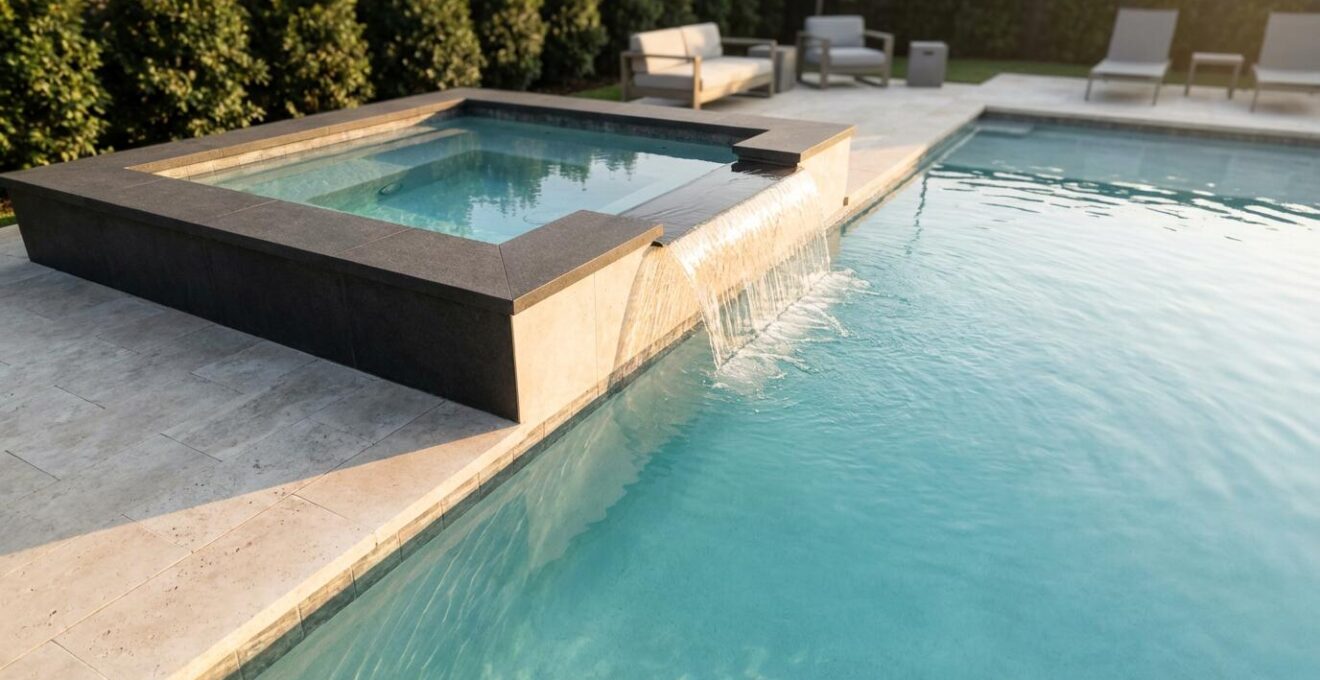
A spillover spa transforms a flat landscape not through its mere presence, but through the deliberate engineering of its visual and acoustic drama.
- The perfect, glass-like sheet of water is a result of precise edge design, not happenstance.
- Material choice directly impacts long-term beauty, with non-porous surfaces like glass tile preventing calcification where natural stone fails.
Recommendation: Approach your spillover spa as a piece of architectural music, where every detail from flow rate to drop height is tuned to create a sensory masterpiece.
For owners of homes set in flat, featureless landscapes, creating vertical interest and a dramatic focal point presents a unique architectural challenge. The spillover spa, often seen as a simple upgrade, holds the potential to be a masterful solution. It introduces the dynamic, elemental forces of moving water—its sight, its sound, its texture—to animate an otherwise static environment. It becomes more than just a place to relax; it serves as a living sculpture.
Many designs, however, fall short of this potential. They settle for a generic trickle of water, an uninspired sound, or materials that quickly degrade. The common advice often overlooks the nuanced physics and material science that separate a mundane water feature from an architectural statement. This guide moves beyond those platitudes. We will not discuss mere aesthetics; we will deconstruct the engineering of beauty.
The true key is understanding that a successful spillover spa is a meticulously calibrated instrument. The secret lies not in simply adding a waterfall, but in controlling the very character of the water itself. It’s about mastering the principles of fluid dynamics to shape a perfect sheet of water, selecting materials for their acoustic properties as much as their looks, and tuning the entire system to compose a specific sensory experience.
This article provides the architectural framework for achieving that vision. We will explore the precise engineering required for a flawless water sheet, the critical choice of materials, the science of flow rates, the art of acoustic tuning, and the structural considerations for even the most challenging terrains. Prepare to see the spillover spa not as an add-on, but as the soul of your landscape design.
To fully grasp the architectural and engineering principles behind a truly exceptional spillover spa, this guide is structured to answer the most critical questions. The following summary outlines the journey from fluid dynamics to structural integrity, providing a complete roadmap for your project.
Summary: Designing the Perfect Spillover Spa: From Flow to Foundation
- How to shape the spillway edge to create a perfect glass-like sheet of water?
- Tile or Stone: Which Material Handles Constant Water Flow Without Calcifying?
- Why is your spillover trickle looking weak and unimpressive?
- The height mistake that makes your waterfall sound like a crashing toilet
- When to run the spillover for visual effect vs stopping it to save heat?
- How Water Curtains Block Traffic Noise in Urban Backyards?
- How to Build a Pool on a 20% Slope Without Risking a Landslide?
- Why Shotcrete is the Only Viable Option for Complex Free-Form Pool Designs?
How to shape the spillway edge to create a perfect glass-like sheet of water?
Achieving a perfectly smooth, transparent, and unbroken sheet of water—a state known as laminar flow—is the pinnacle of spillway design. This is not an accident but the direct result of precise hydraulic engineering at the spillway’s edge, or weir. The goal is to eliminate turbulence and surface tension that would otherwise break the water into chaotic streams. It’s an exercise in controlling physics to create art.
The secret lies in ensuring the water detaches from the edge cleanly and instantly. A sharp, 90-degree edge profile is paramount, as it provides the crispest separation point. Any rounding or texture at this crucial juncture will introduce turbulence. Furthermore, the spillway surface itself must be flawlessly level. Even a slight deviation across its length will cause the water sheet to thicken on one side and thin or disappear on the other, destroying the illusion of a perfect glass plane.
This effect is enhanced by understanding water’s natural tendency to adhere to surfaces, a principle related to the Coanda effect. To counteract this, the wall face below the spillway must be designed to discourage water from clinging to it. A slight outward pitch or a hidden drip groove underneath the edge are essential architectural details that ensure the water falls freely, preserving its perfect form from the moment it leaves the weir.
Action Plan: Checklist for a Perfect Water Sheet
- Design the weir edge with a sharp, 90-degree profile to minimize surface resistance and create clean water separation.
- Pitch the spillway edge slightly away from the pool (5-10 degrees) to reduce water adhesion to the wall face.
- Install a drip edge or groove approximately 1 inch from the spillway edge on the underside to break surface tension.
- Use impeccably smooth materials like glass tile or polished stone for minimal flow disruption across the weir surface.
- Ensure a perfectly level installation across the entire spillway width, verified with laser leveling tools during construction.
Tile or Stone: Which Material Handles Constant Water Flow Without Calcifying?
The choice of material for a spillway is a critical decision that extends far beyond aesthetics; it is a matter of long-term performance and maintenance. Constant water flow, especially in areas with hard water, inevitably leads to calcium carbonate deposits. The material’s surface properties determine its vulnerability to this process, known as calcification or efflorescence.
The key differentiator is material porosity. Non-porous materials like glass tile and high-density porcelain offer a smooth, impermeable surface. Water and its dissolved minerals flow over them without being absorbed, drastically reducing the potential for calcium to gain a foothold and build up. These materials maintain their pristine appearance with minimal effort, often requiring only a simple cleaning to remove any surface film.
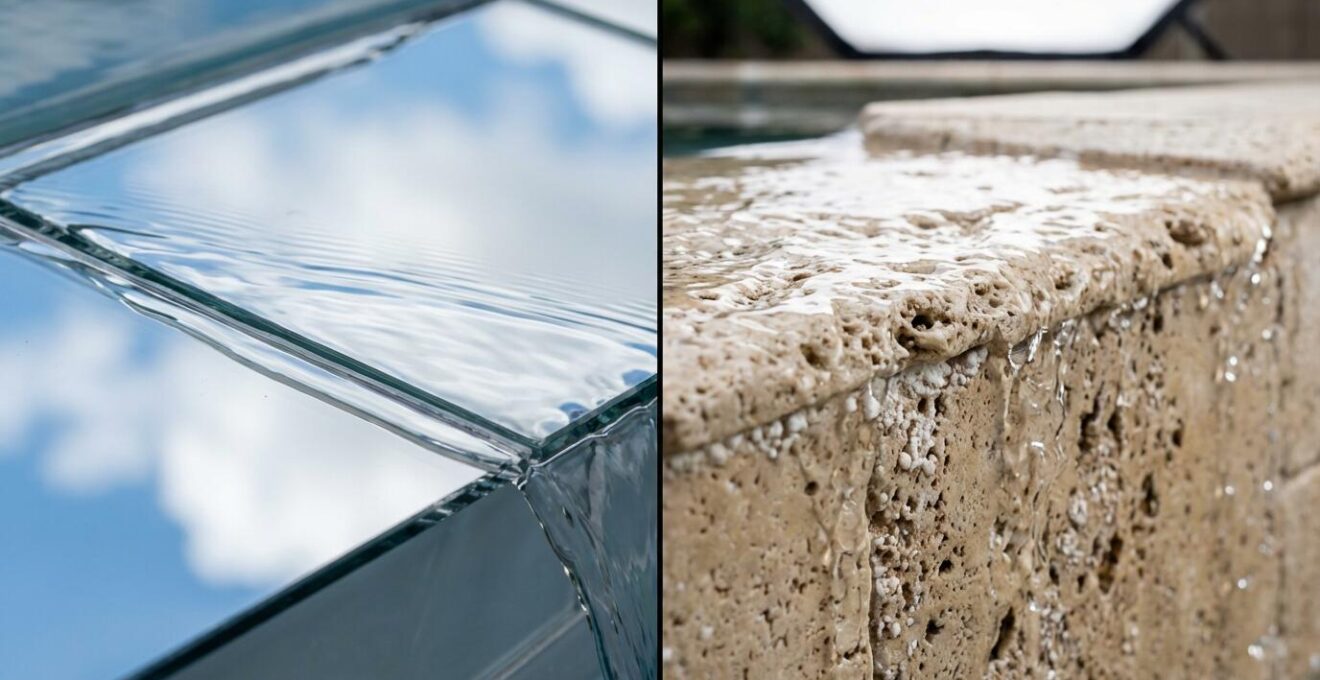
Conversely, natural stone such as travertine or ledger stone is inherently porous. These materials have microscopic voids and textured surfaces that trap water and minerals. As water evaporates, it leaves behind calcium deposits that embed themselves within the stone’s structure, creating a chalky white buildup that is notoriously difficult to remove without damaging the stone. While aesthetically pleasing initially, porous stones demand a rigorous and often frustrating maintenance schedule of sealing and cleaning to combat inevitable calcification.
This table breaks down the performance characteristics, making the architectural choice clear for a low-maintenance, high-performance design.
| Material | Calcium Resistance | Acoustic Properties | Maintenance Requirements |
|---|---|---|---|
| Glass Tile | Excellent – Non-porous surface prevents absorption | Creates crisp, high-pitched water sounds | Minimal – Easy to clean with mild acid wash |
| Porcelain Tile | Very Good – Dense surface resists buildup | Produces clear, bright water tones | Low – Occasional scrubbing required |
| Natural Stone (Travertine) | Poor – Porous surface prone to efflorescence | Generates soft, muted water sounds | High – Requires sealing and frequent cleaning |
| Ledger Stone | Very Poor – Uneven surfaces trap calcium | Creates varied, complex water sounds | Very High – Difficult to clean textured surfaces |
Why is your spillover trickle looking weak and unimpressive?
An underwhelming trickle of water from a spillover spa is a common and frustrating design failure. The cause is almost always an insufficient flow rate, which is a direct consequence of underestimating the complex plumbing calculations required. The visual drama of a full, robust water sheet is a function of delivering the right volume of water per unit of time, a metric known as Gallons Per Minute (GPM).
To create a substantial effect, professional pool designers recommend a flow rate of approximately 10-15 GPM per linear foot of spillway. A 3-foot wide spillway, therefore, requires a dedicated 30-45 GPM just for the waterfall effect, in addition to any flow needed for spa jets or circulation. Achieving this requires a holistic analysis of the entire plumbing system, a concept engineers call Total Dynamic Head (TDH).
TDH is the total equivalent pressure the pump must overcome. It includes the “vertical lift” (the height difference from the pool water level to the spillway) plus all sources of friction within the pipes. Every foot of pipe, every 90-degree elbow, and every valve adds to the TDH. For instance, a single 90-degree elbow can add the friction equivalent of 7-10 feet of straight pipe. Using undersized pipes, such as a 1.5-inch line where a 2.5-inch is needed, dramatically increases friction and “chokes” the pump, crippling its ability to deliver the required GPM. A variable speed pump can offer some flexibility, but it cannot compensate for a fundamentally flawed plumbing design.
The height mistake that makes your waterfall sound like a crashing toilet
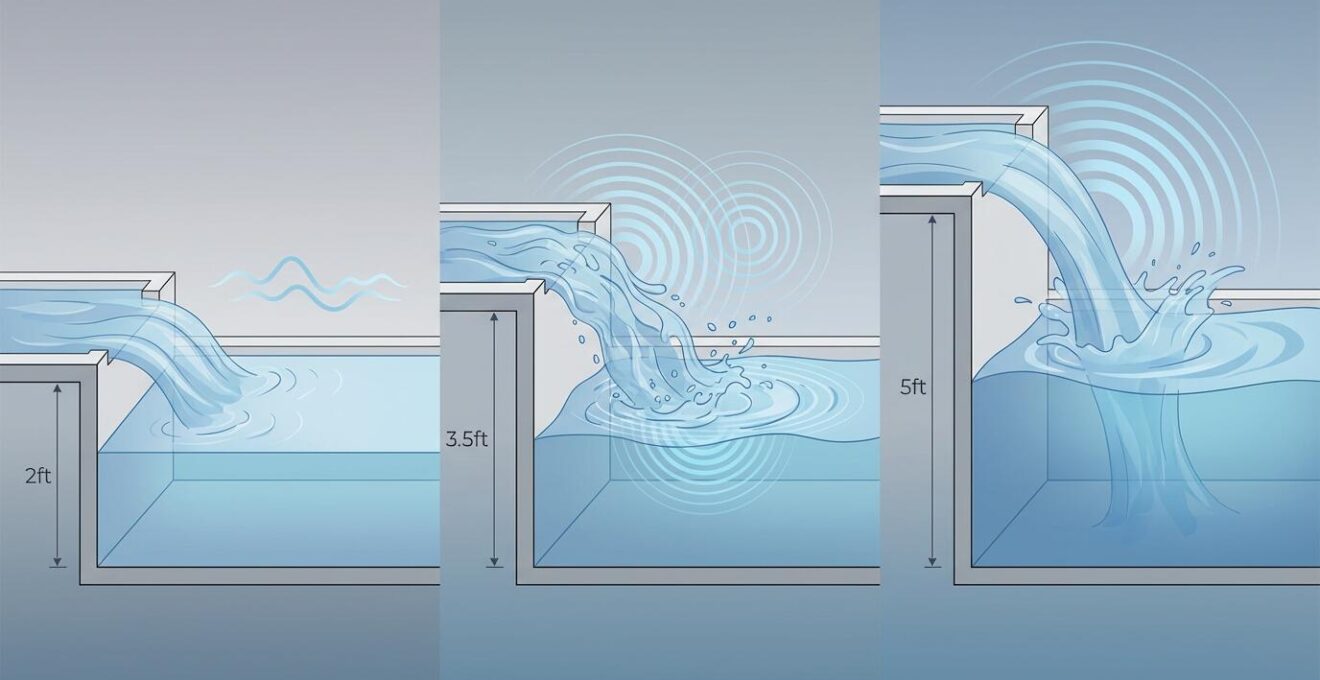
The sound of a waterfall is one of its most compelling attributes, but it’s also the easiest to get wrong. The acoustic character of your spillover is directly controlled by the height of the drop. A common mistake is to assume that a taller drop is always more dramatic. In reality, there is a critical height—typically between 3 and 4 feet—where the falling water gains enough velocity to create a turbulent, gurgling, and unpleasant “crashing” sound, much like a flushing toilet. This is not the tranquil soundscape clients envision.
The art of acoustic tuning involves manipulating the water’s energy to produce a desired sound. A short drop (under 2 feet) generally produces a soft, pleasant splashing sound. A very tall drop (over 5 feet) can create a powerful but often overwhelming roar. The problematic mid-range is where many designs fail. The sound is not just about volume; it’s about frequency and complexity.
Instead of a single, jarring drop, a superior architectural solution is to break the fall. By creating a multi-tiered or stacked stone design, the water’s kinetic energy is dispersed at each level. This transforms a single loud crash into a series of softer, more complex sounds, resulting in a rich, “babbling brook” effect that is both psychologically calming and effective at masking unwanted background noise.
Case Study: Acoustic Design in Spillway Construction
A recent project demonstrated how a stacked spillway design can transform a single loud crash into a pleasant, babbling sound. By positioning rocks in a staircase pattern, the design breaks up the water flow at multiple points. This multi-level approach disperses kinetic energy at each tier, reducing the overall sound intensity while creating more complex, natural acoustic patterns that mask the gurgling noises typical of mid-height single drops.
When to run the spillover for visual effect vs stopping it to save heat?
A spillover spa is a feature of dynamic beauty, but that beauty comes at a thermodynamic cost. The process of water falling through the air, shearing into droplets, and splashing into the pool below creates a massive surface area for evaporation. Since evaporation is a cooling process, running a spillover is one of the fastest ways to lose heat from your spa.
The trade-off is stark: visual and acoustic drama versus energy efficiency. According to pool heating experts, a continuous spillover operation can result in a significant 2-4°F per hour heat loss from the spa. Running the spillover 24/7 essentially turns your spa heater into a non-stop energy consumer, fighting a losing battle against physics. This can lead to surprisingly high energy bills and puts unnecessary strain on the heating equipment.
The architect’s approach is not to eliminate the feature but to control it with purpose. A strategic scheduling strategy, enabled by modern pool automation systems, offers the best of both worlds. The spillover should be treated as a “showcase” feature, activated for specific purposes: to greet guests, to enjoy during sunset, or to create a dramatic backdrop for an evening event. During midday, when the sun is at its peak and can help maintain pool temperature, the spillover can be turned off to conserve the heat built up in the spa. For nighttime ambiance without the heat loss, using dedicated underwater LED lighting within the spa itself can create a stunning visual glow without any water movement.
How Water Curtains Block Traffic Noise in Urban Backyards?
In urban or suburban environments, the tranquility of a backyard is often shattered by the constant, jarring noise of nearby traffic. A spillover spa, when designed correctly, can serve as a powerful tool for acoustic mitigation. It doesn’t eliminate the noise, but rather masks it with a more pleasant sound, a psychoacoustic phenomenon known as sound masking.
The human brain is particularly adept at tuning out consistent, broadband sounds (like falling water) while being easily distracted by intermittent, sharp noises (like a car horn or truck brakes). The continuous sound of a water curtain, often referred to as “white noise,” provides a steady, soothing auditory blanket. This blanket raises the ambient sound floor, making the peaks of traffic noise less noticeable and intrusive. The sharp, unpleasant sounds are effectively blended into a more natural and calming soundscape.
As the design team at Rock Water Farm notes, the spillover is more than just a conduit between spa and pool. In their “Most Common Questions About Spillover Spas,” they highlight its dual function:
It’s a water feature of its own that adds an appealing look and sound to your pool
– Rock Water Farm Design Team, Most Common Questions About Spillover Spas
This principle was effectively demonstrated in a Northern Virginia residential installation, where a spillover spa’s continuous water sound successfully masked noise from a nearby highway. The homeowner reported that the feature created a far more tranquil environment, transforming the backyard from a noisy pass-through space into a genuine urban oasis.
How to Build a Pool on a 20% Slope Without Risking a Landslide?
Building a pool and spa on a significant slope—such as a 20% grade—is a complex geotechnical and structural engineering challenge. Attempting this without a rigorous, safety-first approach is an invitation to disaster, risking soil erosion, structural failure, or even a landslide. The key is to work with the slope, not against it, and to anchor the structure deep into stable ground.
The first and most critical step is a geotechnical soil report. This analysis by a specialized engineer determines the soil’s composition, stability, and bearing capacity, and identifies any potential “slip planes” deep underground. The pool’s foundation must be designed to bypass these unstable layers. This is typically achieved with deep caisson foundations—reinforced concrete piers drilled down to bedrock or stable soil—that act as stilts, securely anchoring the entire structure.
Equally important is managing water, both on the surface and underground. Engineered retaining walls are essential, but they must incorporate robust drainage systems to prevent hydrostatic pressure (the force of water-saturated soil) from building up behind them. A multi-tiered design is often the most elegant solution, using the natural slope to create dramatic cascades or a stunning infinity edge where the spa’s water appears to merge with the horizon. This type of elevated “champagne spa” is a signature feature of high-end slope construction, though professional builders estimate it can represent an additional cost of $10,000 to $20,000 for the specialized engineering and construction required.
- Commission a geotechnical soil report to assess slope stability and bearing capacity.
- Design deep caisson foundations that extend below potential underground slip planes.
- Engineer retaining walls with proper drainage to prevent hydrostatic pressure buildup.
- Create a multi-tiered design that utilizes the natural slope for dramatic cascade or infinity edge effects.
- Install a comprehensive drainage system to manage all surface and subsurface water flow.
Key takeaways
- The quality of a spillover’s water sheet is determined by the precise geometry of its edge, not the volume of water.
- Material choice is a long-term decision; non-porous materials like glass tile prevent the calcification that plagues natural stone.
- The sound of a waterfall is a tunable element controlled by drop height and diffusion, not a random byproduct.
Why Shotcrete is the Only Viable Option for Complex Free-Form Pool Designs?
When a spillover spa design moves beyond simple geometric shapes and into the realm of organic, free-form curves, integrated benches, or custom grottos, the construction method becomes the single most important factor. For these complex projects, shotcrete (or its wet-mix variant, gunite) is not just the best option; it is the only viable one.
Prefabricated fiberglass or vinyl-liner pools are constrained by factory molds and standardized shapes. They cannot accommodate true design customization. Shotcrete, however, is a method where concrete is pneumatically projected at high velocity onto a rebar framework. This process allows for complete design freedom. The pool shell is sculpted on-site, enabling the creation of any curve, contour, or integrated feature the architect can envision.
The primary structural advantage of shotcrete is its monolithic nature. The entire pool and spa shell is formed as a single, seamless piece of steel-reinforced concrete. This eliminates the cold joints and seams found in other construction methods—precisely the points where leaks and structural failures most often occur in complex water features. As Rock Water Farm, a specialist in custom gunite pools, states, these ambitious designs are only possible with this method. They note that the ability to embed all plumbing and electrical conduits directly within the shell during construction is a key advantage, creating a clean aesthetic without compromising structural integrity.
They are only possible from companies that design and build gunite pools
– Rock Water Farm, Custom Pool Construction Expertise
This structural integration ensures that even the most complex spillover spa is a unified, leak-proof, and enduring piece of architecture.
To bring these architectural principles to life, the next step is to translate your vision into a structural plan with a design firm that specializes in custom shotcrete construction.