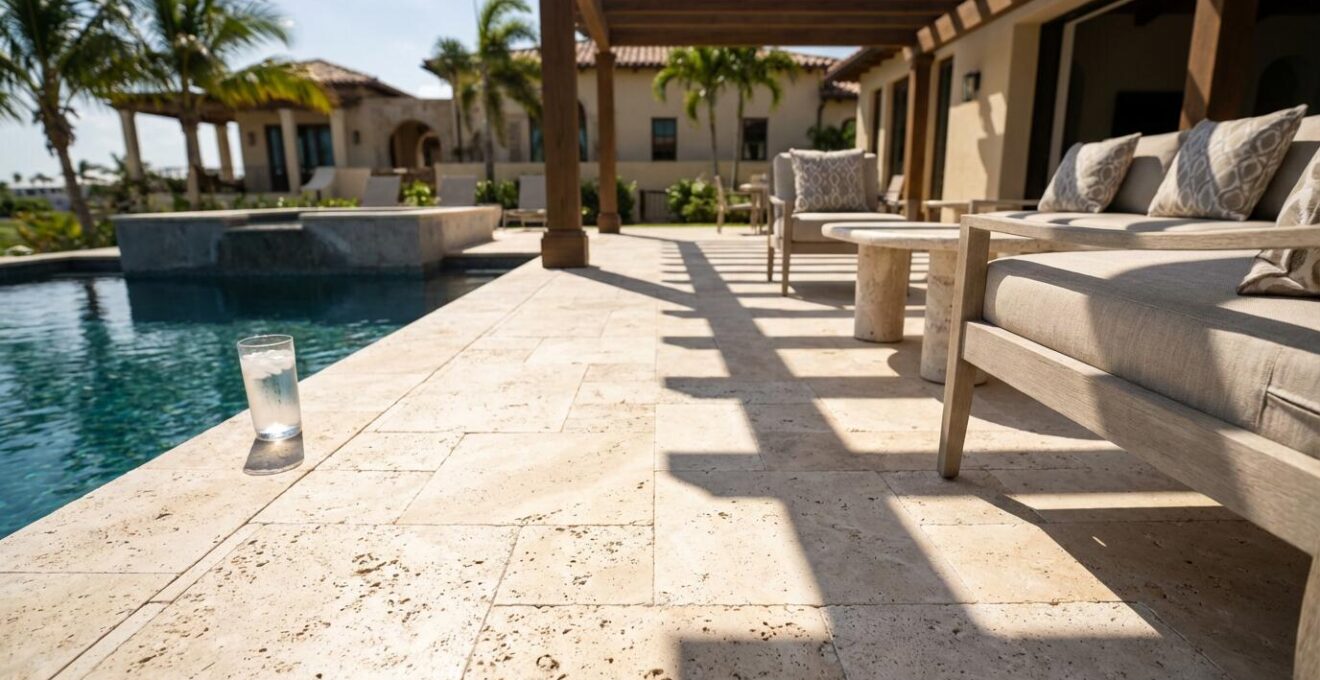
Travertine’s remarkable coolness is not magic; it’s a result of an active thermal regulation system, unlike the passive heat absorption of other materials.
- Its porous capillary network allows it to “breathe,” using trace moisture to dissipate heat through evaporative cooling.
- A high Solar Reflectance Index (SRI) means it reflects, rather than absorbs, a significant portion of solar energy.
Recommendation: When selecting hardscaping, prioritize materials with low thermal inertia and high SRI, like travertine, to ensure surfaces remain walkable even in extreme heat.
The searing summer sun presents a familiar challenge for homeowners: a patio or pool deck so hot it becomes a no-go zone for bare feet. Many resort to common solutions like light-colored concrete or even composite decking, believing that color alone dictates surface temperature. The advice often stops at superficial explanations, suggesting a material stays cool simply because “it’s a light color” or “it’s a natural stone.” While these factors play a role, they miss the fundamental physics at work, especially when it comes to the almost counter-intuitive performance of travertine.
This common understanding overlooks the crucial difference between passively reflecting heat and actively dissipating it. Materials like granite and dense concrete act as thermal batteries; once they heat up, they hold that energy for hours. Travertine, however, operates on a different principle. Its unique geological structure creates a micro-environment that actively fights against heat accumulation. The real secret isn’t just its color, but its internal architecture.
But what if the key to a permanently cool surface wasn’t just in avoiding heat absorption, but in leveraging a material’s ability to “breathe”? This is the core of travertine’s superiority. We will explore the fascinating science behind this phenomenon, moving beyond simple platitudes to reveal how its interconnected pores create a natural cooling system. This guide will dissect the thermal dynamics that make travertine a premier choice and provide the critical knowledge needed for proper selection, installation, and maintenance to preserve this unique property.
This article breaks down the essential factors that contribute to a cool, safe, and durable hardscape. We will delve into the scientific principles of heat resistance, compare material grades, and offer practical advice on everything from slip resistance to long-term maintenance.
Summary : The Science Behind Cool Hardscaping: A Deep Dive into Travertine
- Why Travertine Stays Cooler Than Granite on Hot Summer Days?
- How to Select Hardscaping Materials That Stay Cool Under the Summer Sun?
- Premium vs Commercial Grade: Which Travertine resists freeze-thaw cycles?
- How to grout travertine pores properly to prevent dirt accumulation?
- Tumbled or Honed: Which Travertine Finish Offers the Best Wet Slip Resistance?
- The cleaning mistake that dissolves your travertine surface in minutes
- When to use a French Pattern to hide future stains and wear?
- How to Maintain the Rich Color of Exotic Wood Decking Without Constant Oiling?
Why Travertine Stays Cooler Than Granite on Hot Summer Days?
The ability of travertine to remain comfortably cool under direct sunlight is not an illusion; it is the result of two key physical properties working in tandem: high solar reflectance and low thermal inertia, amplified by evaporative cooling. While many stones appear similar, their internal structures dictate dramatically different thermal behaviors. Travertine, a form of limestone, is defined by a vast, interconnected capillary network of pores and channels created by escaping gases during its formation.
First, its typically light color gives it a high Solar Reflectance Index (SRI), meaning it reflects a large percentage of solar radiation rather than absorbing it as heat. But this is only half the story. The second, more critical mechanism is its porosity. Unlike dense stones like granite, which have high thermal inertia and act as heat sinks, travertine’s pores prevent it from accumulating and storing heat. More importantly, these pores allow the stone to “breathe.” Any moisture within the stone—even microscopic amounts from humidity—can evaporate, a process that actively pulls heat out of the stone’s mass. This evaporative cooling effect is what truly sets it apart. Indeed, field measurements in Tucson show travertine stays up to 30°F cooler than concrete under identical conditions.
This active thermal regulation prevents the surface from reaching the scorching temperatures common with other materials. The illustration below provides a powerful visual metaphor for this difference in heat retention.
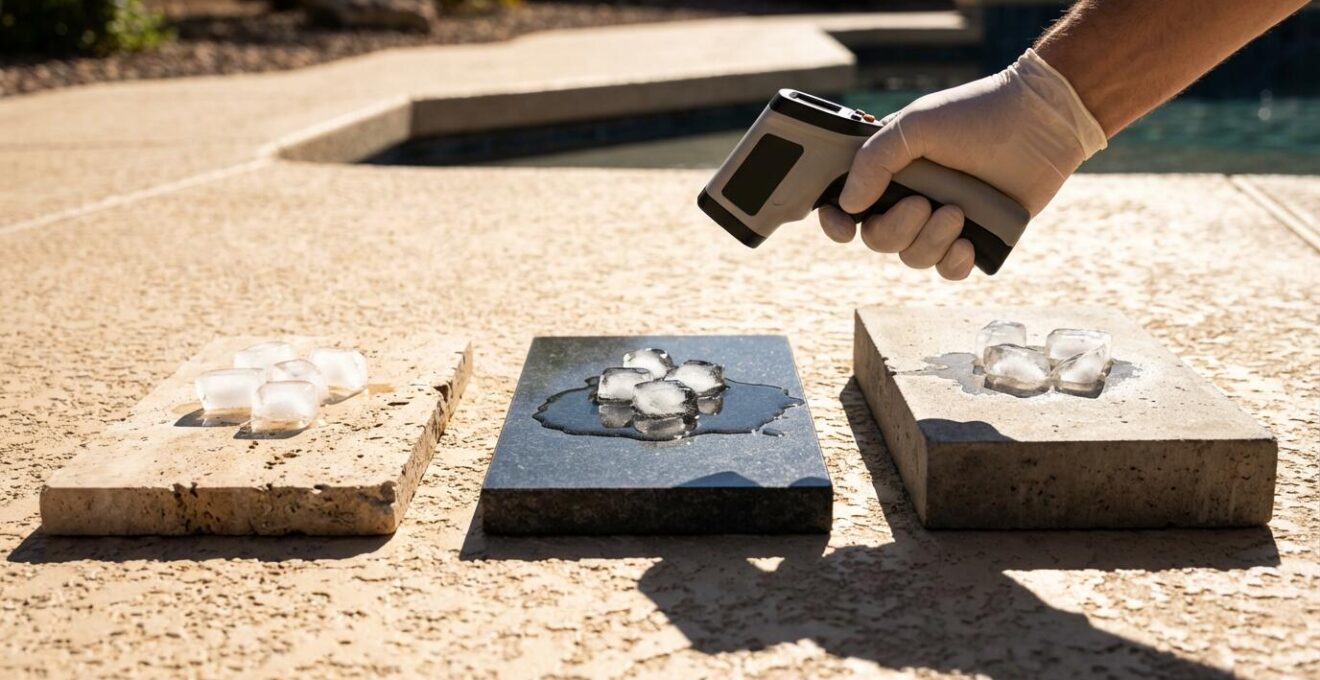
As the visual suggests, dense, non-porous materials absorb and trap solar energy, becoming uncomfortably hot. Travertine, by contrast, uses its unique structure to actively dissipate that energy, keeping its surface cool enough for bare feet even on the hottest days. This makes it an outstanding choice for pool decks, patios, and walkways in scorching climates.
How to Select Hardscaping Materials That Stay Cool Under the Summer Sun?
Choosing the right hardscaping material is a balance of aesthetics, durability, and thermal performance. To make an informed decision, one must look beyond appearance and consider empirical data, specifically the Solar Reflectance Index (SRI) and thermal inertia. SRI is a measure from 0 to 100 that quantifies a material’s ability to reject solar heat, combining both reflectivity (the percentage of sunlight reflected) and emissivity (the ability to release absorbed heat). A higher SRI value indicates a cooler surface.
For areas intended for barefoot traffic like pool surrounds, a high SRI is non-negotiable. Materials that combine a high SRI with low thermal mass (like travertine) perform best because they both reflect heat and fail to store what little they do absorb. For instance, testing shows light-colored travertine achieves an SRI of 70+, placing it in the top tier of cool hardscaping options. In contrast, dark granite or standard composite decking often have SRI values below 30, causing them to absorb and retain significant heat.
The following table provides a comprehensive analysis of common hardscaping materials, comparing their thermal performance, cost, and slip resistance to guide your selection process.
| Material | Temperature (vs ambient) | SRI Value | Cost/sq ft | Slip Resistance (COF) |
|---|---|---|---|---|
| Light Travertine | +5-10°F | 70-85 | $15-30 | 0.60-0.70 |
| Permeable Pavers | +15-20°F | 45-60 | $10-20 | 0.65-0.75 |
| Light Concrete | +25-35°F | 35-45 | $6-12 | 0.65-0.75 |
| Dark Granite | +40-50°F | 15-25 | $20-40 | 0.55-0.65 |
| Composite Decking | +35-45°F | 25-35 | $12-25 | 0.50-0.65 |
When analyzing this data, it becomes clear that light travertine offers a superior balance of low heat absorption (high SRI) and excellent slip resistance, justifying its position as a premium choice. While permeable pavers also offer good performance, they do not match travertine’s low temperature rise. Making the right selection involves weighing these objective metrics against your budget and aesthetic goals.
Premium vs Commercial Grade: Which Travertine resists freeze-thaw cycles?
Not all travertine is created equal. The distinction between Premium, Standard, and Commercial grades is critical, particularly in climates subject to freeze-thaw cycles. This grading is not about aesthetics alone; it directly reflects the stone’s density, porosity, and, consequently, its durability. The key performance indicator for winter resilience is the stone’s water absorption rate. In colder regions, water that penetrates the stone can freeze, expand, and cause spalling, cracking, or delamination.
Premium (or “Select”) grade travertine is the densest, characterized by minimal surface holes and a highly compressed structure. This density is what allows it to resist water ingress. In fact, according to freeze-thaw resistance guidelines, suitable travertine must have a water absorption rate of less than 3%. Only Premium grade consistently meets this stringent requirement. Commercial and Standard grades, by contrast, are more porous. They contain larger, more frequent voids and a higher absorption rate (often over 5-8%), making them unsuitable for environments where freezing is a concern as they will inevitably fail over time.
While the porosity of travertine is beneficial for staying cool in summer, excessive porosity becomes a liability in winter. Therefore, choosing a high-density, Premium grade is a crucial investment for long-term structural integrity in four-season climates. The following table breaks down the key differences between the grades.
| Grade | Porosity | Water Absorption | Freeze-Thaw Suitable | Surface Quality |
|---|---|---|---|---|
| Premium Select | Extremely Dense | <3% | Yes | Few surface holes |
| Commercial Grade | Moderate Density | 5-8% | No | Large holes, gaps present |
| Standard Grade | High Porosity | >8% | No | Requires extensive filling |
Ultimately, selecting the correct grade is a matter of climate. For hot, dry regions, a lower grade may suffice. But for any area with freezing temperatures, investing in Premium Select grade is the only way to ensure the longevity of your hardscaping project.
How to grout travertine pores properly to prevent dirt accumulation?
Properly addressing the joints and pores in travertine is essential not only for preventing dirt accumulation but also for maintaining the stone’s thermal performance. The wrong choice of filler material can seal off the stone’s surface, trapping moisture and negating its natural ability to “breathe” and stay cool. The goal is to fill the gaps in a way that provides stability and a clean look without creating an impermeable barrier.
The superior choice for this task is polymeric sand over traditional cement-based grout. Polymeric sand is a mixture of fine sand and a polymer binding agent that hardens when activated with water. Unlike grout, it remains slightly flexible and, most importantly, breathable. This allows the entire paver system, including the joints, to drain and release moisture, which is fundamental to the evaporative cooling process. Film-forming sealers and impermeable grouts, on the other hand, effectively suffocate the stone, which can lead to trapped moisture, efflorescence, and increased surface temperatures.
A professional installation involves carefully sweeping dry polymeric sand into clean, dry joints, compacting it, and then lightly misting the surface with water to activate the binder without washing it away. This method ensures a firm, durable joint that resists weeds and insects while preserving the all-important porosity of the deck system.
Your Action Plan: Grouting for Peak Thermal Performance
- Choose polymeric sand over traditional grout for breathability, which allows for superior evaporative cooling.
- Apply sand in thin layers, sweeping it into completely dry joints until they are full.
- Mist the surface lightly with water to activate the binding agents without oversaturating the sand.
- Use only penetrating (impregnating) sealers if sealing is desired; never use film-forming products that trap moisture.
- Check joints annually and reapply polymeric sand in high-traffic or washout-prone areas to maintain a complete fill.
By following this method, you ensure the paver joints contribute to the overall performance of the system rather than detracting from it. It’s a critical step in maximizing both the beauty and the unique functional benefits of a travertine installation.
Tumbled or Honed: Which Travertine Finish Offers the Best Wet Slip Resistance?
When selecting travertine for a pool deck or any area exposed to water, slip resistance is a primary safety concern. The finish of the stone plays the most significant role in determining its grip. The two most common finishes for outdoor applications are tumbled and honed. While both are suitable, tumbled travertine generally offers superior wet slip resistance due to its textured, aged surface.
A tumbled finish is created by placing the travertine tiles in a large drum with gravel and water, which rounds the edges and pits the surface, creating an “old-world,” rustic texture. This roughness provides more grip for bare feet, especially when wet. A honed finish, by contrast, is sanded to a smooth, matte surface. While it is not glossy or slippery like polished stone, it offers less texture than a tumbled finish.
The industry standard for measuring slip resistance is the Dynamic Coefficient of Friction (DCOF). For surfaces that are expected to be walked on when wet, safety experts recommend a DCOF rating of 0.60 or higher. Most tumbled travertines easily exceed this standard, often falling in the 0.60-0.70 range, making them an excellent safety choice. Honed travertine can also meet this requirement, but its smoother surface may feel less secure underfoot.
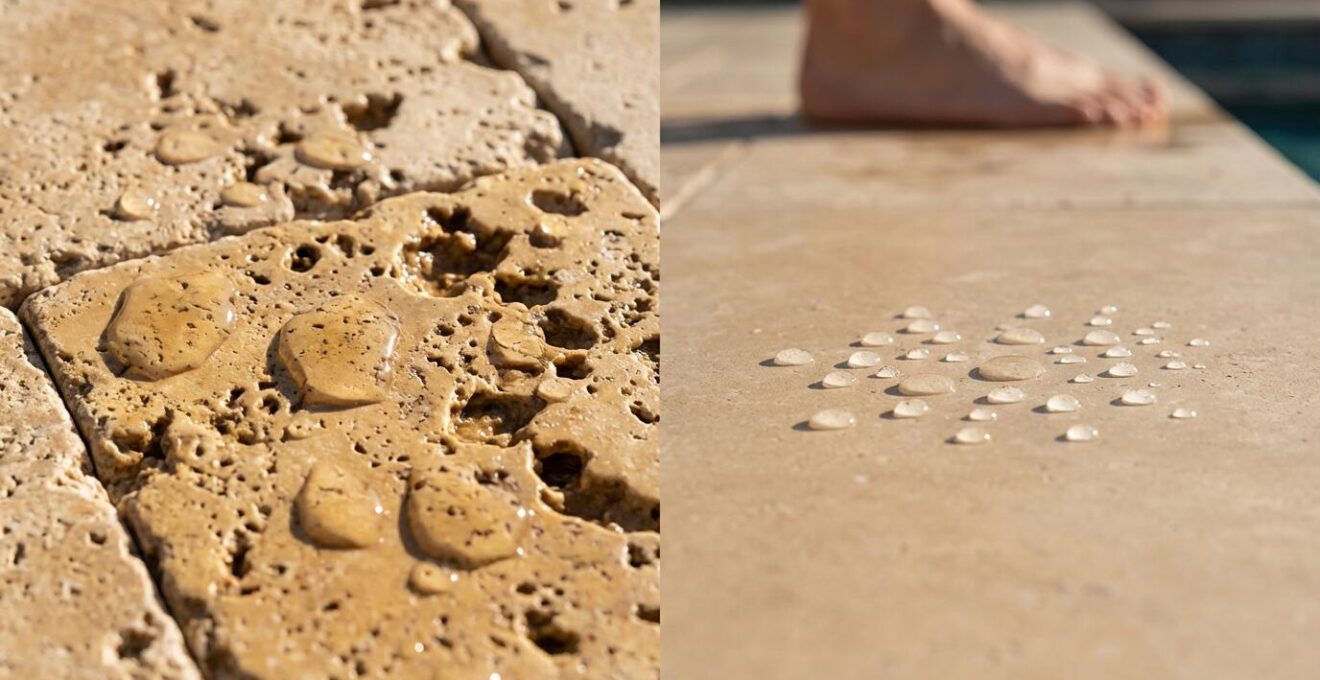
As the comparison shows, the textured, open-pored surface of tumbled travertine (left) provides more channels for water to disperse and more edges to grip. The honed finish (right) is smoother, allowing a film of water to potentially form between the foot and the stone. For maximum peace of mind around a pool, the textured and forgiving surface of tumbled travertine is the definitive choice.
The cleaning mistake that dissolves your travertine surface in minutes
The cardinal sin of travertine maintenance is using acidic cleaners. This single mistake can cause irreversible damage in minutes, permanently etching and dissolving the surface of the stone. Many homeowners, accustomed to using common household cleaners like vinegar or citrus-based products, are unaware that these substances are chemically destructive to travertine.
The reason lies in basic chemistry. Travertine is calcium carbonate (CaCO₃), a base. When an acid—even a mild one like vinegar (acetic acid) or lemon juice (citric acid)—comes into contact with it, a vigorous chemical reaction occurs. The acid dissolves the calcium carbonate, releasing carbon dioxide gas in a process called efflorescence. This reaction literally eats away the stone, leaving behind a dull, rough patch known as an etch mark. This is not a stain that can be cleaned; it is physical damage to the stone itself.
Even pool water chemistry can be a threat. Pool water that drops below a pH of 7.0 becomes acidic and can gradually etch travertine coping and decking over time. It is crucial to maintain a balanced pool pH between 7.2 and 7.6. Similarly, pressure washing with too much force (over 1,200 PSI) can erode the soft stone and dislodge grout. Always use a pH-neutral stone cleaner specifically formulated for calcite-based stones and clean spills immediately by blotting, not wiping, to prevent them from spreading.
Key takeaways
- Travertine’s coolness stems from its porous structure enabling evaporative cooling, not just its light color.
- For durability in cold climates, choose Premium Grade travertine with a water absorption rate below 3%.
- Always use pH-neutral cleaners; acidic substances like vinegar will permanently dissolve and etch the stone surface.
When to use a French Pattern to hide future stains and wear?
The layout pattern of travertine pavers has a significant impact on both the aesthetic and the long-term maintenance visibility of a patio or pool deck. While simple grid or running bond patterns are easy to install, they create uniform lines that can make individual stains, chips, or discolorations stand out. For high-traffic areas or spaces under trees that drop leaves and organic matter, a French Pattern is a strategically superior choice.
Also known as the Versailles pattern, the French Pattern is a modular layout that uses four different-sized tiles to create a seemingly random, interlocking design. This non-repeating arrangement is visually dynamic and breaks up the surface, drawing the eye across the entire installation rather than to any single paver. Its greatest practical advantage is its ability to camouflage imperfections. A small stain or a chipped edge that would be immediately obvious in a grid pattern simply blends into the beautiful complexity of the French Pattern.
This “hiding” effect is particularly valuable with natural stone, where color and texture variations are inherent from tile to tile. The French Pattern celebrates this natural diversity, making it look intentional. As documented in a restoration project for a historic colonial home, the use of a French Pattern not only created an authentic “old-world” aesthetic but also masterfully disguised variations in the stone and staining from surrounding trees. The pattern’s irregularity makes future wear and tear far less conspicuous, reducing the perceived need for constant cleaning or paver replacement.
How to Maintain the Rich Color of Exotic Wood Decking Without Constant Oiling?
While travertine dominates the conversation for cool hardscaping, exotic hardwoods like Ipe and Cumaru are also premium choices, prized for their density and rich color. However, many owners find themselves trapped in a cycle of constant oiling to preserve the wood’s “new” appearance. A more sustainable and architecturally celebrated approach is to embrace the wood’s natural aging process: the development of a silvery-grey patina.
This philosophy, inspired by the Japanese concept of ‘wabi-sabi’ which finds beauty in imperfection and transience, treats the silvering not as a defect but as a desirable evolution. High-end architectural projects are increasingly adopting this mindset. For example, a Miami residence embraced the natural silver patina of its Ipe deck, eliminating the need for quarterly oiling. For over 15 years, the deck has required only an annual cleaning with an oxygen-based cleaner to remove surface grime, while its structural integrity remains uncompromised. This demonstrates that the silvering is purely a surface-level oxidation of pigments and does not indicate rot or decay in these dense woods.
For those who wish to periodically restore the wood’s original tones without oil, an annual deep clean using a sodium percarbonate-based (oxygen bleach) cleaner is highly effective. This type of cleaner lifts dirt and dead wood fibers from the surface without harsh chemicals. After letting the solution dwell, a light scrub and thorough rinse can often restore up to 70% of the wood’s natural color. This method provides a middle ground, allowing the beauty of the aged wood to shine through with minimal, non-oily intervention.
By understanding the unique physics and chemistry of your chosen materials, you can move from reactive cleaning to proactive care, ensuring your investment remains beautiful and functional for decades. The next logical step is to apply this knowledge to your own project, selecting the right materials and maintenance routines for your specific climate and lifestyle.
Frequently Asked Questions about Travertine Pool Decks
Why does vinegar damage travertine even though it’s a mild cleaner?
Travertine is calcium carbonate, and even mild acids like vinegar (pH 2.5) cause a chemical reaction that literally dissolves the stone surface, creating permanent etching within minutes.
Can pressure washing damage travertine pool decks?
Yes, excessive pressure (over 1,200 PSI) can erode the stone surface and dislodge grout. Always use wide-angle tips and maintain a distance of at least 12 inches from the surface.
What pH level pool water is safe for travertine coping?
Maintain pool water pH between 7.2-7.6. Below 7.0, the water becomes acidic enough to gradually etch travertine surfaces over time.